
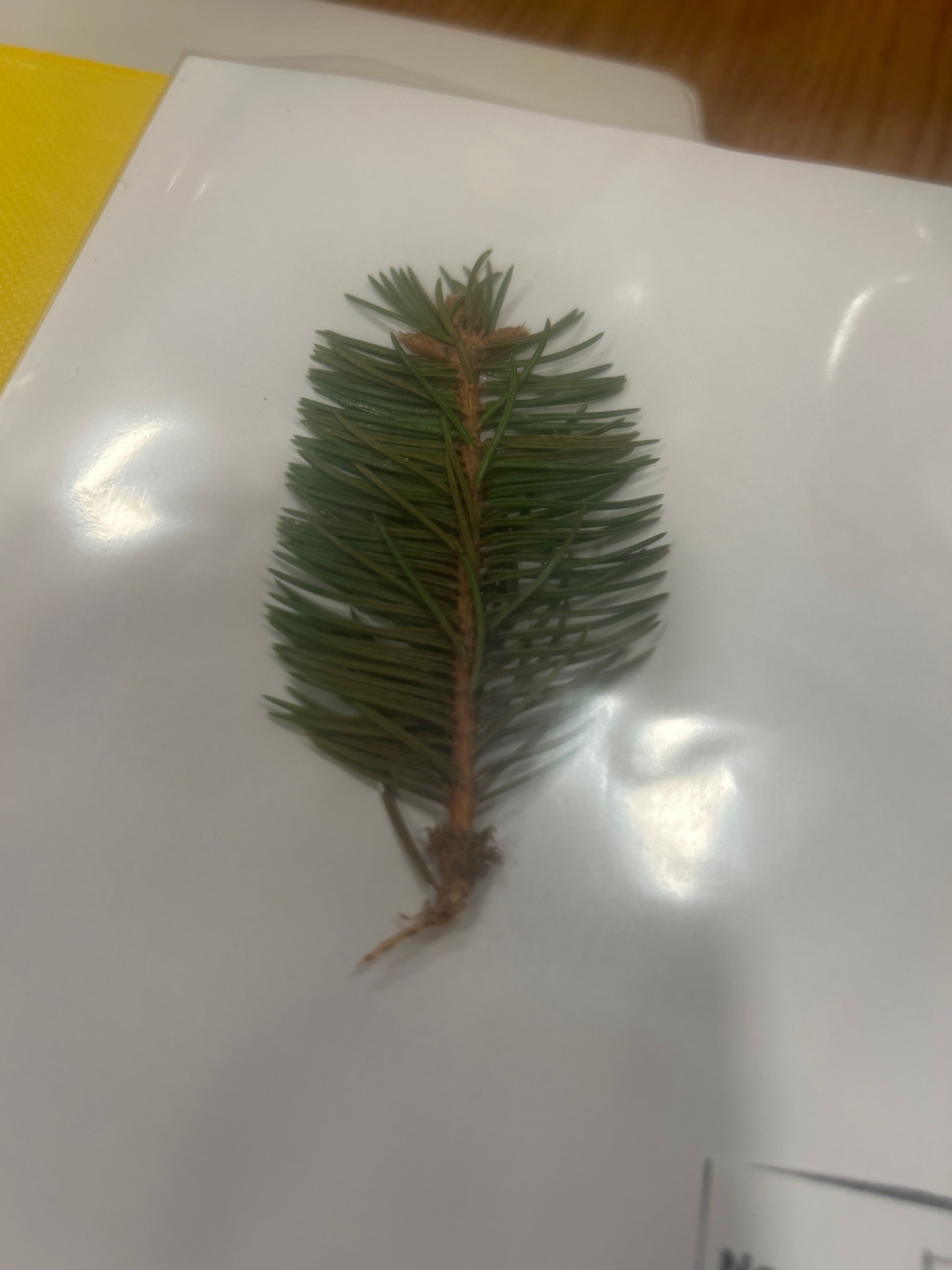
Balsam Fir
Abies balsamea
An evergreen conifer with flat, needle-like leaves that attach individually to the twig via a circular base resembling a small suction cup, leaving smooth circular scars when detached. Needles are dark green above with prominent whitish bands beneath.
- Light
- Full sun to partial shade, requiring at least 6 hours of direct sunlight daily for optimal growth.
- Water
- High moisture requirements; grows best in consistently moist soil and does not tolerate prolonged drought. Water deeply during dry spells.
- Growth
- Perennial evergreen tree featuring a distinct pyramidal growth form, reaching mature heights of 45 to 75 feet with a spread of 20 to 25 feet, growing at a slow to medium rate.
Care instructions
Prefers full sun to partial shade and consistently moist, well-draining soils rich in organic matter. Mulch around the base to retain moisture, and water regularly during dry periods.
Growing details
Sunlight
Full sun to partial shade, requiring at least 6 hours of direct sunlight daily for optimal growth.
Watering
High moisture requirements; grows best in consistently moist soil and does not tolerate prolonged drought. Water deeply during dry spells.
Soil
Prefers acidic, moist, loamy, or sandy soils with good drainage, thriving in a pH range of 4.5 to 6.0.
Hardiness zone
USDA Hardiness Zones 3 through 6, displaying excellent cold tolerance but struggling in extreme summer heat.
Growth habit
Perennial evergreen tree featuring a distinct pyramidal growth form, reaching mature heights of 45 to 75 feet with a spread of 20 to 25 feet, growing at a slow to medium rate.
Bloom season
Non-flowering; produces upright cylindrical cones that mature and disintegrate on the branches in autumn.
Propagation
Propagated primarily from seeds sown in autumn or stratified for spring planting, though softwood cuttings can occasionally be used.
Common pests & issues
Susceptible to spruce budworm, balsam woolly adelgid, root rot in poorly drained soils, and needle cast fungi during wet seasons.
Similar species
Can be confused with Fraser Fir (Abies fraseri) and Eastern Hemlock (Tsuga canadensis); distinguished by its wider native range, needle arrangement, and cone characteristics.