
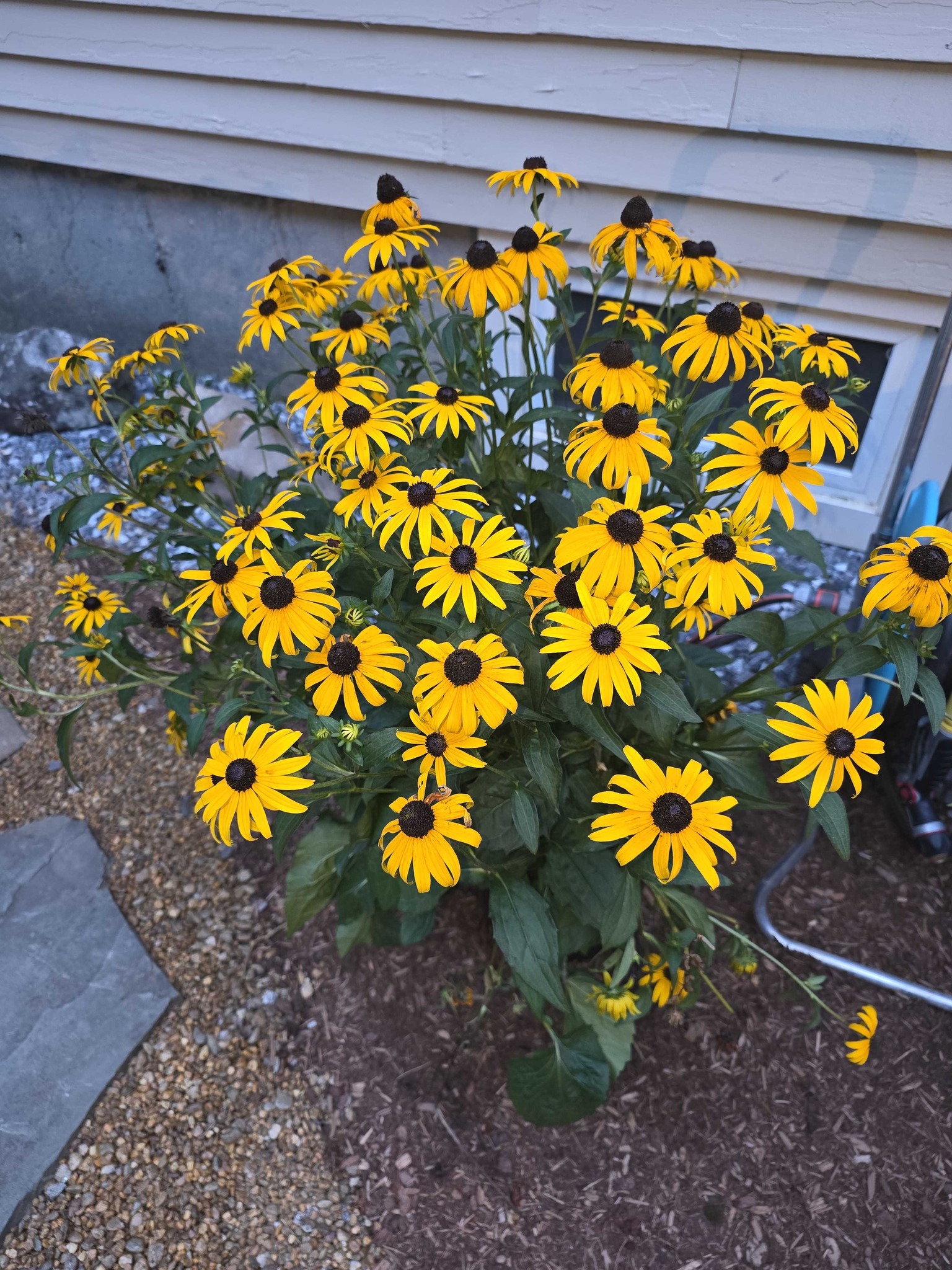
Black-eyed Susan
Rudbeckia hirta
An upright herbaceous plant featuring bright golden-yellow daisy-like ray florets surrounding prominent, dark brown to black central cone-like flower heads.
- Light
- Full sun, requiring at least 6 to 8 hours of direct sunlight per day
- Water
- Moderate watering needs. Water deeply when the top inch of soil becomes dry. Established plants show good drought tolerance.
- Growth
- Typically grown as a short-lived perennial or biennial, reaching heights of 2 to 3 feet with a spread of 1 to 2 feet, exhibiting an upright, clump-forming habit.
Care instructions
Plant in an area receiving full sun with well-draining soil. Water regularly during establishment and periods of extended drought. Apply a balanced fertilizer in spring for optimal growth.
Growing details
Sunlight
Full sun, requiring at least 6 to 8 hours of direct sunlight per day
Watering
Moderate watering needs. Water deeply when the top inch of soil becomes dry. Established plants show good drought tolerance.
Soil
Prefers loamy, well-draining soil with a neutral pH range of 6.0 to 7.0, though adaptable to clay and sandy soils.
Hardiness zone
USDA Hardiness Zones 3 through 9
Growth habit
Typically grown as a short-lived perennial or biennial, reaching heights of 2 to 3 feet with a spread of 1 to 2 feet, exhibiting an upright, clump-forming habit.
Bloom season
Blooms from early summer through autumn with bright yellow ray petals and contrasting dark brown central discs.
Propagation
Propagated easily by collecting and sowing seeds in spring or autumn, or through division of established clumps in early spring.
Common pests & issues
Susceptible to powdery mildew and fungal leaf spots in humid conditions with poor air circulation. Pests such as aphids can occasionally appear.
Similar species
Coneflowers (Echinacea spp.) share a similar daisy-like structure with prominent central cones, but Echinacea typically features pink, purple, or white ray petals rather than bright golden-yellow.