
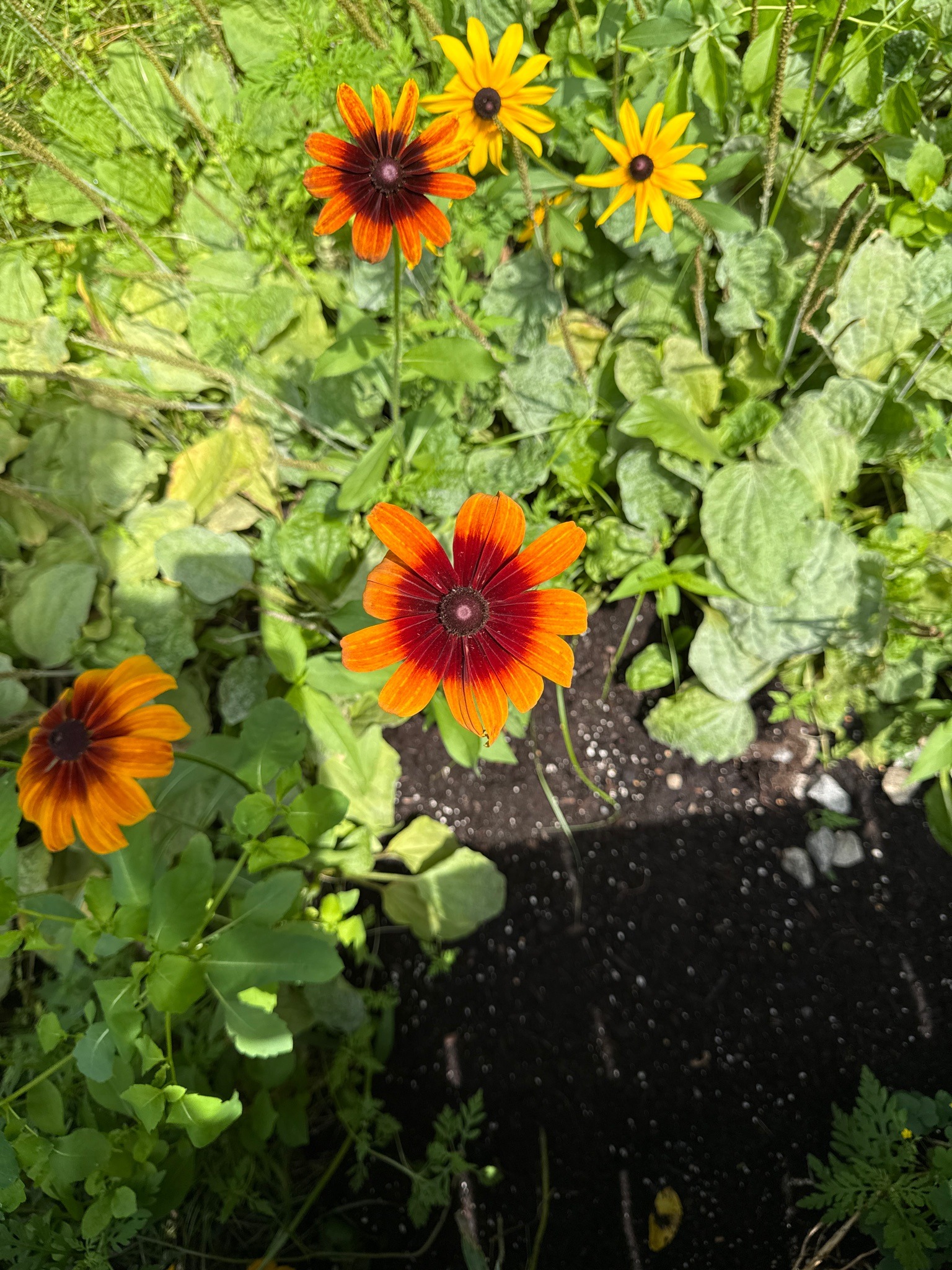
Black-Eyed Susan
Rudbeckia hirta
An upright herbaceous wildflower featuring daisy-like flower heads with golden-yellow to deep orange or bi-color reddish petals surrounding a prominent dark brown central cone, with coarse, hairy green leaves.
- Light
- Full sun (at least 6 hours of direct sunlight daily) for best blooming performance.
- Water
- Moderate watering when young. Once established, it requires infrequent watering and can tolerate dry spells.
- Growth
- Upright, clumping annual, biennial, or short-lived perennial growing 1 to 3 feet tall with a spread of 1 to 2 feet.
Care instructions
Plant in a location receiving full sun and well-draining soil. Water regularly after planting until established, after which it becomes drought-tolerant. deadhead spent blooms to encourage continuous flowering and neat growth.
Growing details
Sunlight
Full sun (at least 6 hours of direct sunlight daily) for best blooming performance.
Watering
Moderate watering when young. Once established, it requires infrequent watering and can tolerate dry spells.
Soil
Adaptable to various soil types including clay, loam, and sand, provided there is good drainage. Soil pH around 6.0 to 7.0 is ideal.
Hardiness zone
USDA Zones 3 through 9
Growth habit
Upright, clumping annual, biennial, or short-lived perennial growing 1 to 3 feet tall with a spread of 1 to 2 feet.
Bloom season
Mid-summer to early autumn, bearing large composite heads with yellow, orange, or rusty-red ray florets and dark central disk florets.
Propagation
Easily propagated by seed sown in spring or early autumn, or by dividing established clumps in spring.
Common pests & issues
Generally resilient, but can occasionally suffer from powdery mildew, leaf spot, or aphid infestations in crowded or overly humid conditions.
Similar species
Echinacea purpurea (Purple Coneflower) has distinct pinkish-purple petals; Rudbeckia fulgida (Orange Coneflower) has smoother foliage and a more reliably perennial habit.