
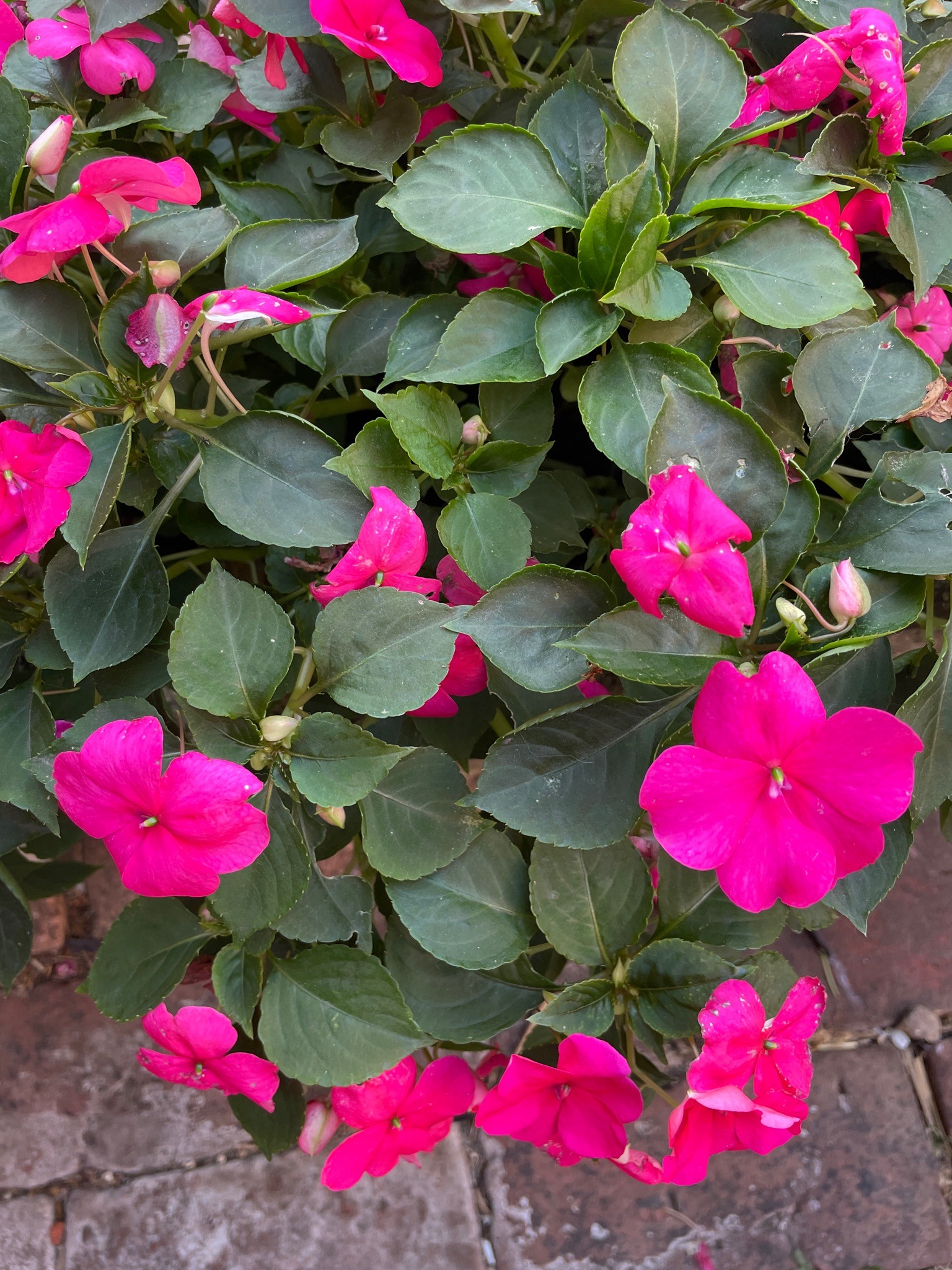
Busy Lizzie
Impatiens walleriana
A succulent-stemmed, tender perennial plant grown commonly as an annual, featuring bright green to dark bronze leaves and vibrant flat-faced flowers in shades of pink, red, orange, purple, and white.
- Light
- Partial shade to full shade, receiving 3 to 6 hours of indirect or morning light per day.
- Water
- Requires frequent watering to keep soil evenly moist. High sensitivity to drought; wilts quickly when dry but recovers rapidly upon watering. Avoid overhead watering if possible to prevent fungal leaf spots.
- Growth
- Mounding, herbaceous tender perennial or annual growing 6 to 24 inches tall with a similar spread, exhibiting a fast growth rate.
Care instructions
Provide partial to full shade with moist, well-draining soil rich in organic matter. Water regularly to keep the soil consistently damp without letting it become waterlogged. Feed lightly every two weeks during the growing season with a balanced water-soluble fertilizer.
Growing details
Sunlight
Partial shade to full shade, receiving 3 to 6 hours of indirect or morning light per day.
Watering
Requires frequent watering to keep soil evenly moist. High sensitivity to drought; wilts quickly when dry but recovers rapidly upon watering. Avoid overhead watering if possible to prevent fungal leaf spots.
Soil
Rich, moisture-retentive, well-draining loamy soil with a slightly acidic to neutral pH between 6.0 and 6.5.
Hardiness zone
USDA hardiness zones 10 to 11 as a perennial; widely cultivated as an annual in zones 2 through 9.
Growth habit
Mounding, herbaceous tender perennial or annual growing 6 to 24 inches tall with a similar spread, exhibiting a fast growth rate.
Bloom season
Blooms continuously from late spring until the first frost in autumn, producing flat, single or double flowers in vivid hues.
Propagation
Easily propagated through stem cuttings placed in water or moist potting mix, or by sowing seeds indoors in late winter.
Common pests & issues
Susceptible to downy mildew, powdery mildew, and stem rot, particularly in damp or overcrowded conditions. Pests include aphids, spider mites, and thrips.
Similar species
Impatiens hawkeri (New Guinea Impatiens), which has larger flowers, broader bronze or variegated foliage, and higher tolerance for brighter sunlight.