
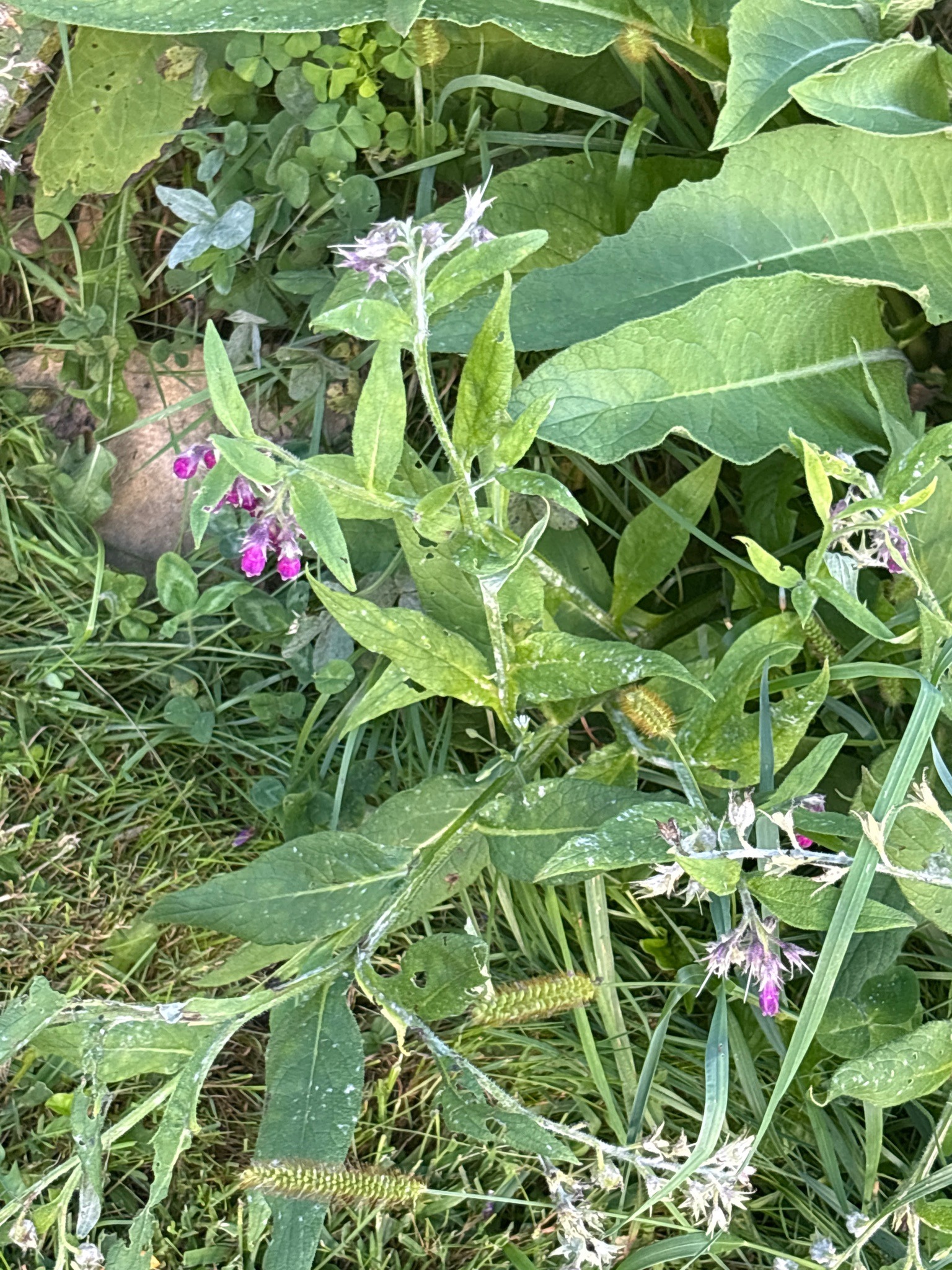
Common Comfrey
Symphytum officinale
A large, hairy, herbaceous perennial featuring coarse, lance-shaped leaves and drooping clusters of bell-shaped flowers that transition from pink to purple.
- Light
- Full sun to partial shade, requiring at least 4 to 6 hours of direct sunlight daily.
- Water
- Prefers consistently moist soil. Water deeply during dry spells as it has low drought tolerance; wilting is a clear sign of underwatering, while yellowing lower leaves can indicate overwatering.
- Growth
- Herbaceous perennial forming a dense, bushy clump with a mature height of 2 to 3 feet and a spread of 2 to 3 feet, exhibiting a fast growth rate.
Care instructions
Plant in full sun to partial shade with consistently moist, fertile soil. Apply a balanced organic fertilizer in spring to support vigorous foliage and flower development.
Growing details
Sunlight
Full sun to partial shade, requiring at least 4 to 6 hours of direct sunlight daily.
Watering
Prefers consistently moist soil. Water deeply during dry spells as it has low drought tolerance; wilting is a clear sign of underwatering, while yellowing lower leaves can indicate overwatering.
Soil
Thrives in rich, loamy, well-draining soils with a neutral pH between 6.0 and 7.0, though it adapts well to clay soils.
Hardiness zone
USDA hardiness zones 3 through 9, demonstrating strong cold tolerance down to -40 degrees Fahrenheit.
Growth habit
Herbaceous perennial forming a dense, bushy clump with a mature height of 2 to 3 feet and a spread of 2 to 3 feet, exhibiting a fast growth rate.
Bloom season
Blooms from late spring through mid-summer, producing small, bell-shaped flowers in shades of pink, purple, or creamy white arranged in coiled cymes.
Propagation
Easily propagated through root cuttings, crown division in early spring or autumn, or occasionally by seeds sown in spring.
Common pests & issues
Susceptible to powdery mildew and rust in humid conditions; managed by ensuring proper air circulation and removing affected foliage. Slugs and snails may occasionally damage the leaves.
Similar species
Borage (Borago officinalis) is similar in flower shape and family, but borage is an annual with star-shaped blue flowers and rough, bristly stems, whereas comfrey is a perennial with bell-shaped clustered flowers.