
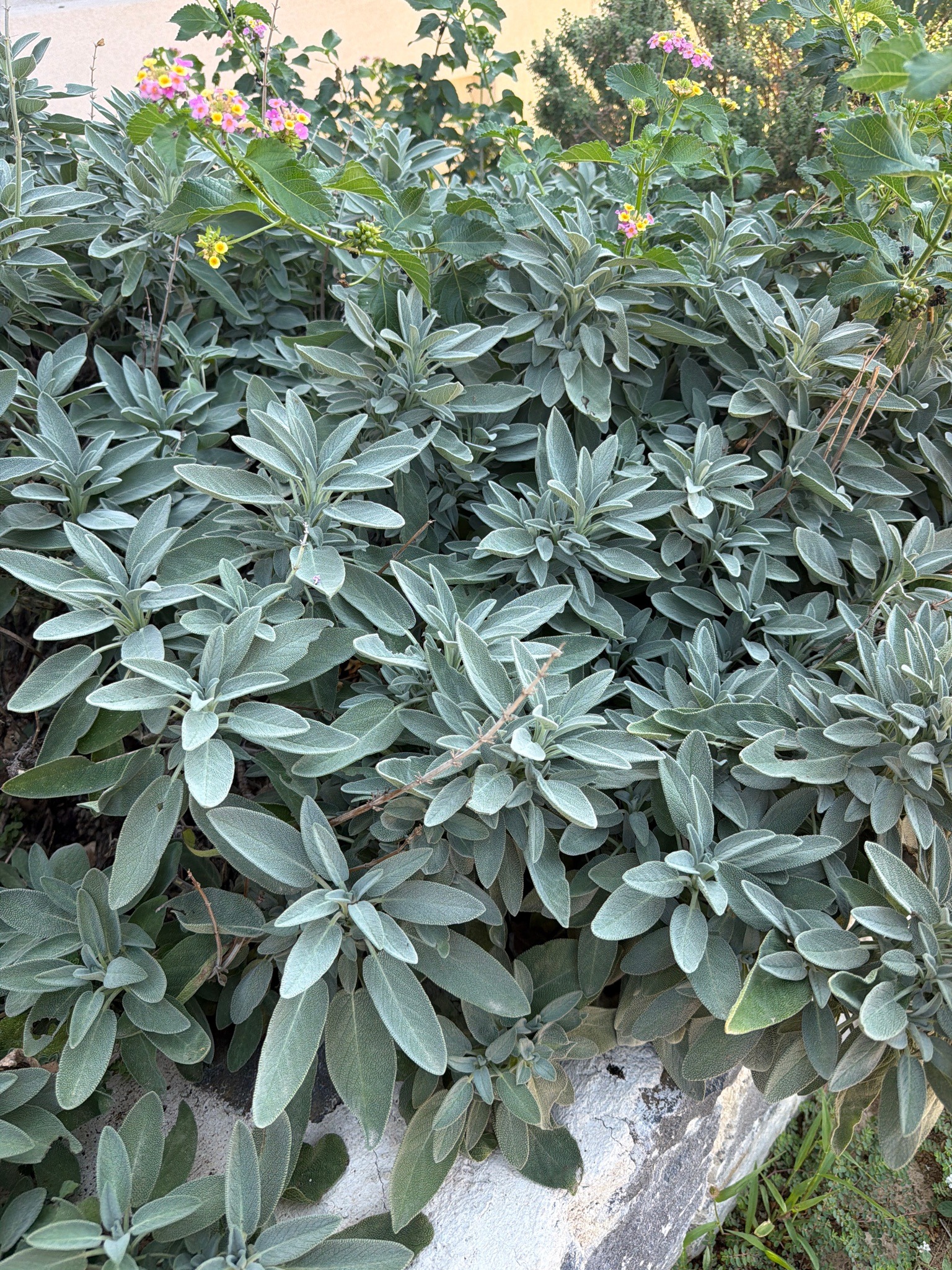
Common Sage
Salvia officinalis
A perennial, evergreen subshrub with woody stems, grayish-green to silvery leaves that are softly textured with fine hairs, and whorled clusters of purplish-blue flowers.
- Light
- Full sun, requiring at least 6 to 8 hours of direct sunlight daily.
- Water
- Low water needs once established. Highly drought tolerant. Avoid overwatering, as excess moisture leads to root rot.
- Growth
- An evergreen perennial subshrub with a mounding, bushy growth habit. Reaches a mature height of 1 to 2 feet and a spread of 2 to 3 feet with a moderate growth rate.
Care instructions
Provide full sun and well-draining soil. Water deeply but infrequently, allowing the soil to dry out completely between waterings. Prune lightly in spring to remove dead stems and encourage bushier growth.
Growing details
Sunlight
Full sun, requiring at least 6 to 8 hours of direct sunlight daily.
Watering
Low water needs once established. Highly drought tolerant. Avoid overwatering, as excess moisture leads to root rot.
Soil
Prefers sandy or loamy, well-draining soil with a neutral to slightly alkaline pH between 6.5 and 7.5.
Hardiness zone
USDA Hardiness Zones 4 through 8, thriving in temperate climates with mild winters.
Growth habit
An evergreen perennial subshrub with a mounding, bushy growth habit. Reaches a mature height of 1 to 2 feet and a spread of 2 to 3 feet with a moderate growth rate.
Bloom season
Flowers in late spring to early summer, producing tubular, two-lipped flowers typically in shades of purple, blue, pink, or white arranged in verticils.
Propagation
Easily propagated through stem cuttings taken in spring or summer, layerings, or by starting from seeds sown in spring.
Common pests & issues
Susceptible to powdery mildew and root rot in overly humid conditions or poorly draining soils. Pests such as spider mites and whiteflies can occasionally appear.
Similar species
Other Salvia species such as Salvia leucantha (Mexican bush sage) or Salvia sclarea (clary sage), which can be distinguished by larger flower bracts, different leaf textures, and varying growth heights.