
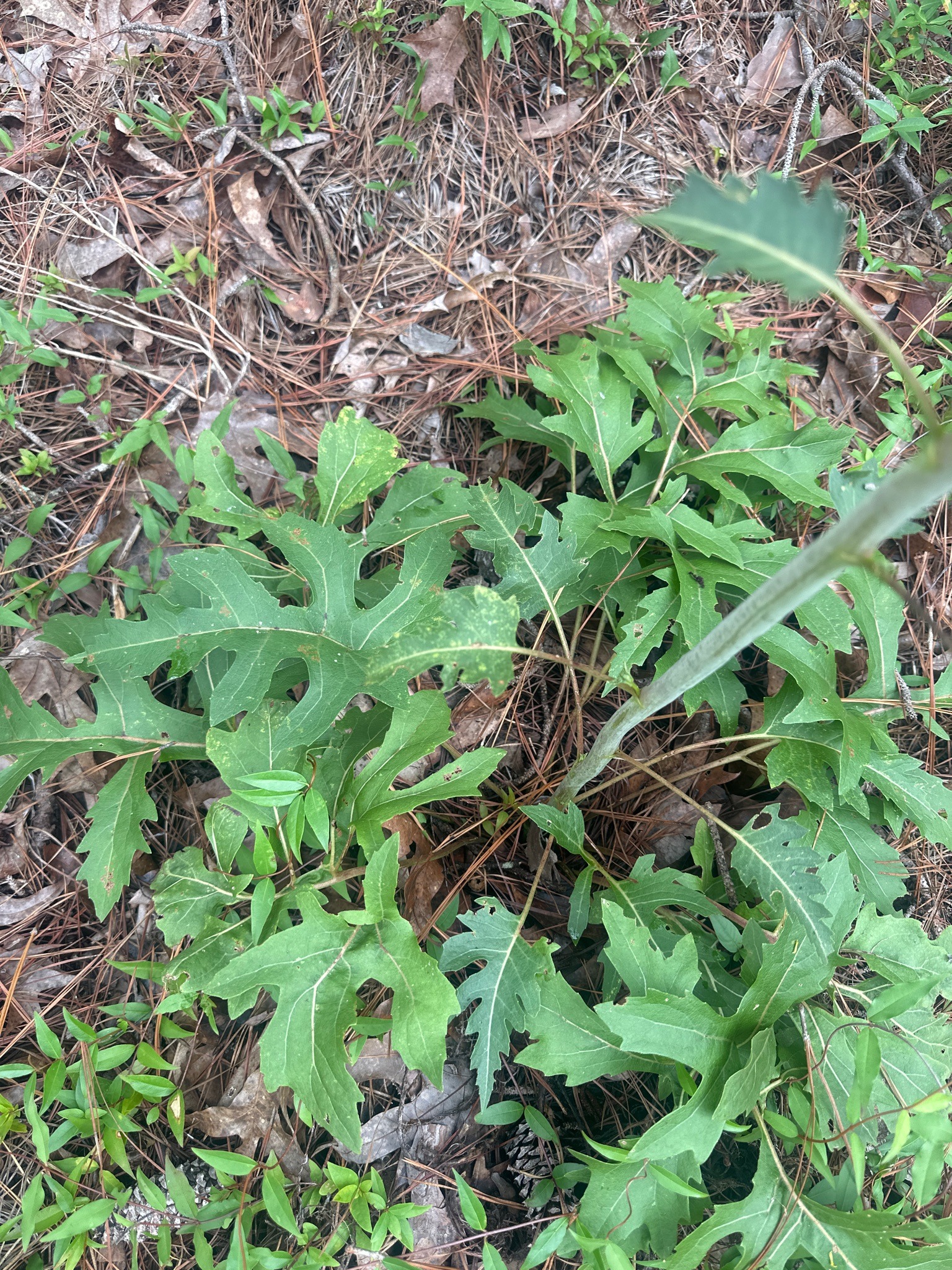
Compass Plant
Silphium laciniatum
A tall, prairie native herbaceous perennial featuring deeply pinnatifid, rough-textured leaves that tend to orient themselves north-to-south, and large, bright yellow composite flowers held aloft on thick, coarse stems.
- Light
- Full sun (at least 6 hours of direct sunlight daily)
- Water
- Low to medium watering requirements; highly drought-tolerant once mature. Deep watering during prolonged dry spells helps young plants establish.
- Growth
- Herbaceous perennial with a basal rosette of large, deeply lobed leaves and vertical flowering stalks reaching 6 to 10 feet tall with a spread of 2 to 3 feet.
Care instructions
Plant in full sun and well-draining soil. Requires minimal supplemental watering once established due to its deep taproot. Avoid over-fertilizing, as excessive nutrients can lead to weak, floppy stems.
Growing details
Sunlight
Full sun (at least 6 hours of direct sunlight daily)
Watering
Low to medium watering requirements; highly drought-tolerant once mature. Deep watering during prolonged dry spells helps young plants establish.
Soil
Adaptable to various soil types including clay, loam, and gravelly soils; prefers well-draining neutral to slightly alkaline pH.
Hardiness zone
USDA Zones 3 to 9
Growth habit
Herbaceous perennial with a basal rosette of large, deeply lobed leaves and vertical flowering stalks reaching 6 to 10 feet tall with a spread of 2 to 3 feet.
Bloom season
Mid-summer to early autumn (July through September), producing large yellow, sunflower-like flower heads 2 to 4 inches in diameter.
Propagation
Propagated mainly by seed sown in autumn or cold-stratified before spring planting; difficult to divide due to its deep taproot.
Common pests & issues
Generally resistant to major diseases; occasionally affected by powdery mildew, leaf spot, or stem borers in crowded or highly humid conditions.
Similar species
Silphium terebinthinaceum (Prairie Dock), which has large, unlobed, heart-shaped leaves, and Silphium perfoliatum (Cup Plant), which has leaves that join around the stem to form a cup.