
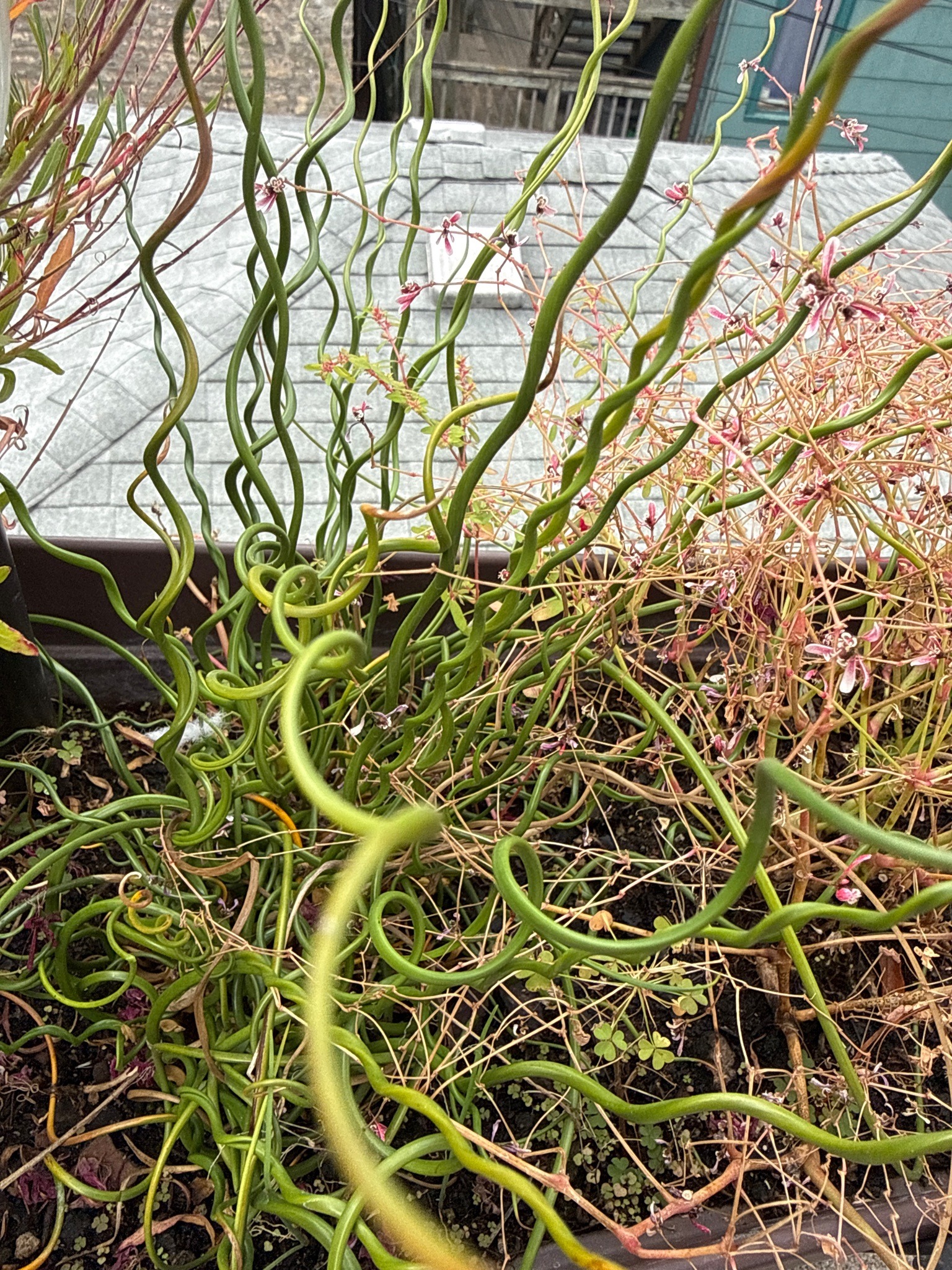
Corkscrew Rush
Juncus effusus 'Spiralis'
A distinctive perennial marginal aquatic or bog plant notable for its bright green, cylindrical stems that twist, curl, and spiral dramatically in corkscrew patterns.
- Light
- Full sun to partial shade, ideally 6 or more hours of direct sunlight daily.
- Water
- Requires high moisture and frequent watering; thrives in wet soil, boggy conditions, or shallow standing water up to a few inches deep. Never allow the soil to dry out completely.
- Growth
- Clump-forming herbaceous perennial with a dense, upright to sprawling habit, reaching mature heights and spreads of 12 to 24 inches with a moderate growth rate.
Care instructions
Provide consistently moist to wet soil and full sun to partial shade. Water frequently so the soil never dries out, and feed occasionally during the growing season with a balanced, water-soluble fertilizer.
Growing details
Sunlight
Full sun to partial shade, ideally 6 or more hours of direct sunlight daily.
Watering
Requires high moisture and frequent watering; thrives in wet soil, boggy conditions, or shallow standing water up to a few inches deep. Never allow the soil to dry out completely.
Soil
Rich, loamy, or clay-heavy soils that retain moisture exceptionally well. Prefers a neutral to acidic pH range between 5.5 and 6.5.
Hardiness zone
USDA Hardiness Zones 4 through 9, exhibiting strong cold tolerance within these ranges.
Growth habit
Clump-forming herbaceous perennial with a dense, upright to sprawling habit, reaching mature heights and spreads of 12 to 24 inches with a moderate growth rate.
Bloom season
Summer; produces inconspicuous, brownish-green, clustered flowers along the stems, though the plant is primarily grown for its unique foliage rather than blooms.
Propagation
Easily propagated through root division in spring by splitting established clumps into smaller sections, or grown from seed in consistently damp medium.
Common pests & issues
Generally pest and disease-free, though underwatering can cause brown, crispy tips on the stems. Pruning back dead or brown stems in early spring encourages fresh, vibrant new growth.
Similar species
Juncus inflexus (Hard Rush) and other Juncus species, which typically feature straight, upright stems rather than the pronounced spiraling curls of the 'Spiralis' cultivar.