
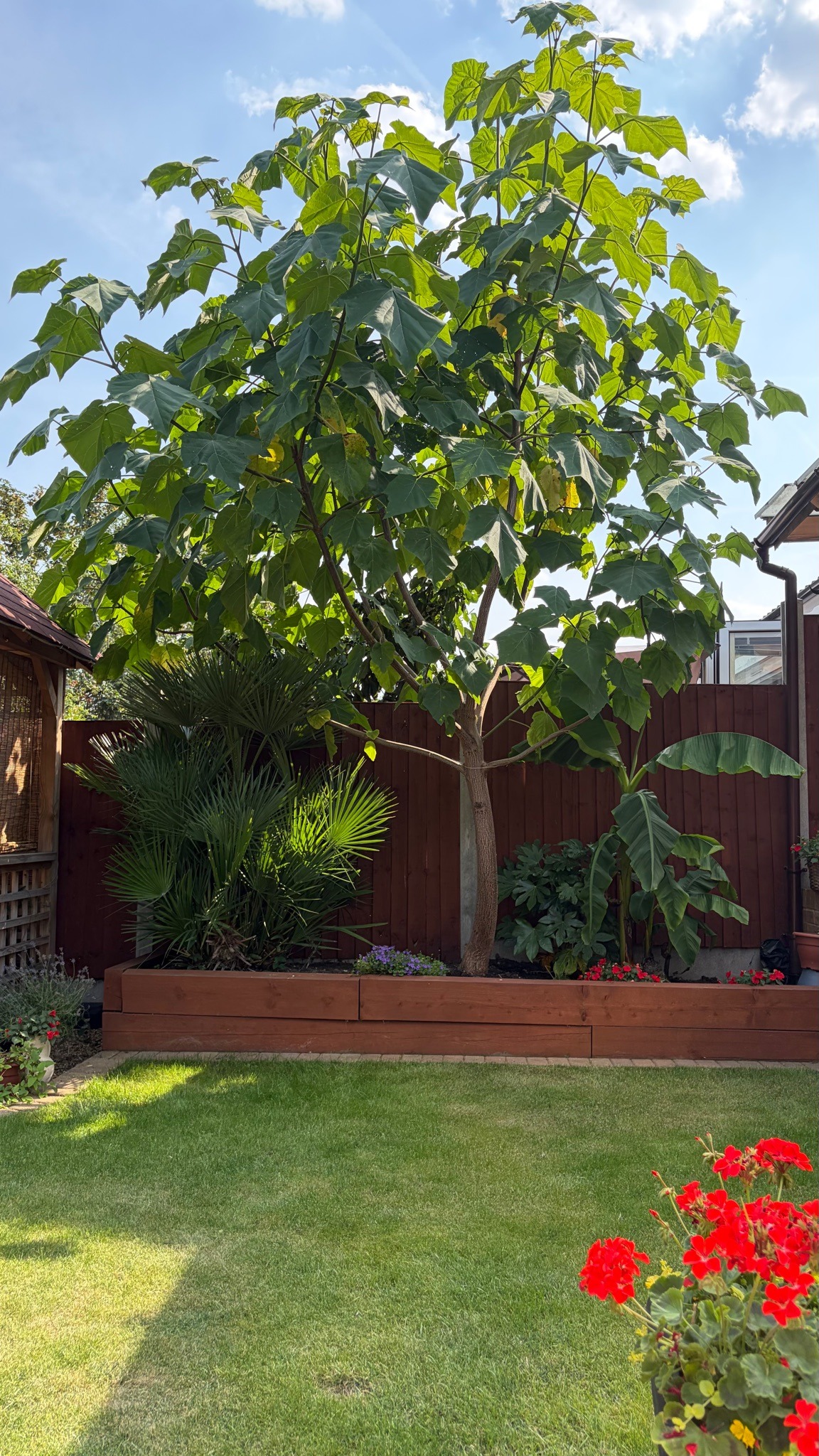
Empress Tree
Paulownia tomentosa
A fast-growing deciduous tree featuring extremely large, heart-shaped leaves, smooth greyish bark, and an upright canopy. It produces showy clusters of pale violet to blue flowers before the leaves fully emerge in spring.
- Light
- Full sun, requiring at least six to eight hours of direct sunlight per day.
- Water
- Water regularly when young to establish a deep root system. Once established, it is relatively drought-tolerant, requiring irrigation only during prolonged dry spells. Avoid waterlogged soils.
- Growth
- Fast-growing deciduous perennial tree reaching mature heights of 30 to 50 feet with an equally wide, spreading canopy.
Care instructions
Provide full sun and well-draining soil. Water deeply during establishment, though mature trees show good drought tolerance. Apply a balanced, slow-release fertilizer in early spring if growth is sluggish.
Growing details
Sunlight
Full sun, requiring at least six to eight hours of direct sunlight per day.
Watering
Water regularly when young to establish a deep root system. Once established, it is relatively drought-tolerant, requiring irrigation only during prolonged dry spells. Avoid waterlogged soils.
Soil
Prefers loose, deep, fertile, and well-draining loamy soils with a neutral to slightly acidic pH range between 6.0 and 7.5.
Hardiness zone
USDA zones 5 through 9, demonstrating good cold hardiness once established.
Growth habit
Fast-growing deciduous perennial tree reaching mature heights of 30 to 50 feet with an equally wide, spreading canopy.
Bloom season
Mid-spring, producing large, upright panicles of tubular, foxglove-like pale violet flowers with a pleasant fragrance.
Propagation
Propagated primarily through root cuttings, softwood cuttings taken in summer, or by seeds sown on the surface of a moist, well-draining medium in spring.
Common pests & issues
Generally resilient, but can occasionally be affected by leaf spots, powdery mildew, and wood-boring insects. Ensuring proper spacing and good airflow helps prevent fungal issues.
Similar species
Catalpa speciosa (Northern Catalpa), which features similar heart-shaped leaves and showy flowers, but can be distinguished by its elongated, bean-like seed pods and whorled leaf arrangement.