
Garden Phlox
Phlox paniculata
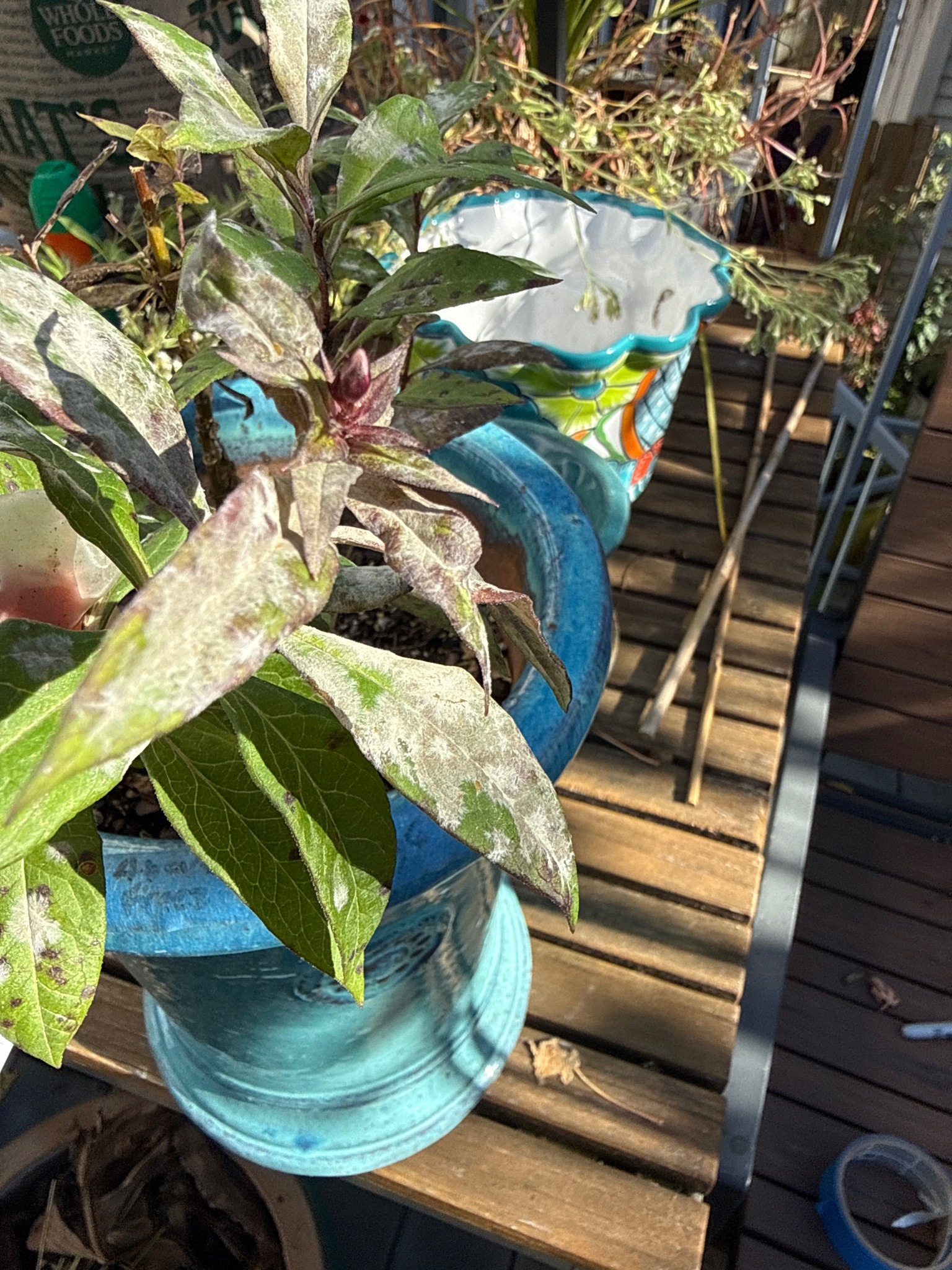
An upright perennial with dark green, lance-shaped leaves arranged oppositely along sturdy stems, displaying significant white powdery residue characteristic of fungal infection on the foliage.
- Light
- Full sun to partial shade, requiring at least six hours of direct sunlight per day.
- Water
- Moderate and regular watering. Prefers consistently moist soil; tolerates brief dry spells once established, but drought stress weakens the plant.
- Growth
- Herbaceous perennial forming dense clumps with an upright growth habit, typically reaching mature heights of 2 to 4 feet and a spread of 2 to 3 feet with a moderate growth rate.
Care instructions
Provide full sun to partial shade with good air circulation. Water regularly at the base to keep soil evenly moist without waterlogging, avoiding overhead watering to limit fungal spore spread. Plant in rich, well-draining soil and apply a balanced fertilizer in early spring.
Growing details
Sunlight
Full sun to partial shade, requiring at least six hours of direct sunlight per day.
Watering
Moderate and regular watering. Prefers consistently moist soil; tolerates brief dry spells once established, but drought stress weakens the plant.
Soil
Rich, loamy, organic-rich soil with excellent drainage and a neutral pH range of 6.0 to 7.0.
Hardiness zone
USDA hardiness zones 4 through 8, demonstrating good cold tolerance.
Growth habit
Herbaceous perennial forming dense clumps with an upright growth habit, typically reaching mature heights of 2 to 4 feet and a spread of 2 to 3 feet with a moderate growth rate.
Bloom season
Blooms from mid to late summer, producing large, terminal panicles of showy, tubular flowers in shades of pink, purple, white, or red.
Propagation
Propagated easily through stem cuttings taken in spring or early summer, division of mature clumps in spring or autumn, or from seeds.
Common pests & issues
Highly susceptible to powdery mildew, visible as a white powdery coating on the leaves and stems, which can be mitigated by improving air circulation, avoiding overhead watering, and applying appropriate fungicidal treatments if necessary. Also prone to spider mites and stem nematodes.
Similar species
Wild Sweet William (Phlox maculata), which has smoother, spotted stems and narrower cylindrical flower clusters, and Moss Phlox (Phlox subulata), which features a low-growing, mat-forming habit instead of upright stems.