
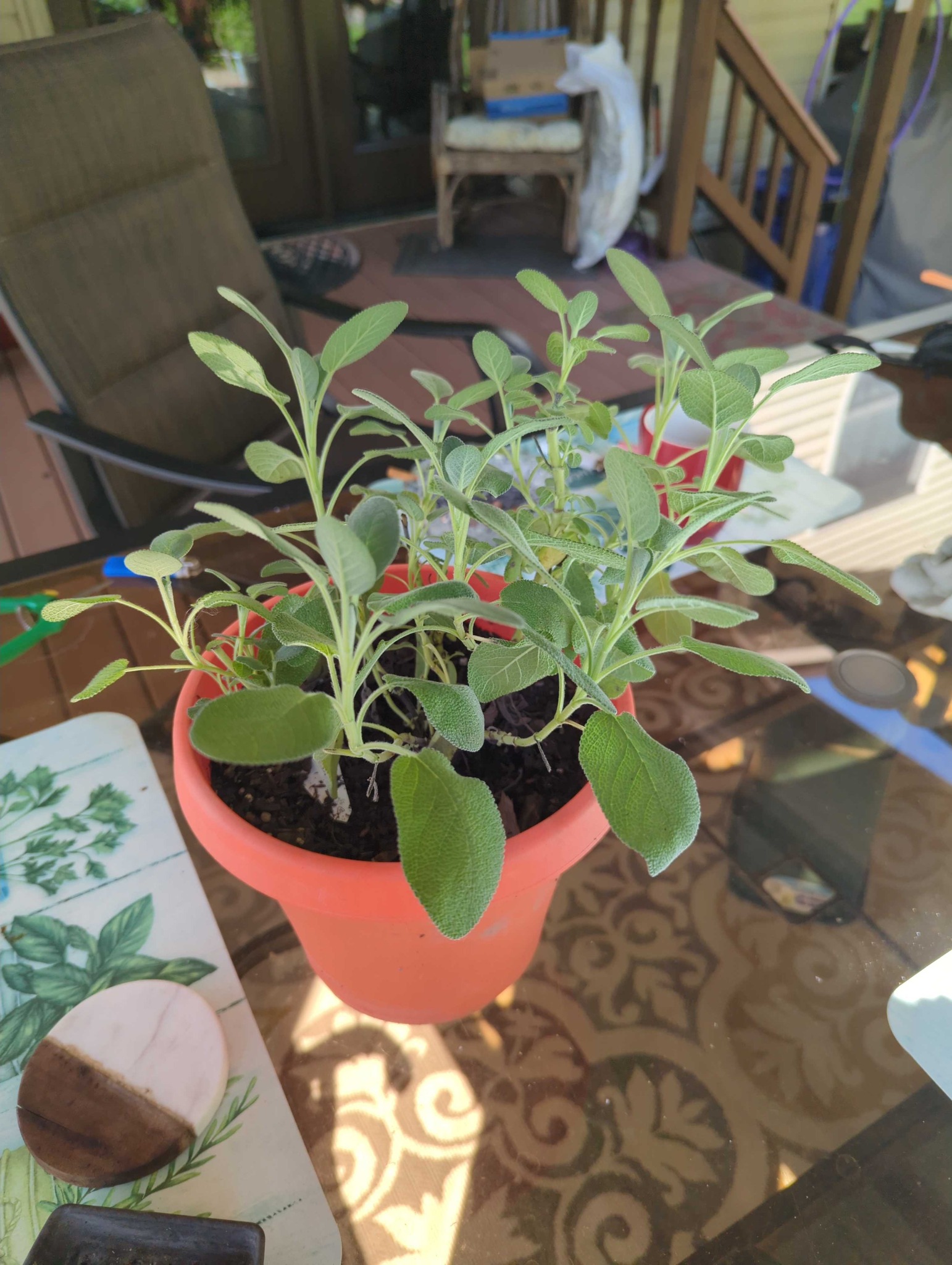
Garden Sage
Salvia officinalis
An evergreen subshrub featuring grayish-green, oblong, rugose leaves covered in fine hairs that give them a soft texture, arranged oppositely along square stems.
- Light
- Full sun, requiring at least 6 to 8 hours of direct sunlight daily.
- Water
- Low watering needs once established. Highly drought tolerant; allow the soil to dry out completely between waterings to prevent root rot.
- Growth
- Perennial subshrub with an upright, branching growth form, reaching a mature height of 1 to 2 feet and spreading up to 2 feet wide.
Care instructions
Provide full sun and well-draining soil. Water deeply only when the top few inches of soil are dry to the touch, and avoid high humidity or overly damp conditions.
Growing details
Sunlight
Full sun, requiring at least 6 to 8 hours of direct sunlight daily.
Watering
Low watering needs once established. Highly drought tolerant; allow the soil to dry out completely between waterings to prevent root rot.
Soil
Well-draining, sandy or loamy soils with a neutral to slightly alkaline pH between 6.5 and 7.0.
Hardiness zone
USDA Hardiness Zones 5 through 8
Growth habit
Perennial subshrub with an upright, branching growth form, reaching a mature height of 1 to 2 feet and spreading up to 2 feet wide.
Bloom season
Blooms in late spring to early summer, producing spikes of small, tubular flowers in shades of purple, blue, pink, or white.
Propagation
Propagated easily from stem cuttings taken in spring or early summer, through layering, or by starting from seeds.
Common pests & issues
Prone to powdery mildew and root rot if kept in poorly draining soil or stagnant, humid conditions. Pests are minimal but can occasionally include spider mites or whiteflies.
Similar species
Other Salvia species such as Lavender (Lavandula angustifolia), which has narrower leaves and distinct floral spikes, and Russian Sage (Salvia yangii), which has finely divided, silvery-gray foliage.