
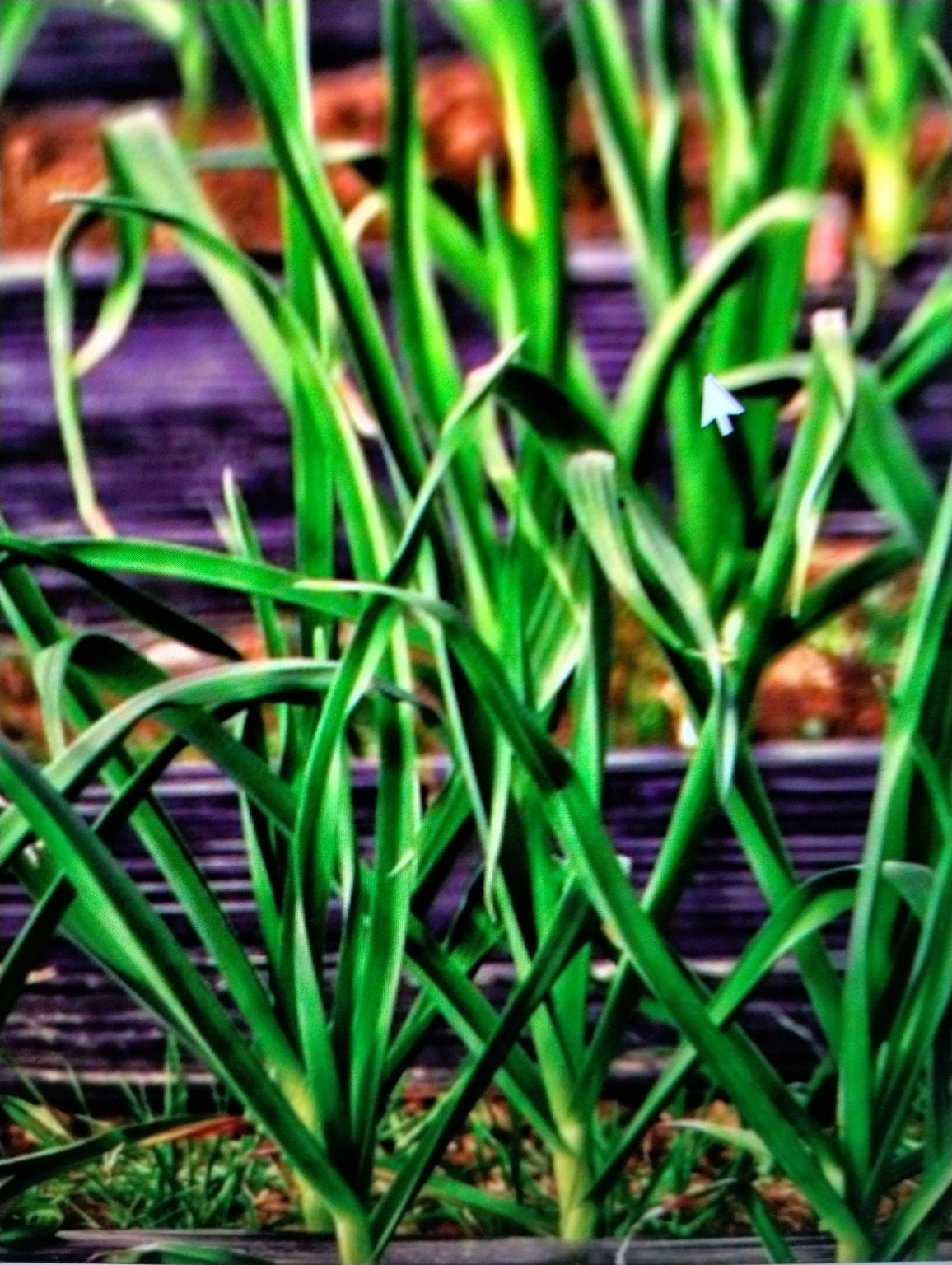
Garlic
Allium sativum
Garlic is a bulbous, herbaceous perennial plant that grows upright with long, flat, strap-shaped green leaves that arise from a central base, and an underground underground bulb composed of multiple cloves encased in a papery sheath.
- Light
- Full sun, requiring at least 6 to 8 hours of direct sunlight daily
- Water
- Moderate watering needs. Keep the soil evenly moist during the spring growth phase, then reduce watering as the leaves begin to yellow and dry out near maturity. Avoid waterlogged soils.
- Growth
- Herbaceous perennial grown typically as an annual, reaching heights of 12 to 24 inches with a narrow, upright growth habit.
Care instructions
Grow in full sun with consistent watering during the active growth phase, allowing soil to dry slightly between waterings. Plant in well-draining, fertile soil rich in organic matter, and provide a balanced fertilizer during early vegetative growth stages.
Growing details
Sunlight
Full sun, requiring at least 6 to 8 hours of direct sunlight daily
Watering
Moderate watering needs. Keep the soil evenly moist during the spring growth phase, then reduce watering as the leaves begin to yellow and dry out near maturity. Avoid waterlogged soils.
Soil
Well-draining loamy or sandy loam soils rich in organic matter with a neutral pH range between 6.0 and 7.0.
Hardiness zone
USDA zones 4 through 9
Growth habit
Herbaceous perennial grown typically as an annual, reaching heights of 12 to 24 inches with a narrow, upright growth habit.
Bloom season
Late spring to early summer, producing small white or pinkish flowers arranged in an umbel, often accompanied by a central flowering stalk known as a scape.
Propagation
Propagated vegetatively by separating and planting individual cloves in the autumn or early spring, oriented with the pointed end facing upward.
Common pests & issues
Susceptible to fungal pathogens such as white rot and rust, as well as pests like bulb mites and thrips. Prevent issues by ensuring proper soil drainage, avoiding excessive moisture, and practicing crop rotation.
Similar species
Often confused with other Allium species such as leeks (Allium ampeloprasum) and shallots (Allium cepa var. aggregatum), but distinguished by its narrow, folded leaves and segmented underground bulb structure.