
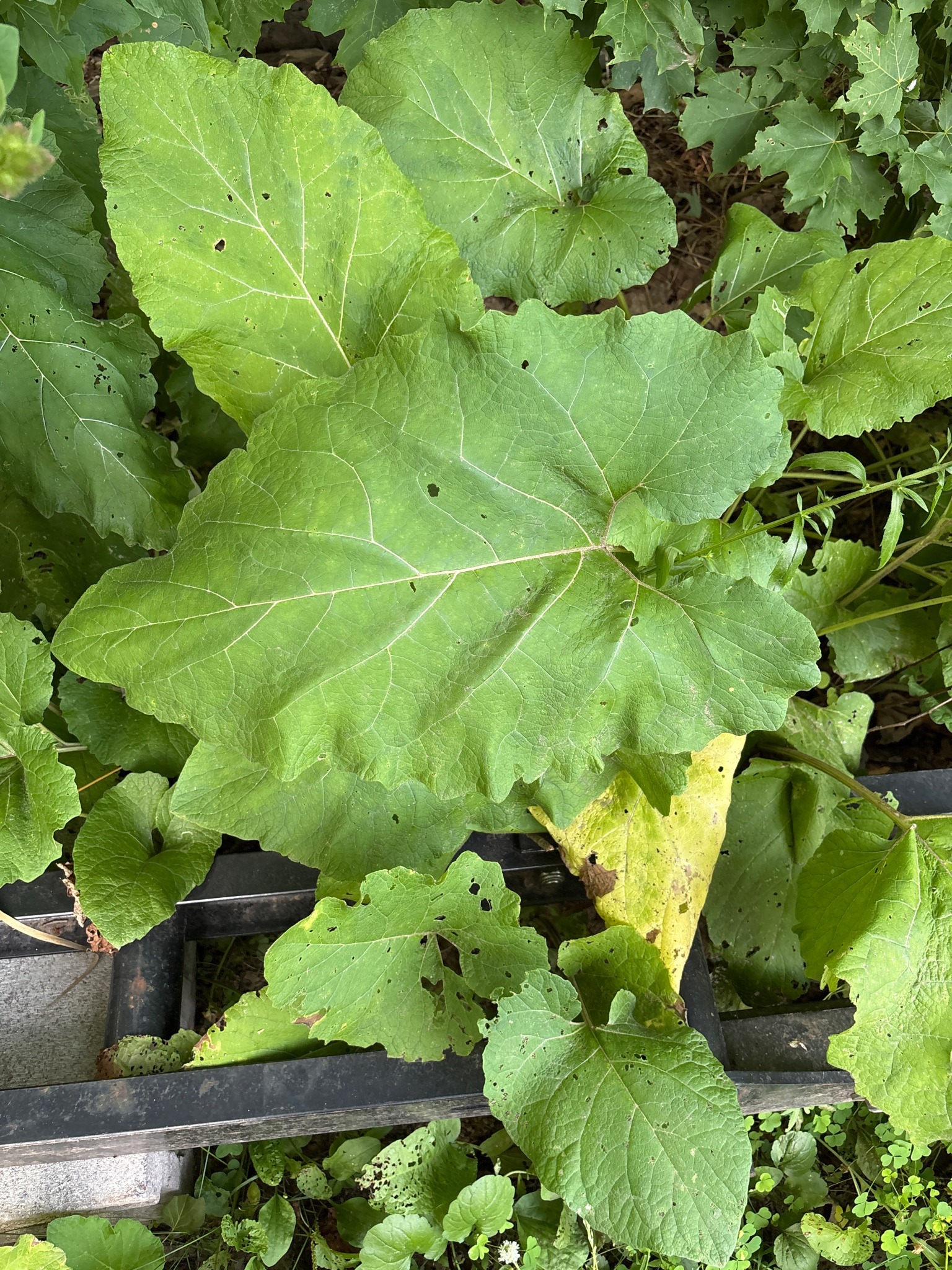
Greater Burdock
Arctium lappa
A robust biennial herb characterized by extremely large, broad, heart-shaped (cordate) basal leaves with wavy margins, prominent whitish veins, and somewhat woolly undersides.
- Light
- Full sun to partial shade, requiring at least 6 hours of direct sunlight daily.
- Water
- Moderate watering needs. Water deeply when the top few inches of soil become dry. Established plants tolerate short periods of dry conditions.
- Growth
- Herbaceous biennial forming a low-lying rosette of massive leaves in the first year, then sending up a branching flower stalk in the second year reaching heights of 4 to 9 feet with a spread of 2 to 3 feet.
Care instructions
Grow in full sun to partial shade in well-drained soils. Provide moderate moisture, allowing the soil to dry slightly between waterings once established.
Growing details
Sunlight
Full sun to partial shade, requiring at least 6 hours of direct sunlight daily.
Watering
Moderate watering needs. Water deeply when the top few inches of soil become dry. Established plants tolerate short periods of dry conditions.
Soil
Prefers rich, loamy, well-draining soil with a neutral to slightly alkaline pH range of 6.0 to 7.5.
Hardiness zone
USDA zones 3 through 9, exhibiting strong cold hardiness.
Growth habit
Herbaceous biennial forming a low-lying rosette of massive leaves in the first year, then sending up a branching flower stalk in the second year reaching heights of 4 to 9 feet with a spread of 2 to 3 feet.
Bloom season
Summer to early autumn, producing purple, thistle-like flower heads enclosed in hooked bracts.
Propagation
Propagated strictly by seeds, which scatter easily via the hooked burs attaching to passing animals and materials.
Common pests & issues
Susceptible to powdery mildew, leaf spot, and insect herbivores such as caterpillars and aphids, which can be managed with proper spacing, air circulation, and horticultural soap if necessary.
Similar species
Can be confused with rhubarb (Rheum rhabarbarum) or butterbur (Petasites hybridus), but distinguished by its prominent wavy leaf margins, woolly undersides, and distinct floral structures.