
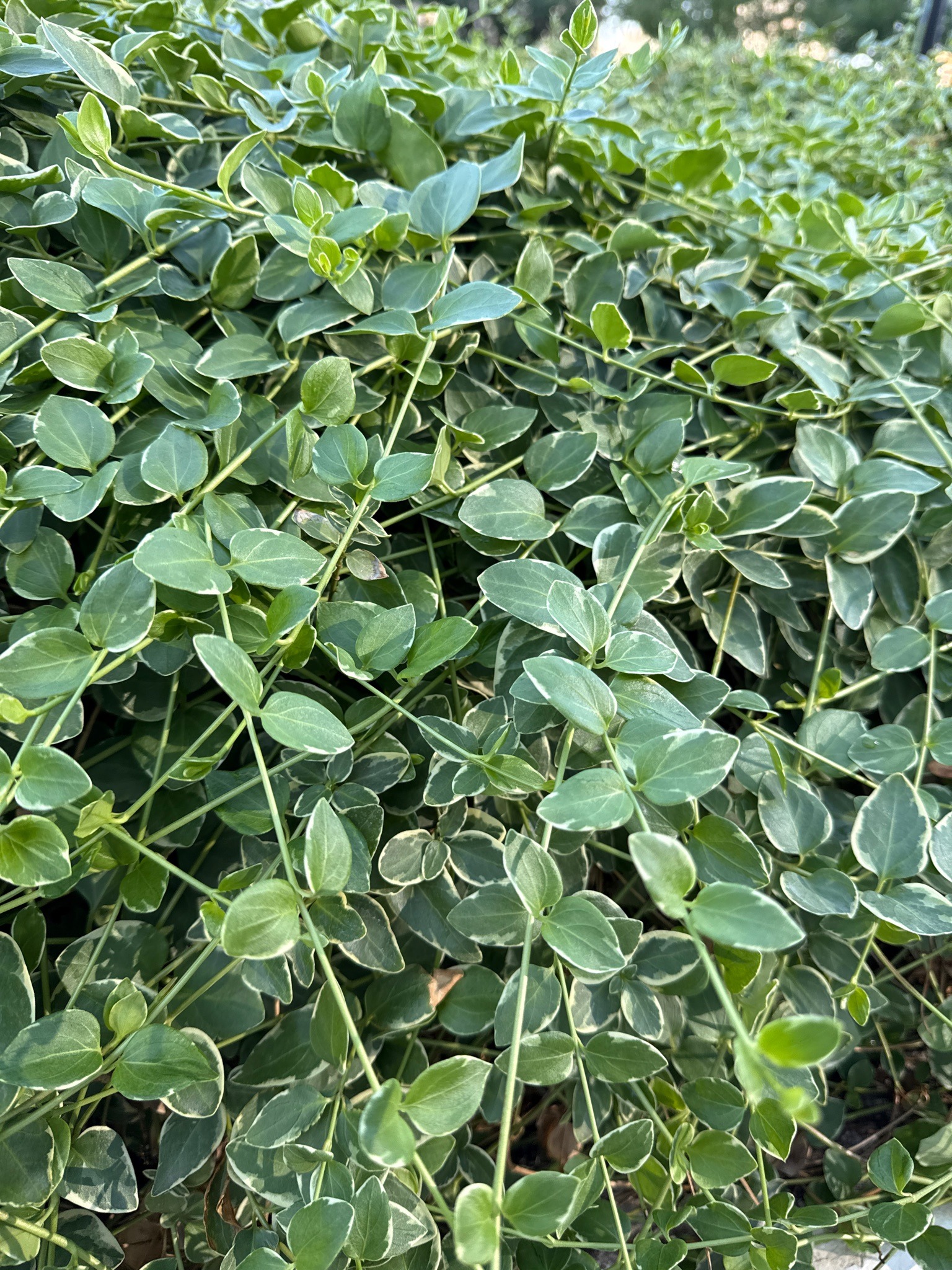
Greater Periwinkle
Vinca major
A vigorous, evergreen trailing vine featuring opposite, glossy, dark green leaves with creamy white margins and slender stems that root at the nodes.
- Light
- Partial shade to full sun, about 4 to 6 hours of direct or filtered sunlight per day.
- Water
- Requires regular watering to establish root systems. Once established, it exhibits moderate drought tolerance. Allow the top inch of soil to dry out between waterings.
- Growth
- Perennial evergreen trailing subshrub forming dense mats, growing 6 to 18 inches tall with an indefinite spreading habit via rooting stems.
Care instructions
Grow in partial shade to full sun with moderate, regular watering. Adaptable to various soils as long as drainage is adequate. Apply a balanced, slow-release fertilizer in spring to support healthy growth.
Growing details
Sunlight
Partial shade to full sun, about 4 to 6 hours of direct or filtered sunlight per day.
Watering
Requires regular watering to establish root systems. Once established, it exhibits moderate drought tolerance. Allow the top inch of soil to dry out between waterings.
Soil
Prefers loamy, well-draining soil rich in organic matter with a neutral pH range between 6.0 and 7.5.
Hardiness zone
USDA zones 7 through 9, demonstrating good cold tolerance down to zero degrees Fahrenheit.
Growth habit
Perennial evergreen trailing subshrub forming dense mats, growing 6 to 18 inches tall with an indefinite spreading habit via rooting stems.
Bloom season
Blooms from early spring through summer, producing solitary, funnel-shaped, violet-blue flowers nestled among the foliage.
Propagation
Easily propagated through stem cuttings, division of established clumps, or by pinning trailing stems to the soil to encourage root development at the nodes.
Common pests & issues
Generally resilient against major pests and diseases, though root rot can occur in poorly draining soils. Spider mites may appear in very dry conditions.
Similar species
Vinca minor (Lesser Periwinkle), which is distinguished by smaller, narrower leaves and a less aggressive growth habit.