
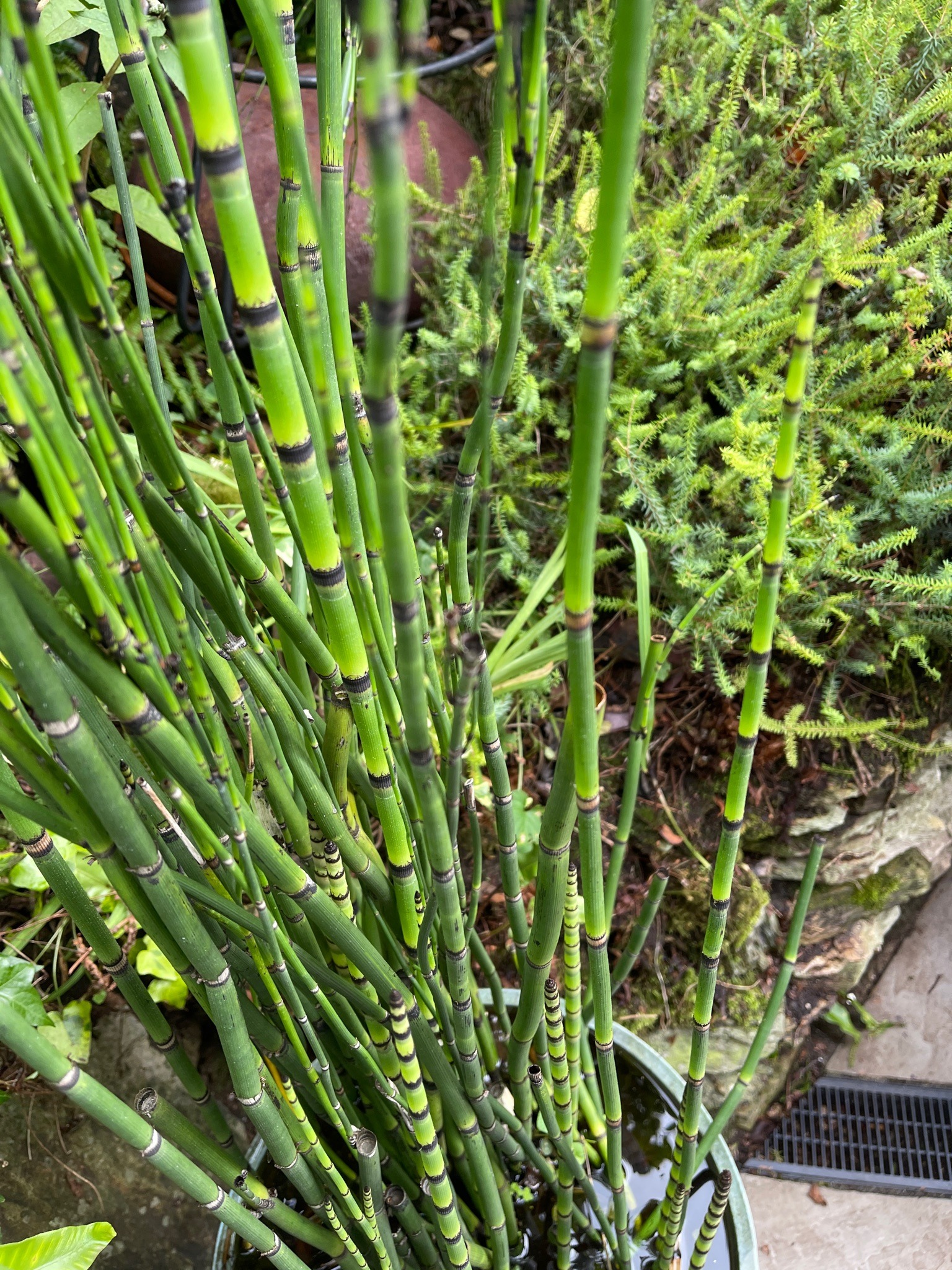
Horsetail Reed
Equisetum hyemale
A striking, prehistoric-looking perennial fern ally featuring hollow, jointed, bright green vertical stems marked with distinct dark bands at the nodes.
- Light
- Full sun to partial shade, receiving at least 6 hours of direct sunlight daily for optimal green coloration.
- Water
- Requires extremely high moisture levels. Best grown in saturated soils, bog gardens, or standing water up to a few inches deep; never allow the soil to dry out.
- Growth
- An herbaceous perennial that spreads rapidly via underground rhizomes, forming dense vertical colonies reaching 2 to 4 feet in height with a moderate to fast spread.
Care instructions
Grow in full sun to partial shade with consistently wet soil or standing water. Feed sparingly with a balanced liquid fertilizer during the active growing season.
Growing details
Sunlight
Full sun to partial shade, receiving at least 6 hours of direct sunlight daily for optimal green coloration.
Watering
Requires extremely high moisture levels. Best grown in saturated soils, bog gardens, or standing water up to a few inches deep; never allow the soil to dry out.
Soil
Prefers heavy, clay-rich, or loamy soils that retain moisture well, with a broad pH tolerance ranging from acidic to alkaline (5.5 to 7.5).
Hardiness zone
USDA zones 4 through 9, demonstrating robust cold tolerance through winter.
Growth habit
An herbaceous perennial that spreads rapidly via underground rhizomes, forming dense vertical colonies reaching 2 to 4 feet in height with a moderate to fast spread.
Bloom season
Non-flowering; reproduces via spores produced in cone-like strobili at the stem tips rather than producing flowers or seeds.
Propagation
Easily propagated by root division in spring or autumn by separating sections of the creeping rhizomes and planting them directly into saturated soil.
Common pests & issues
Generally resistant to pests and diseases due to the high silica content in the stems; however, container-grown plants may occasionally attract spider mites in dry indoor environments.
Similar species
Scouring rush (Equisetum praealtum) is very similar, though Equisetum hyemale typically has darker bands at the stem nodes and slightly sturdier stems.