
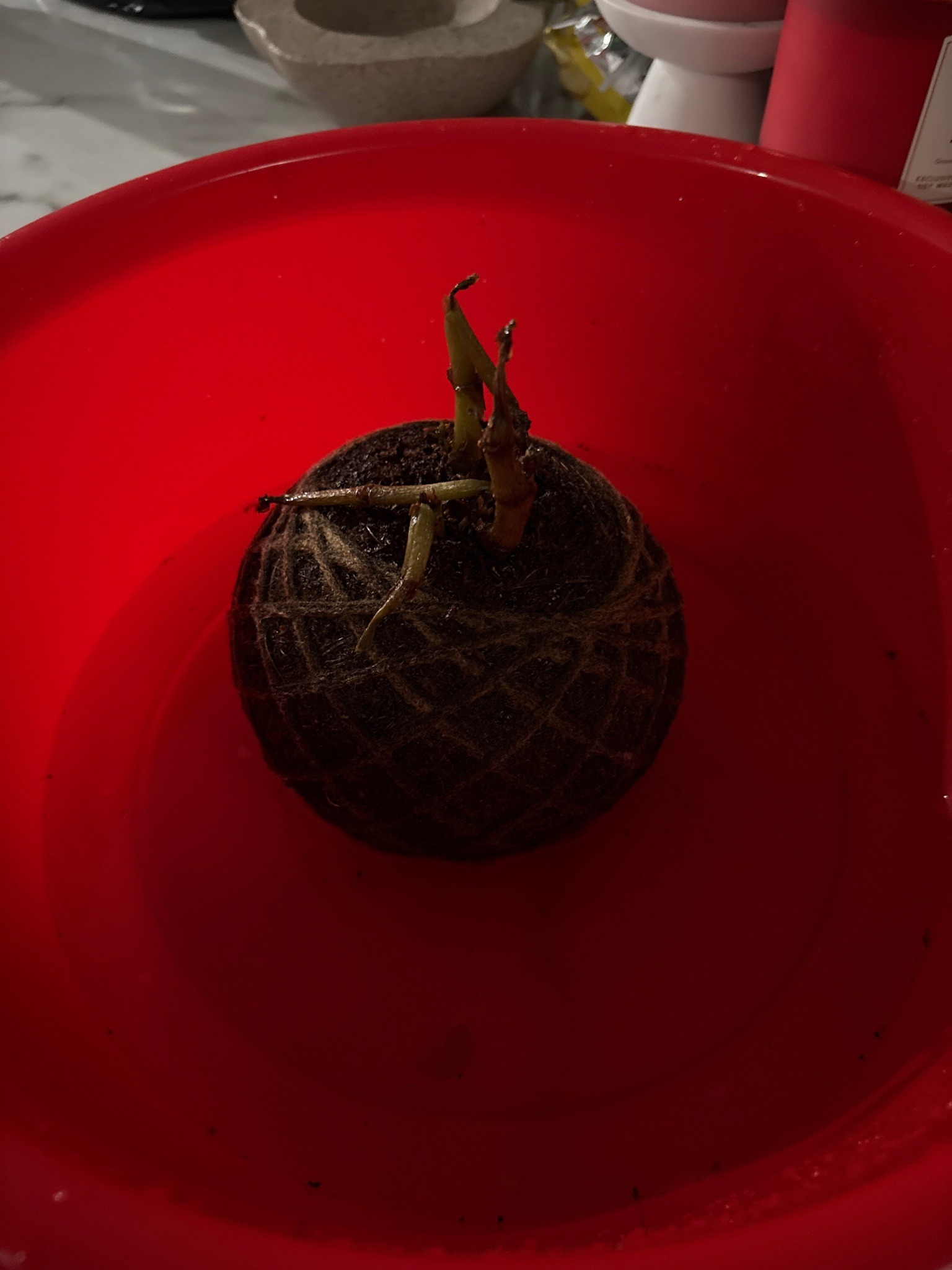
Kokedama (Japanese Moss Ball)
Not applicable
A traditional Japanese horticultural technique where a plant's root system is wrapped in peat-rich soil and sheet moss, bound tightly with string or twine to form a decorative spherical mass.
- Light
- Bright, indirect light for 6 to 8 hours per day; avoid harsh direct sunlight which can scorch the moss and internal plant foliage.
- Water
- Water thoroughly once every 1 to 2 weeks by immersing the entire moss ball in a basin of water for 10 to 15 minutes until heavy, then allow to drain completely.
- Growth
- Compact, spherical display form with dimensions determined by the size of the central root ball and the specific plant species growing from the top.
Care instructions
Submerge the moss ball in water until fully saturated when the sphere feels light and dry. Provide bright, indirect indoor lighting and mist the outer moss layer regularly to maintain green color and prevent drying.
Growing details
Sunlight
Bright, indirect light for 6 to 8 hours per day; avoid harsh direct sunlight which can scorch the moss and internal plant foliage.
Watering
Water thoroughly once every 1 to 2 weeks by immersing the entire moss ball in a basin of water for 10 to 15 minutes until heavy, then allow to drain completely.
Soil
A mixture of peat moss and keto-tsuchi (special Japanese bonsai soil or heavy clay-rich soil) capable of holding shape and moisture well, with a neutral to slightly acidic pH range of 6.0 to 6.8.
Hardiness zone
Usually maintained indoors; outdoor suitability depends entirely on the specific plant species housed within the moss sphere, typically zones 9 to 11 if tropical.
Growth habit
Compact, spherical display form with dimensions determined by the size of the central root ball and the specific plant species growing from the top.
Bloom season
Not applicable
Propagation
Not applicable
Common pests & issues
Outer moss drying out due to low humidity, or fungal growth and root decline caused by over-submersion without sufficient drying periods between waterings.
Similar species
Wardian cases and traditional potted container gardening, distinguished by the complete absence of a rigid pot and the exposed root-ball wrapped exterior.