
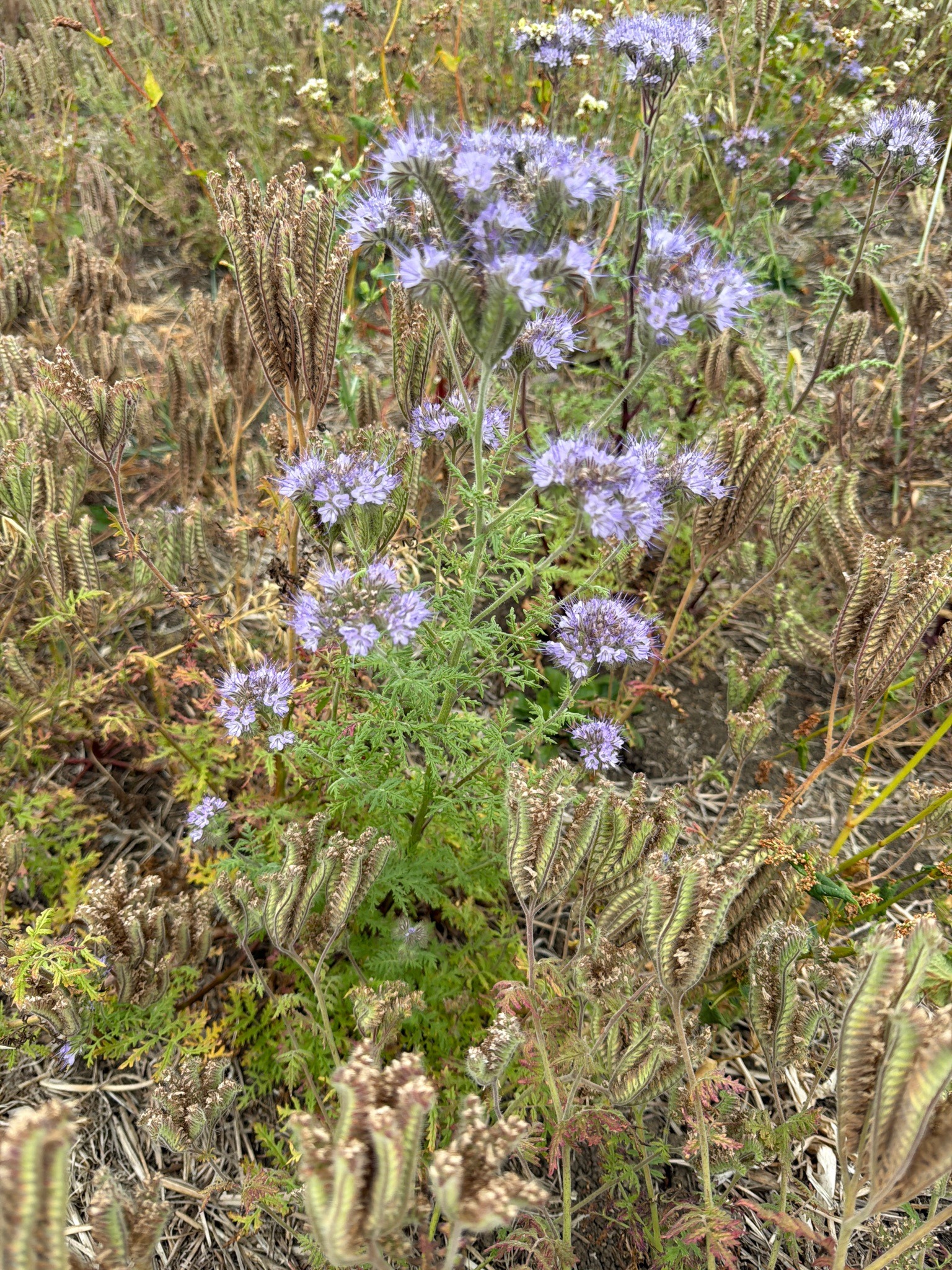
Lacy Phacelia
Phacelia tanacetifolia
An herbaceous annual plant featuring deeply divided, fern-like green foliage and characteristic one-sided, curved flower clusters that open into lavender to purple bell-shaped blossoms with prominent protruding stamens.
- Light
- Full sun, requiring at least six hours of direct sunlight daily
- Water
- Low to moderate water requirements; allow the soil to dry out significantly between watering sessions. Overwatering can lead to root rot.
- Growth
- Upright herbaceous annual growing to a mature height of 1 to 3 feet with a spread of about 1 foot, featuring a moderate growth rate.
Care instructions
Provide full sun exposure in well-draining soil. Water sparingly once established as the plant is moderately drought-tolerant. Avoid heavy fertilizers, as poor to average soil often yields the best structural growth.
Growing details
Sunlight
Full sun, requiring at least six hours of direct sunlight daily
Watering
Low to moderate water requirements; allow the soil to dry out significantly between watering sessions. Overwatering can lead to root rot.
Soil
Prefers sandy or loamy, well-draining soils with a neutral to slightly alkaline pH, though it adapts well to poor soils.
Hardiness zone
USDA hardiness zones 3 through 10 as an annual
Growth habit
Upright herbaceous annual growing to a mature height of 1 to 3 feet with a spread of about 1 foot, featuring a moderate growth rate.
Bloom season
Spring through early summer, producing dense, curved, scorpioid cymes of lavender-blue flowers.
Propagation
Propagated strictly via seeds sown directly into the garden bed in early spring or autumn, as the seedlings do not transplant well.
Common pests & issues
Generally trouble-free, but may occasionally encounter powdery mildew or root rot if grown in poorly draining, overly wet soils.
Similar species
Other members of the Phacelia genus, such as Phacelia campanularia, which can be distinguished by broader, less dissected leaves and more intense blue bell-shaped flowers.