
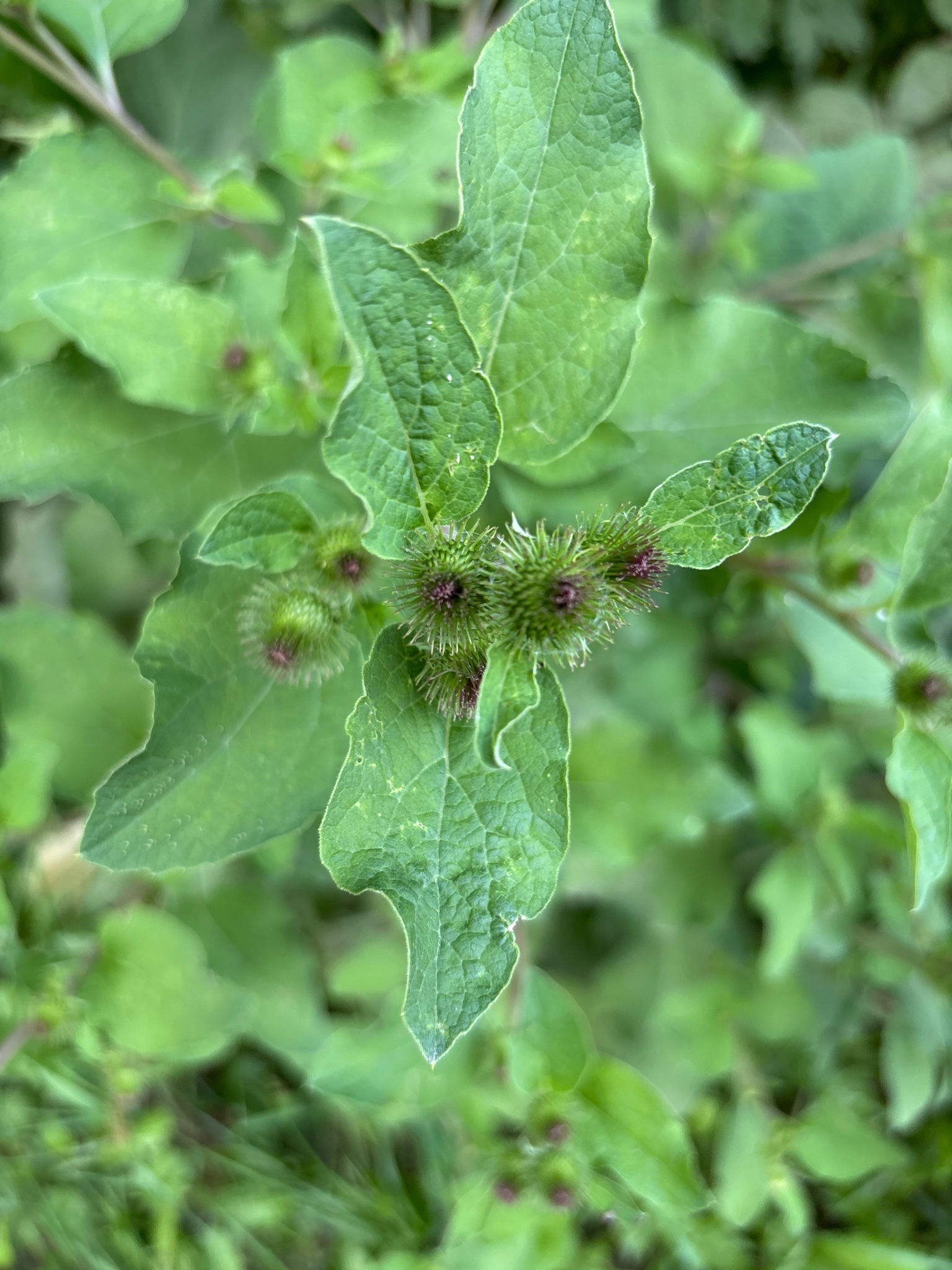
Lesser Burdock
Arctium minus
A biennial herb featuring large, ovate, wavy-edged basal and alternate cauline leaves, and distinctive spherical flower heads covered in hooked bracts that develop into clingy burrs.
- Light
- Full sun to partial shade, requiring at least 6 hours of direct sunlight daily for optimal growth.
- Water
- Moderate watering needs. Water deeply when the top few inches of soil become dry. Drought tolerant once established.
- Growth
- Biennial plant forming a low rosette of large leaves in the first year, followed by a branching flowering stalk reaching 3 to 5 feet in height during the second year.
Care instructions
Prefers full sun to partial shade and adapts to various well-draining soils. Water moderately during establishment, as mature plants tolerate occasional dry periods. Typically managed as a wild or naturalized herb rather than a cultivated garden plant.
Growing details
Sunlight
Full sun to partial shade, requiring at least 6 hours of direct sunlight daily for optimal growth.
Watering
Moderate watering needs. Water deeply when the top few inches of soil become dry. Drought tolerant once established.
Soil
Thrives in rich, loamy, or clay soils with good drainage, but adapts well to disturbed soils. Prefers a neutral to slightly alkaline pH range (6.0 to 7.5).
Hardiness zone
USDA hardiness zones 3 through 9.
Growth habit
Biennial plant forming a low rosette of large leaves in the first year, followed by a branching flowering stalk reaching 3 to 5 feet in height during the second year.
Bloom season
Flowers from mid-summer to early autumn, producing small purple or pinkish tubular florets enclosed in spherical, hook-tipped burrs.
Propagation
Propagates readily by seed. The hooked burrs attach to passing animals and clothing, dispersing seeds over wide distances.
Common pests & issues
Susceptible to powdery mildew and leaf spot fungal diseases in damp conditions, and occasionally targeted by aphids or caterpillars.
Similar species
Greater Burdock (Arctium lappa), which is generally larger with longer flower stalks, and Common Cocklebur (Xanthium strumarium), which has different leaf shapes and separate male and female flower structures.