
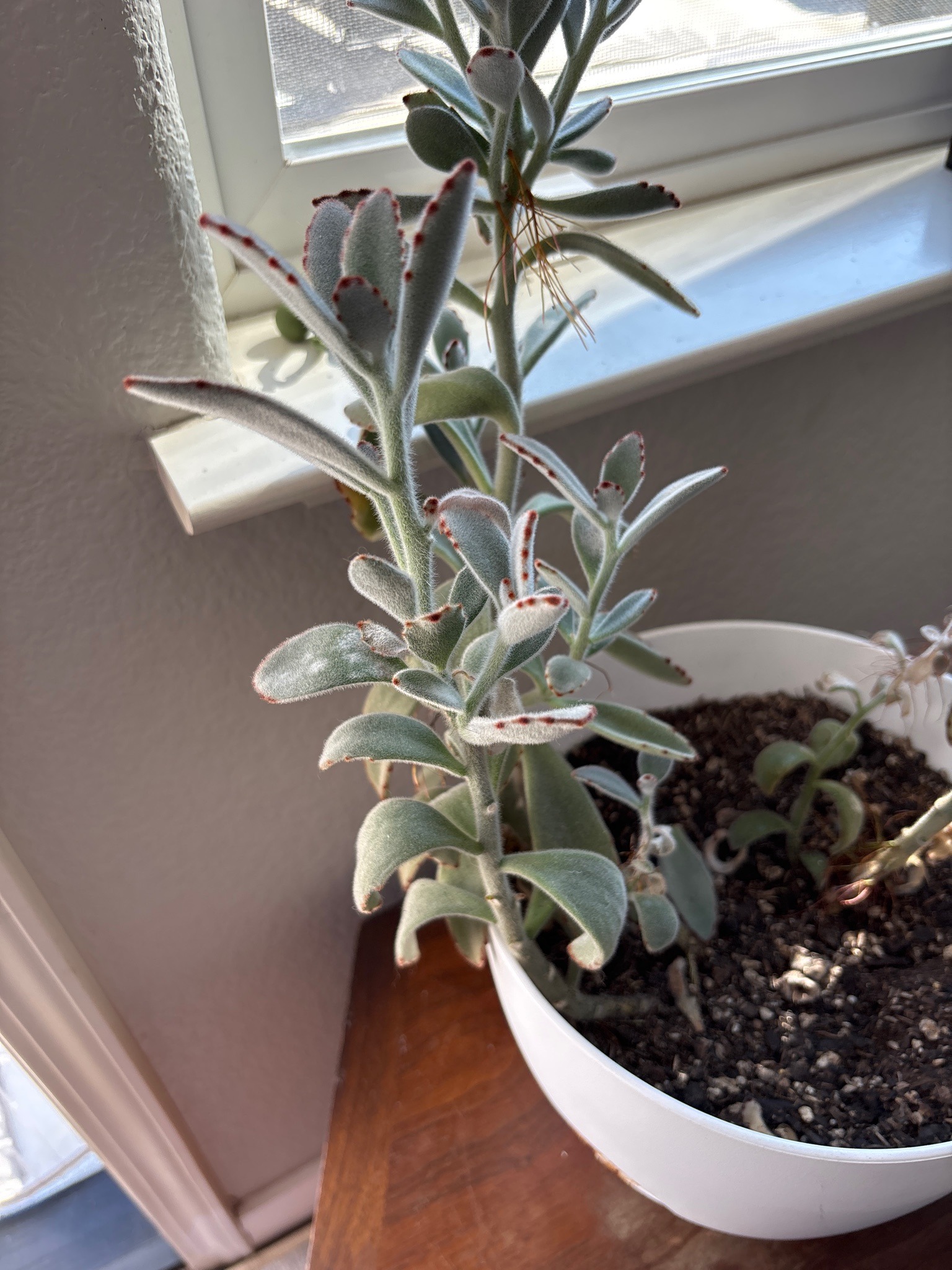
Panda Plant
Kalanchoe tomentosa
An upright, branching succulent featuring thick, silvery-green leaves covered in soft, velvety white hairs and distinctive dark brown to rusty-red spots along the leaf margins and tips.
- Light
- Full sun to bright indirect light, around 6 hours per day.
- Water
- Low water requirements. Allow the potting medium to dry out completely between waterings. Reduce watering significantly during the winter months.
- Growth
- An evergreen perennial succulent with an upright, branching shrubby growth habit. Typically reaches mature heights of 1 to 2.5 feet with a similar spread under optimal container conditions.
Care instructions
Provide bright, indirect to direct sunlight for at least 6 hours a day. Water thoroughly only when the soil has completely dried out, using the soak-and-dry method. Plant in a fast-draining succulent or cactus potting mix. Fertilize lightly during the active spring and summer growing seasons with a balanced, diluted liquid fertilizer.
Growing details
Sunlight
Full sun to bright indirect light, around 6 hours per day.
Watering
Low water requirements. Allow the potting medium to dry out completely between waterings. Reduce watering significantly during the winter months.
Soil
Fast-draining, coarse sandy or gravelly succulent potting mix with a neutral to slightly acidic pH range of 6.0 to 7.0.
Hardiness zone
USDA zones 10 through 12, as it is sensitive to frost and freezing temperatures.
Growth habit
An evergreen perennial succulent with an upright, branching shrubby growth habit. Typically reaches mature heights of 1 to 2.5 feet with a similar spread under optimal container conditions.
Bloom season
Rarely blooms indoors. When grown outdoors in ideal conditions, it produces small, bell-shaped, brownish-green or yellowish flowers in late spring or summer.
Propagation
Easily propagated through leaf cuttings or stem cuttings allowed to callus over for a few days before being placed in dry, well-draining propagation medium.
Common pests & issues
Prone to root rot if overwatered or kept in poorly draining soil. Mealybugs and scale insects can occasionally target the foliage, which can be managed by removing them manually or using targeted treatments.
Similar species
Kalanchoe beharensis (Felt Bush), which features much larger, triangular leaves with ruffled edges, and Kalanchoe orgyalis (Copper Spoon), which has copper-colored foliage.