
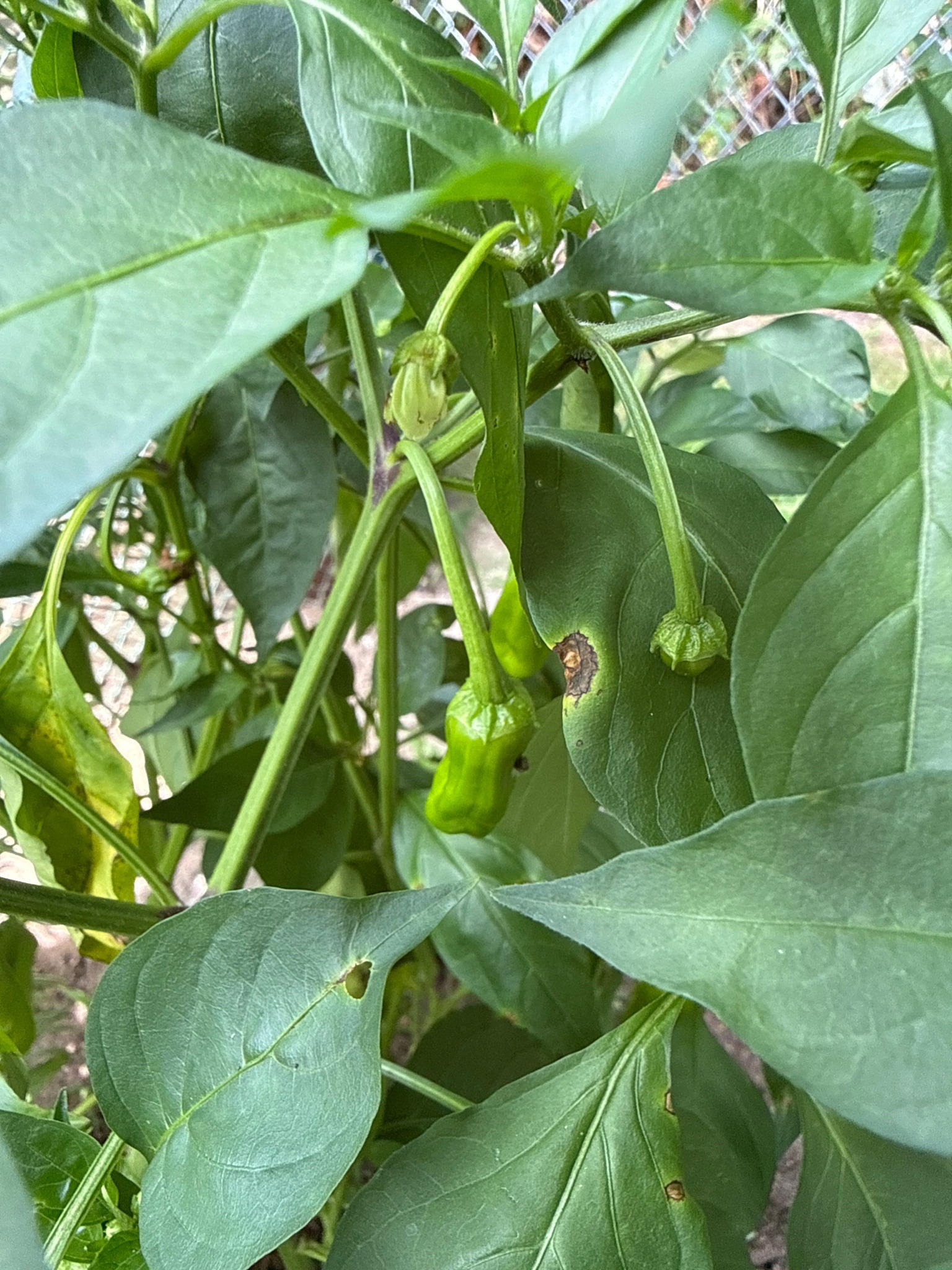
Pepper
Capsicum annuum
A bushy herbaceous subshrub featuring dark green foliage, small white or greenish flowers, and pendulous glossy green fruits that mature into red, yellow, orange, or brown forms.
- Light
- Full sun, requiring at least 6 to 8 hours of direct light daily.
- Water
- Requires regular watering to maintain consistent soil moisture. Water deeply when the top inch of soil feels dry. Avoid overhead watering to reduce foliage disease.
- Growth
- Upright, branching tender perennial grown as an annual. Reaches 1.5 to 3 feet in height with a spread of 1 to 2 feet.
Care instructions
Provide full sun and well-draining, organic-rich soil. Water consistently to keep the soil evenly moist but never waterlogged. Apply a balanced fertilizer during early growth and transition to a lower-nitrogen, higher-phosphorus formulation once flowering and fruiting begin.
Growing details
Sunlight
Full sun, requiring at least 6 to 8 hours of direct light daily.
Watering
Requires regular watering to maintain consistent soil moisture. Water deeply when the top inch of soil feels dry. Avoid overhead watering to reduce foliage disease.
Soil
Prefers warm, fertile, sandy-loam or loamy soil rich in organic matter. Optimal pH range is 6.0 to 6.8.
Hardiness zone
USDA zones 9 through 11 as a perennial; commonly grown globally as a tender annual.
Growth habit
Upright, branching tender perennial grown as an annual. Reaches 1.5 to 3 feet in height with a spread of 1 to 2 feet.
Bloom season
Late spring through summer into autumn. Flowers are small, star-shaped, white to cream-colored, typically borne individually at node joints.
Propagation
Propagated primarily by seed sown indoors 6-8 weeks before the last spring frost date.
Common pests & issues
Susceptible to aphids, spider mites, blossom end rot (caused by inconsistent watering/calcium deficiency), bacterial leaf spot, and powdery mildew.
Similar species
Capsicum chinense (Habenero/Ghost types) and Capsicum baccatum (Aji types), which differ in flower petal coloration, calyx morphology, and node branching density.