
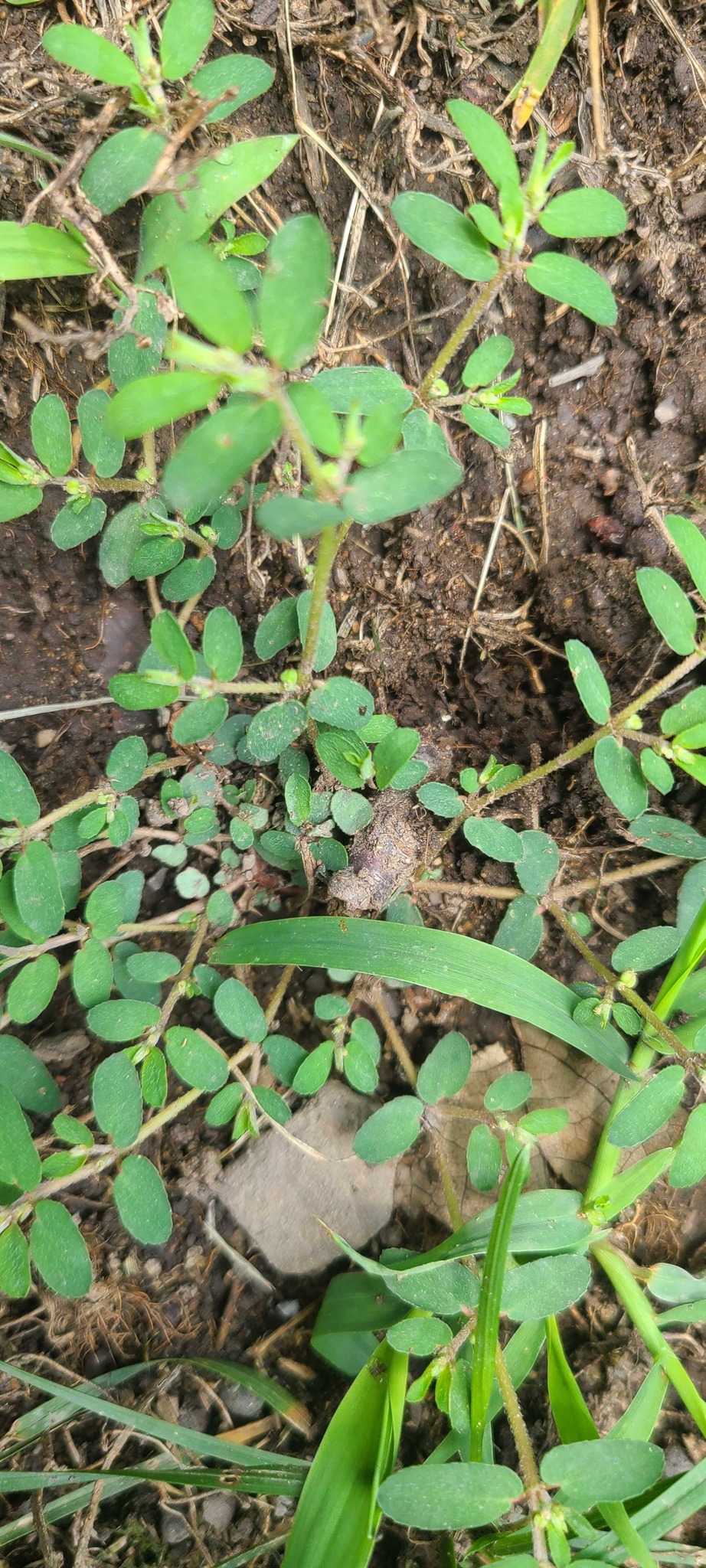
Prostrate Spurge
Euphorbia prostrata
A low-growing, mat-forming annual weed with reddish stems that exude a milky white sap when broken. The small, oval leaves are arranged in pairs opposite each other along the stems.
- Light
- Full sun to partial shade; prefers at least 6 hours of direct light.
- Water
- Low watering needs; highly drought-tolerant. Over-watering can lead to root rot in compacted soils.
- Growth
- Prostrate, mat-forming annual. Stems can reach up to 8-10 inches in length but rarely rise more than an inch off the ground.
Care instructions
Rarely cultivated intentionally as it is used as a medicinal herb or treated as a weed. It thrives in neglected areas with full sun and minimal water. If growing, provide well-drained soil and avoid over-watering.
Growing details
Sunlight
Full sun to partial shade; prefers at least 6 hours of direct light.
Watering
Low watering needs; highly drought-tolerant. Over-watering can lead to root rot in compacted soils.
Soil
Prefers dry, sandy, or gravelly soils but can grow in almost any soil type with a pH of 5.5 to 8.0.
Hardiness zone
Typically grows as a summer annual in zones 4-11, though it can survive as a perennial in frost-free climates.
Growth habit
Prostrate, mat-forming annual. Stems can reach up to 8-10 inches in length but rarely rise more than an inch off the ground.
Bloom season
Summer through early fall; produces tiny, inconspicuous green or pinkish flowers (cyathia) in the leaf axils.
Propagation
Primarily by seed; a single plant can produce thousands of seeds that remain viable in the soil for years.
Common pests & issues
Few pests bother it due to its toxic sap, but it is a frequent host for powdery mildew in humid conditions.
Similar species
Spotted Spurge (Euphorbia maculata) which usually has a dark red spot in the center of the leaf, and Petty Spurge (Euphorbia peplus) which grows more upright.