
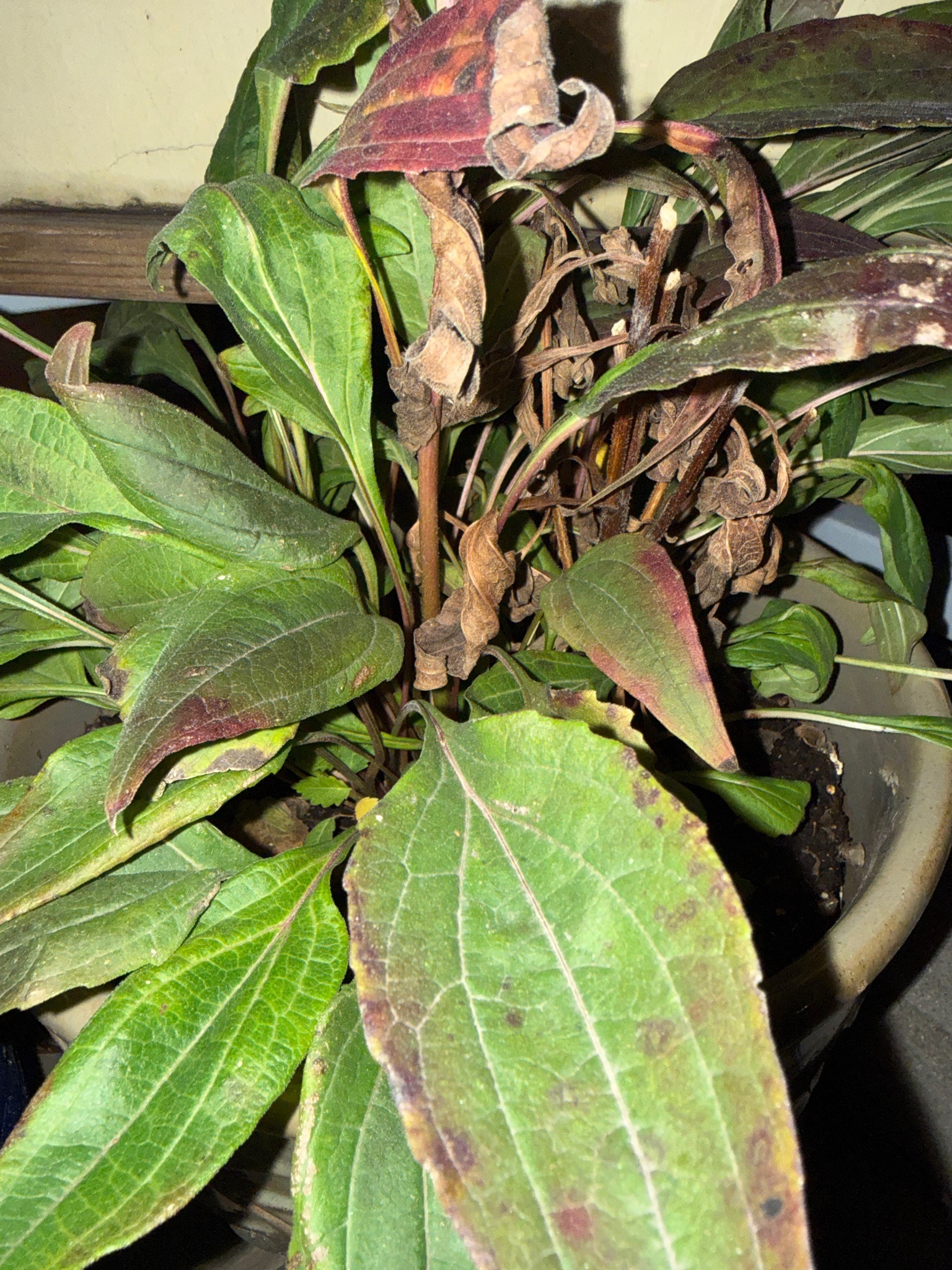
Purple Coneflower
Echinacea purpurea
An herbaceous perennial featuring coarse, lance-shaped to broad ovate green leaves with prominent veins, branching stems, and basal foliage clusters showing some marginal browning and dieback.
- Light
- Full sun, requiring at least six to eight hours of direct sunlight daily for optimal growth and flowering
- Water
- Moderate drought tolerance once established. Water thoroughly whenever the soil dries out completely. Avoid waterlogged conditions to prevent root issues.
- Growth
- Herbaceous perennial forming upright clumps with a mature height of 2 to 4 feet and a spread of 1.5 to 2 feet, featuring a moderate growth rate
Care instructions
Provide full sun to partial shade in well-draining soil. Water deeply when the top two inches of soil feel dry, allowing the medium to dry out between waterings. Apply a balanced slow-release fertilizer in early spring.
Growing details
Sunlight
Full sun, requiring at least six to eight hours of direct sunlight daily for optimal growth and flowering
Watering
Moderate drought tolerance once established. Water thoroughly whenever the soil dries out completely. Avoid waterlogged conditions to prevent root issues.
Soil
Prefers loamy, sandy, or well-draining clay soils with a neutral pH range between 6.0 and 7.0
Hardiness zone
USDA zones 3 through 9, exhibiting strong cold tolerance and moderate heat resilience
Growth habit
Herbaceous perennial forming upright clumps with a mature height of 2 to 4 feet and a spread of 1.5 to 2 feet, featuring a moderate growth rate
Bloom season
Flowers from mid-summer to late autumn, producing prominent daisy-like heads with pink to purple ray petals curving downward around a spiny central cone
Propagation
Propagated successfully via seeds sown in spring, root division in early spring or autumn, or stem cuttings taken during active growth phases
Common pests & issues
Susceptible to powdery mildew, leaf spot, and aphid infestations, which can be prevented by ensuring good air circulation and avoiding overhead watering
Similar species
Rudbeckia fulgida (Black-eyed Susan), which features bright yellow ray petals rather than the distinct purple or pink petals of Echinacea purpurea