
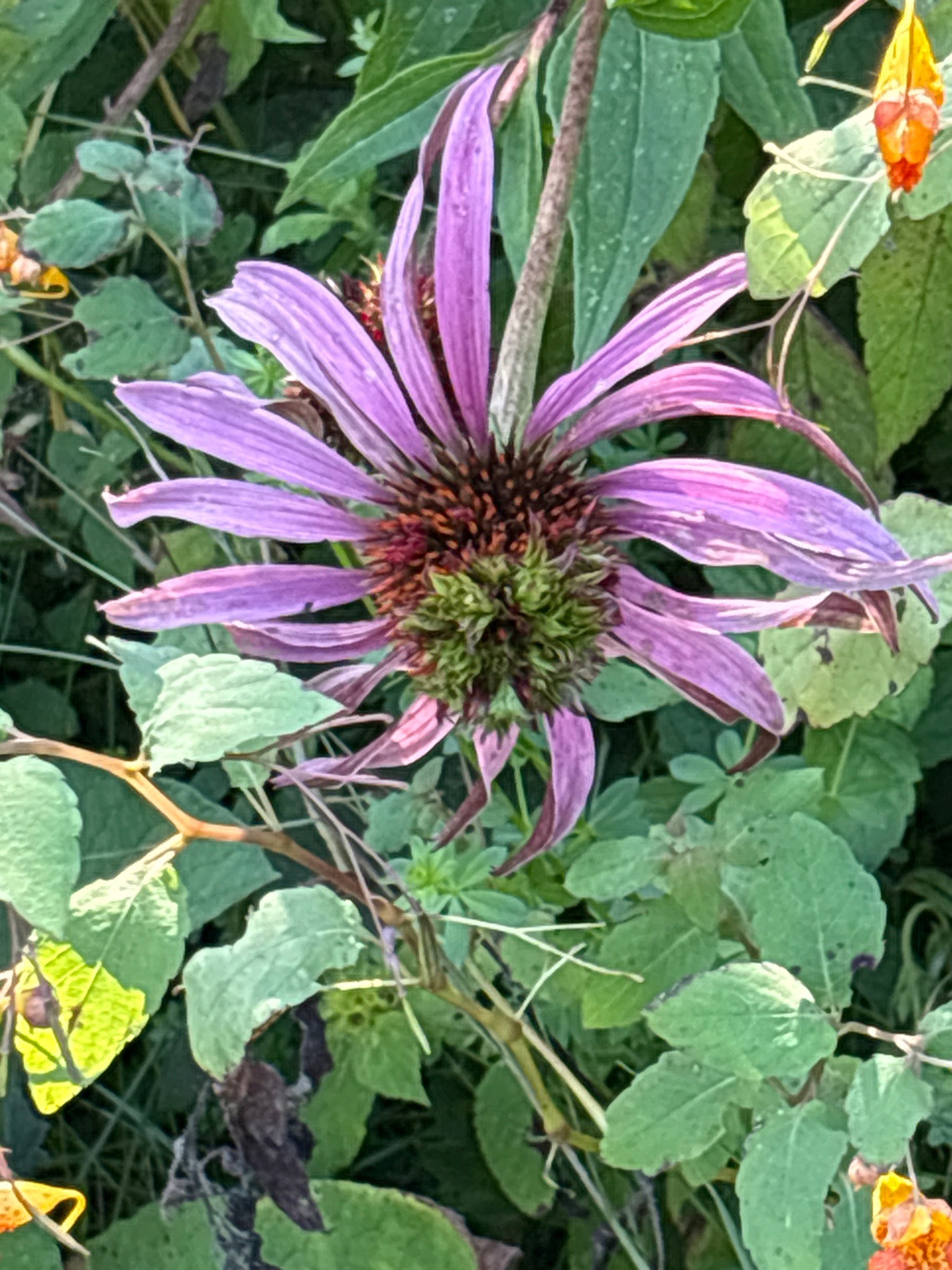
Purple Coneflower
Echinacea purpurea
A herbaceous perennial featuring large daisy-like flowers with distinctive drooping purple to pink petals and a prominent, spiny, brownish-orange central cone. Note that the specimen pictured displays aster yellows phytoplasma symptoms, causing petal-like distortion and green leafy proliferation in the central cone.
- Light
- Full sun, requiring 6 to 8 hours of direct sunlight daily
- Water
- Moderate drought tolerance once established; water when the top few inches of soil become dry, avoiding waterlogged conditions.
- Growth
- Herbaceous perennial with an upright, clump-forming habit, growing 2 to 4 feet tall with a spread of 1.5 to 2 feet, exhibiting a moderate growth rate.
Care instructions
Provide full sun to partial shade and plant in well-draining soil. Water deeply during establishment, and apply a balanced fertilizer in early spring if soil fertility is low.
Growing details
Sunlight
Full sun, requiring 6 to 8 hours of direct sunlight daily
Watering
Moderate drought tolerance once established; water when the top few inches of soil become dry, avoiding waterlogged conditions.
Soil
Adaptable to various soil types including clay, loam, and sand, provided there is good drainage. Prefers a neutral pH range between 6.0 and 7.0.
Hardiness zone
USDA Hardiness Zones 3 through 9
Growth habit
Herbaceous perennial with an upright, clump-forming habit, growing 2 to 4 feet tall with a spread of 1.5 to 2 feet, exhibiting a moderate growth rate.
Bloom season
Blooms from early summer through late summer, featuring prominent pink-to-purple ray florets surrounding a raised cone.
Propagation
Propagated easily by seed sown in spring, root cuttings, or division of mature clumps in early spring or autumn.
Common pests & issues
Generally resilient, but susceptible to powdery mildew, leaf spots, and aster yellows (a disease caused by phytoplasmas resulting in distorted green flower structures as seen in the image). Manage by ensuring good air circulation and removing affected plants.
Similar species
Pale purple coneflower (Echinacea pallida), which features narrower, significantly drooping petals and a taproot system rather than fibrous roots.