
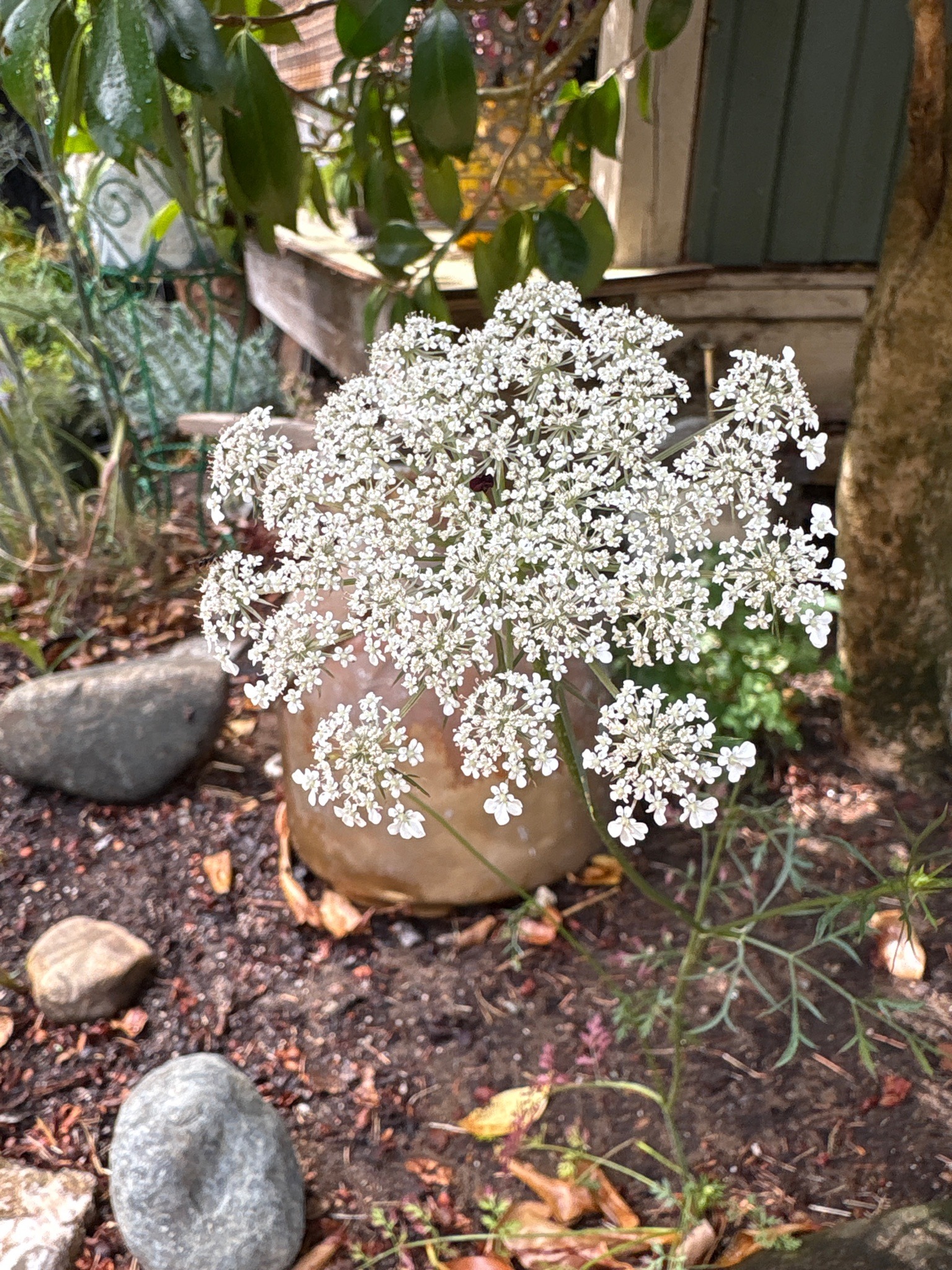
Queen Anne's Lace
Daucus carota
A herbaceous biennial featuring lace-like compound umbels of tiny white flowers, typically centered by a single dark purple or red floret, supported by finely dissected, fern-like foliage and hairy stems.
- Light
- Full sun to partial shade (at least 4 to 6 hours of direct light daily).
- Water
- Low to moderate. Drought-tolerant once established; water during extended dry spells.
- Growth
- Biennial herb. First-year growth forms a basal rosette of leaves; second year sends up erect, branched, hairy flowering stems reach 1 to 4 feet in height.
Care instructions
Plant in full sun to light shade in well-draining soil. Water occasionally during dry periods once established; it requires very little maintenance and tolerates poor soil conditions.
Growing details
Sunlight
Full sun to partial shade (at least 4 to 6 hours of direct light daily).
Watering
Low to moderate. Drought-tolerant once established; water during extended dry spells.
Soil
Prefers well-drained loamy, sandy, or clay soils with a neutral to slightly alkaline pH (6.5 to 7.5).
Hardiness zone
USDA Zones 3 through 9.
Growth habit
Biennial herb. First-year growth forms a basal rosette of leaves; second year sends up erect, branched, hairy flowering stems reach 1 to 4 feet in height.
Bloom season
Late spring through summer (May to September). Flowers are small, white, and arranged in flat to slightly domed compound umbels, often with a distinct dark central spot.
Propagation
Propagates readily by seed sown directly in early spring or autumn.
Common pests & issues
Generally trouble-free; occasionally susceptible to powdery mildew, leaf blight, or aphid infestations in damp or overcrowded conditions.
Similar species
Poison hemlock (Conium maculatum) has smooth, purple-spotted stems without hair, unlike the hairy green stems of Daucus carota. Wild parsnip (Pastinaca sativa) has yellow flowers.