
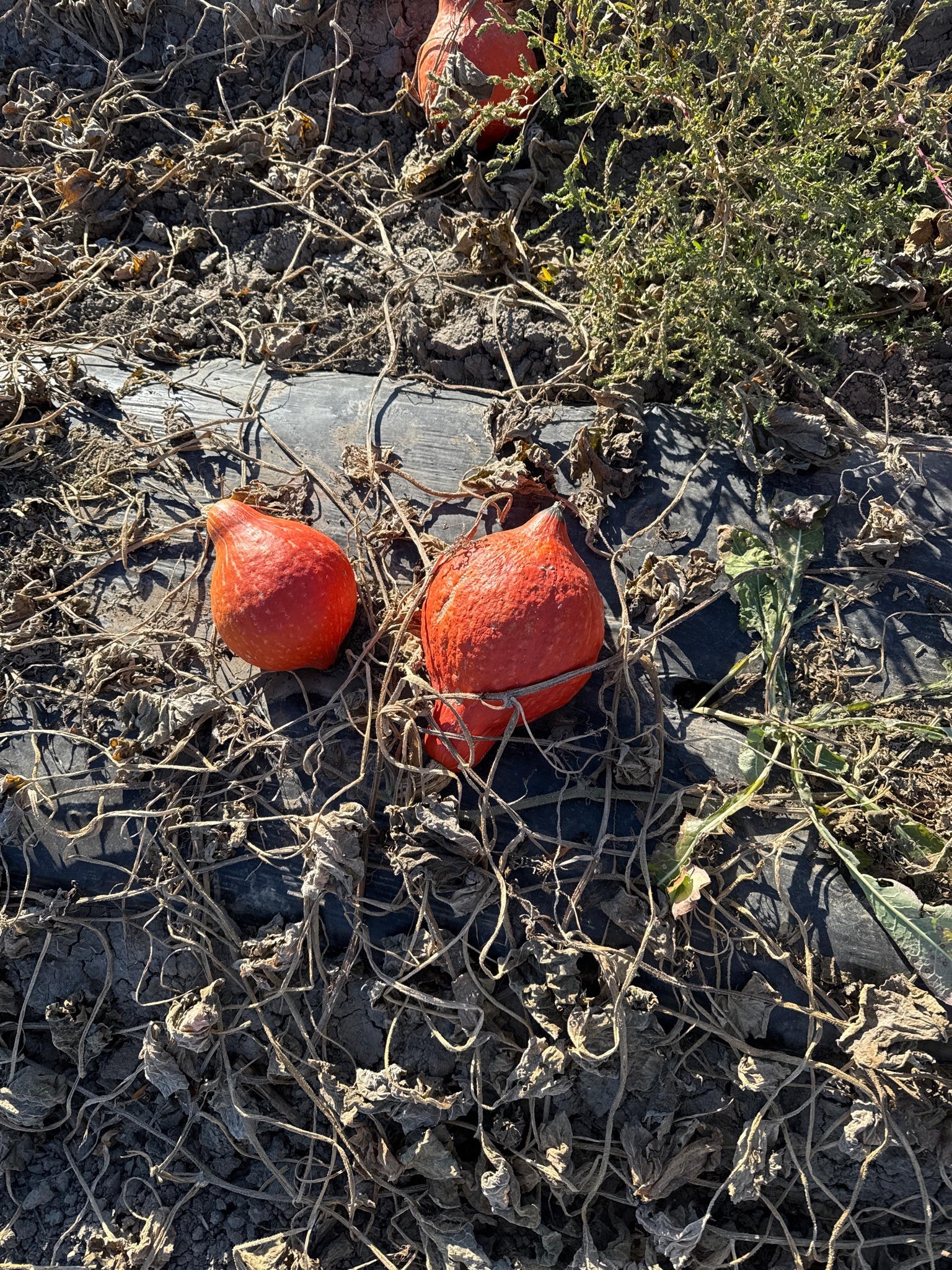
Red Kuri Squash
Cucurbita maxima
A vining herbaceous plant producing teardrop-shaped fruits with smooth, vibrant reddish-orange rind and deep yellow-orange interior flesh.
- Light
- Full sun, requiring at least 6 to 8 hours of direct sunlight daily.
- Water
- Requires regular and consistent watering, about 1 inch of water per week, allowing soil to dry slightly between waterings; avoid wetting the foliage to prevent fungal issues.
- Growth
- A sprawling, vine-forming annual plant that spreads extensively across the ground, reaching vines up to 10 to 15 feet long.
Care instructions
Provide full sun exposure, consistent moisture via regular watering at the base, and plant in rich, well-draining soil with balanced organic fertilizer applications during the growing season.
Growing details
Sunlight
Full sun, requiring at least 6 to 8 hours of direct sunlight daily.
Watering
Requires regular and consistent watering, about 1 inch of water per week, allowing soil to dry slightly between waterings; avoid wetting the foliage to prevent fungal issues.
Soil
Rich, loamy, well-draining soil with high organic matter content and a neutral pH range between 6.0 and 6.8.
Hardiness zone
Typically grown as an annual across USDA Hardiness Zones 3 through 11.
Growth habit
A sprawling, vine-forming annual plant that spreads extensively across the ground, reaching vines up to 10 to 15 feet long.
Bloom season
Flowers during mid-summer, producing large, bright yellow, funnel-shaped monoecious flowers.
Propagation
Propagated primarily from seeds sown directly into warm soil after the final frost date or started indoors 3 to 4 weeks prior.
Common pests & issues
Susceptible to powdery mildew, downy mildew, vine borers, and cucumber beetles; prevent with proper spacing, crop rotation, and floating row covers.
Similar species
Other winter squash varieties such as Buttercup squash and Kabocha squash, distinguished primarily by rind texture, color variations, and fruit shape.