
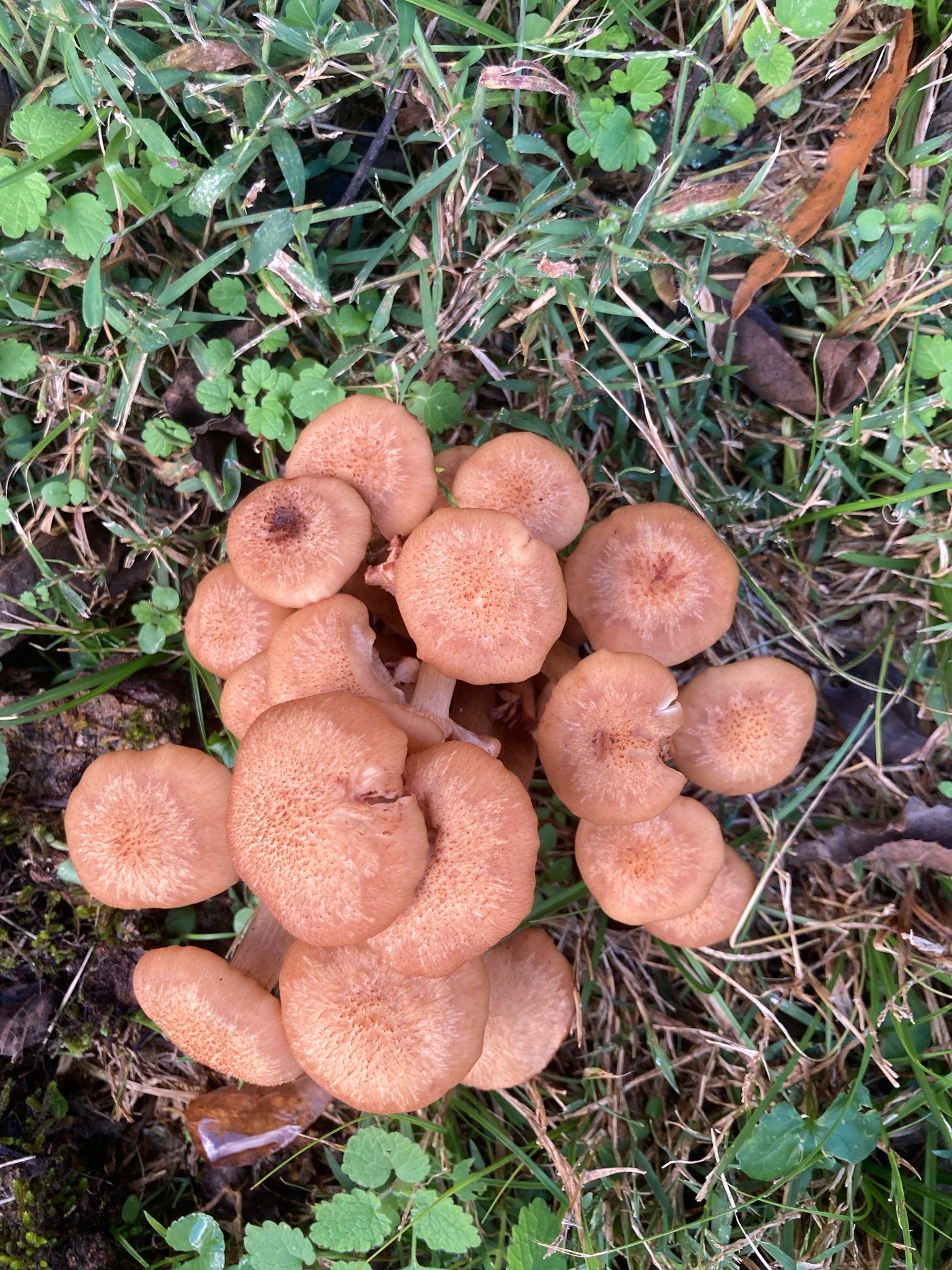
Ringless Honey Mushroom
Desarmillaria tabescens
Forms dense clusters of mushrooms with convex to flat, honey-brown caps covered in tiny dark scales, growing directly from buried wood or tree roots.
- Light
- Shaded to partially shaded environments, typically growing beneath forest canopies or near decaying wood.
- Water
- Requires high moisture in the surrounding soil and decaying wood substrate to support fungal fruiting body development.
- Growth
- Fungal organism producing seasonal clustered epigeous fruiting bodies from subterranean mycelial networks.
Care instructions
This is a fungus rather than a cultivated green plant, growing saprophytically or parasitically on woody substrates in forested or garden soils.
Growing details
Sunlight
Shaded to partially shaded environments, typically growing beneath forest canopies or near decaying wood.
Watering
Requires high moisture in the surrounding soil and decaying wood substrate to support fungal fruiting body development.
Soil
Rich forest soils containing abundant organic matter, buried wood, and decaying root systems with a slightly acidic to neutral pH.
Hardiness zone
USDA Hardiness Zones 3 through 9.
Growth habit
Fungal organism producing seasonal clustered epigeous fruiting bodies from subterranean mycelial networks.
Bloom season
Not applicable
Propagation
Propagates naturally via microscopic spores released from the gills of mature caps, as well as vegetative spread of underground mycelium.
Common pests & issues
Acts as a pathogen on living trees while also functioning as a saprobe on dead wood, occasionally causing root rot in surrounding woody vegetation.
Similar species
Armillaria mellea (Honey Fungus), which typically features a distinct ring on the stipe, whereas Desarmillaria tabescens completely lacks a ring.
User notes
Near a very old tree that is dead