
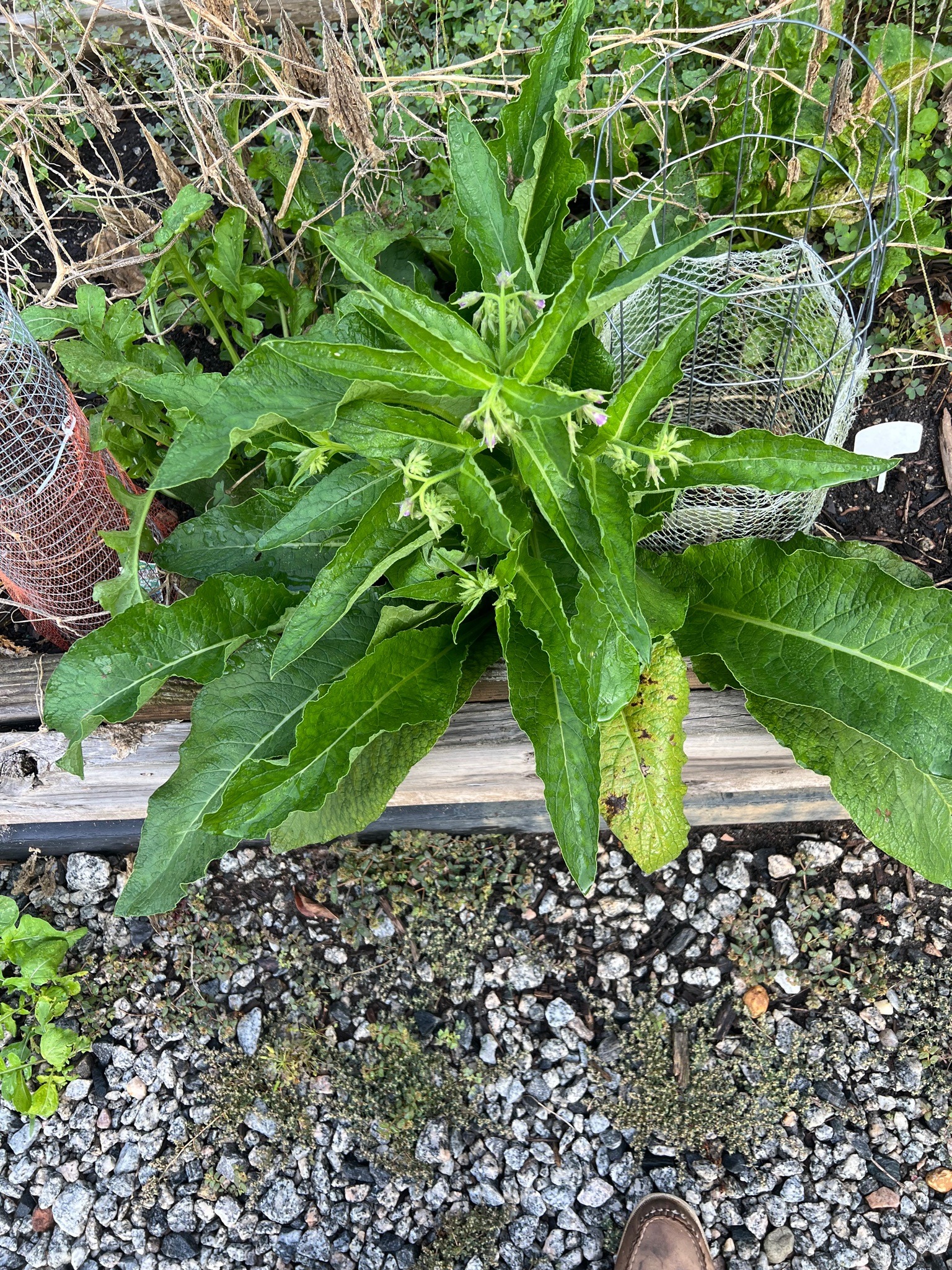
Russian comfrey
Symphytum x uplandicum
Russian comfrey is a large, herbaceous perennial forming a clump of coarse, hairy, dark green leaves with wavy margins. It produces clusters of small, bell-shaped flowers that open from pink or purple buds into shades of blue, purple, or cream.
- Light
- Full sun to partial shade, requiring at least 6 hours of direct sunlight daily for optimal growth.
- Water
- Prefers consistently moist soil. Water deeply during dry periods. Established plants have deep taproots that provide moderate drought tolerance, but prolonged dryness reduces foliage yield.
- Growth
- Herbaceous perennial growing in a dense, upright clump. Reaches a mature height of 2 to 4 feet with an equal or slightly wider spread. Displays a very rapid growth rate once established.
Care instructions
Provide full sun to partial shade in moist, fertile, well-draining soil. Water regularly during dry spells to maintain consistent soil moisture. Apply a balanced organic fertilizer in spring to support robust foliage development.
Growing details
Sunlight
Full sun to partial shade, requiring at least 6 hours of direct sunlight daily for optimal growth.
Watering
Prefers consistently moist soil. Water deeply during dry periods. Established plants have deep taproots that provide moderate drought tolerance, but prolonged dryness reduces foliage yield.
Soil
Thrives in deep, rich, organic-rich loamy soils with excellent drainage and a neutral pH range between 6.0 and 7.0.
Hardiness zone
USDA hardiness zones 3 through 9, demonstrating high cold hardiness and strong resilience through winter dormancy.
Growth habit
Herbaceous perennial growing in a dense, upright clump. Reaches a mature height of 2 to 4 feet with an equal or slightly wider spread. Displays a very rapid growth rate once established.
Bloom season
Blooms from late spring through mid-summer. Flowers are borne in drooping cymes, featuring tubular or bell-shaped corollas that transition from pinkish-purple buds to shades of blue or violet.
Propagation
Propagated primarily through root cuttings or crown division in early spring or autumn. Seed propagation is less common because hybrid cultivars like Russian comfrey are often sterile or do not come true from seed.
Common pests & issues
Generally resilient, but can occasionally be affected by powdery mildew in humid conditions or rust fungus on foliage. Root rot may occur in poorly drained, waterlogged soils. Slugs and snails may feed on young leaves.
Similar species
Common comfrey (Symphytum officinale), which features narrower leaves and creamy-white or yellowish flowers, whereas Russian comfrey typically displays bluish-purple flowers and larger, broader leaves.