
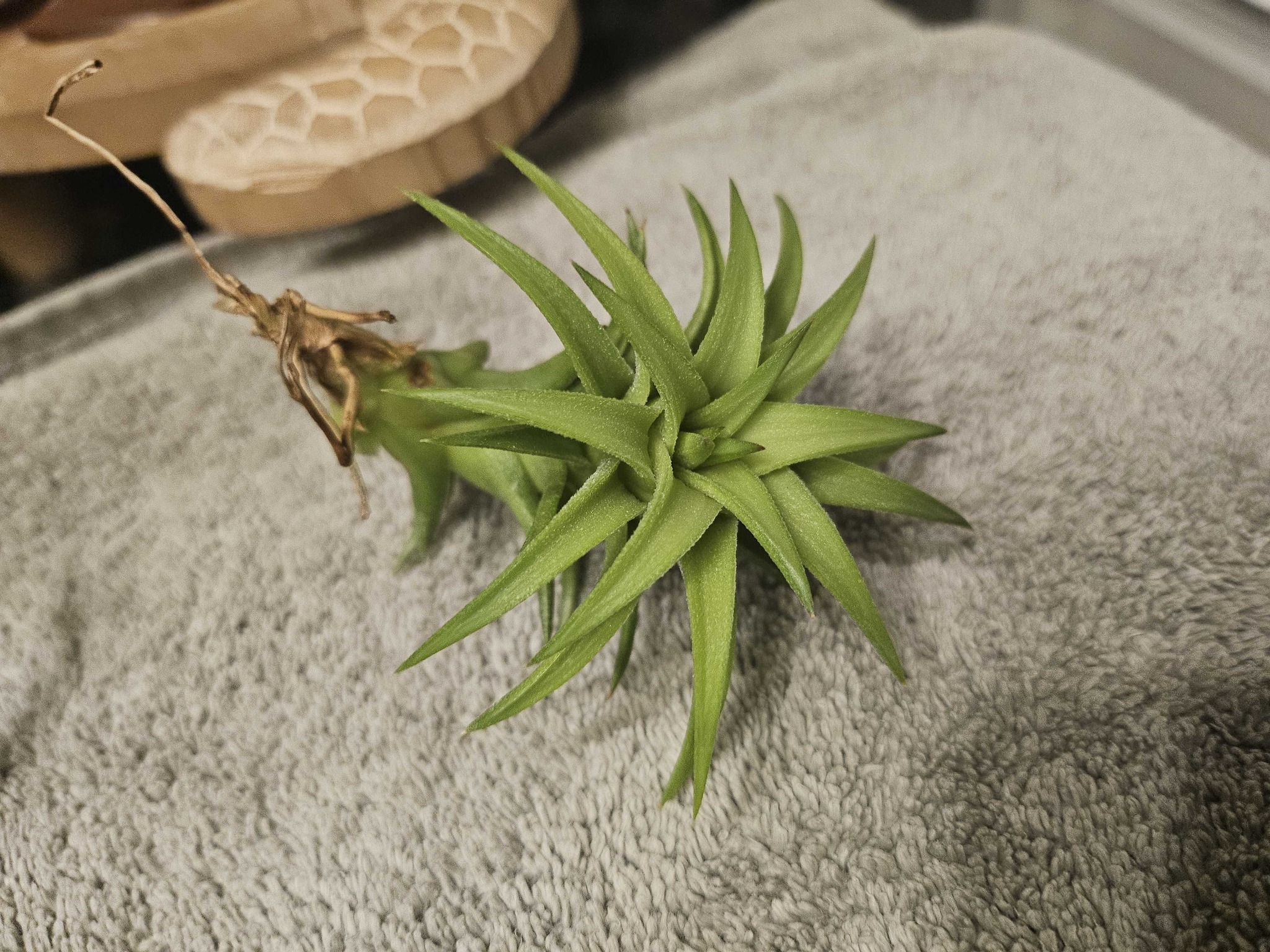
Sky Plant
Tillandsia ionantha
A small epiphyte featuring a rosette of rigid, succulent green leaves that often blush vibrant red or pink when preparing to bloom.
- Light
- Bright, indirect light for 6 to 8 hours per day; avoid harsh direct afternoon sun.
- Water
- Submerge or thoroughly mist 1 to 2 times per week depending on ambient humidity, allowing it to dry completely within 4 hours.
- Growth
- Perennial epiphyte forming a dense, compact rosette, growing slowly to about 2 to 5 inches in height and spread.
Care instructions
Provide bright, indirect sunlight and submerge the plant in water for 20 to 30 minutes once a week, ensuring it is shaken dry and placed in good airflow to prevent rot. No soil is required.
Growing details
Sunlight
Bright, indirect light for 6 to 8 hours per day; avoid harsh direct afternoon sun.
Watering
Submerge or thoroughly mist 1 to 2 times per week depending on ambient humidity, allowing it to dry completely within 4 hours.
Soil
Grows epiphytically without soil attached to bark, mounts, or decorative holders; requires excellent airflow around the roots.
Hardiness zone
USDA zones 9 to 11, sensitive to freezing temperatures and cold drafts.
Growth habit
Perennial epiphyte forming a dense, compact rosette, growing slowly to about 2 to 5 inches in height and spread.
Bloom season
Blooms intermittently, typically in spring or summer, producing tubular purple flowers nestled inside bright red or pink bracts.
Propagation
Propagated by separating offsets, known as pups, which emerge from the base of the parent plant after blooming once they reach at least one-third the size of the parent.
Common pests & issues
Prone to rotting if water becomes trapped in the center of the rosette for too long; scale insects and mealybugs can occasionally affect indoor specimens and should be removed manually.
Similar species
Tillandsia brachycaulos, which has softer, wider leaves and a more open rosette compared to the stiffer, tighter growth of Tillandsia ionantha.