
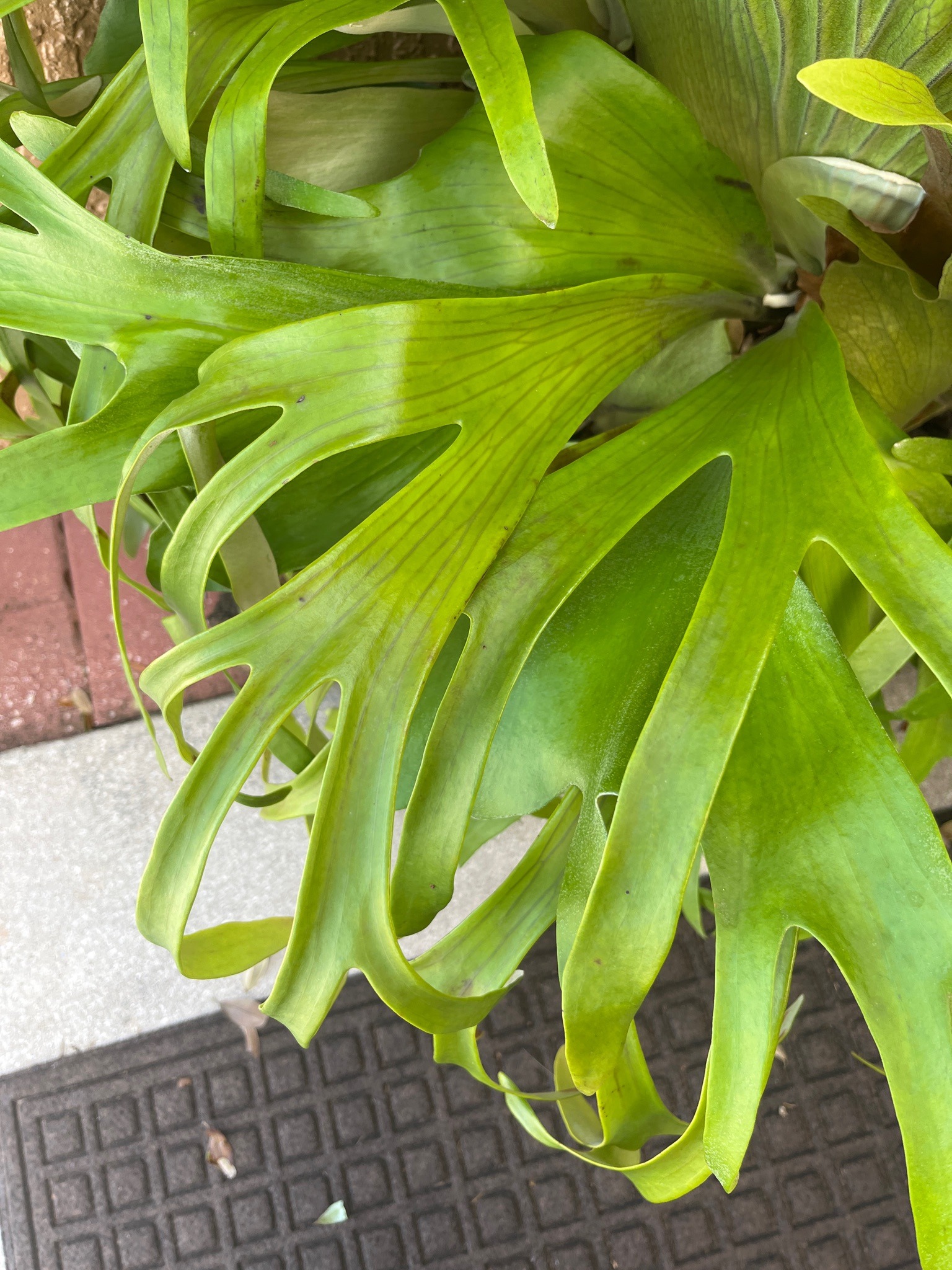
Staghorn Fern
Platycerium bifurcatum
An epiphytic fern characterized by two distinct types of fronds: broad, flat basal shield fronds that hug the mounting surface, and deeply forked, antler-like fertile fronds that arch outward.
- Light
- Bright, indirect light for 6 to 8 hours daily; avoid direct midday sun to prevent scorching.
- Water
- Water thoroughly when the root ball or mounting medium is nearly dry. Often watered by soaking the entire mount or root mass for 10-15 minutes, then allowing it to drain completely.
- Growth
- Epiphytic perennial fern with a slow to moderate growth rate. Mature specimens can spread several feet across depending on the mounting support.
Care instructions
Mount on wood or plant in a well-draining orchid mix. Provide bright, indirect light, water thoroughly when the medium approaches dryness, and maintain high ambient humidity with good air circulation.
Growing details
Sunlight
Bright, indirect light for 6 to 8 hours daily; avoid direct midday sun to prevent scorching.
Watering
Water thoroughly when the root ball or mounting medium is nearly dry. Often watered by soaking the entire mount or root mass for 10-15 minutes, then allowing it to drain completely.
Soil
Requires an exceptionally well-aerated, fast-draining medium such as a mix of orchid bark, peat, and sphagnum moss with a slightly acidic to neutral pH (6.0-7.0).
Hardiness zone
USDA Hardiness Zones 9 to 11, grown primarily as an indoor plant or sheltered patio plant in cooler climates.
Growth habit
Epiphytic perennial fern with a slow to moderate growth rate. Mature specimens can spread several feet across depending on the mounting support.
Bloom season
Non-flowering
Propagation
Propagated by division of basal pups (offsets) that emerge from the base of mature plants, or rarely via spores.
Common pests & issues
Prone to scale insects, mealybugs, and root rot if kept in excessively wet, poorly draining media with low air circulation.
Similar species
Platycerium grande and Platycerium coronarium, which can be distinguished by larger shield fronds and different spore patch configurations.