
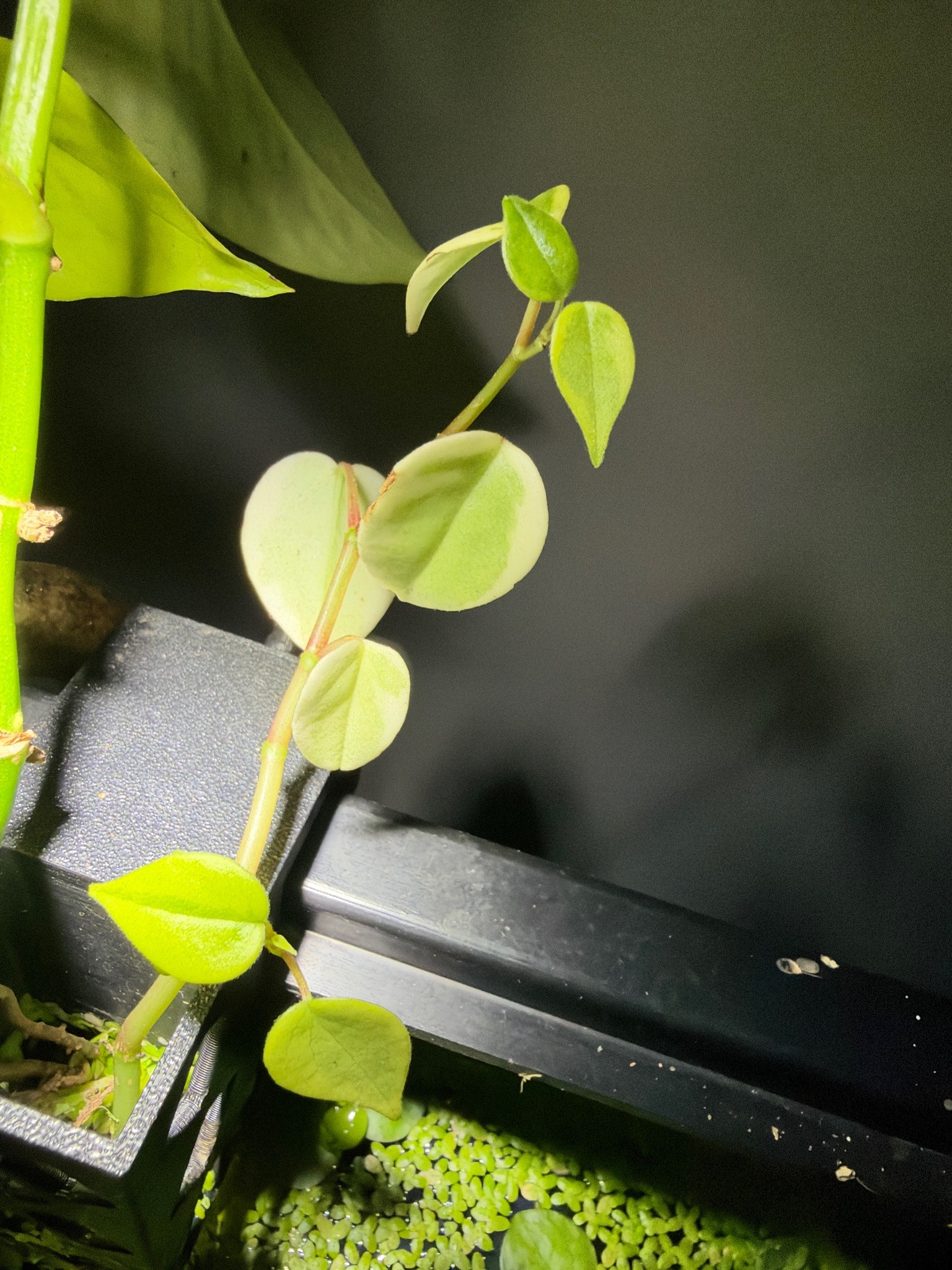
Teardrop Peperomia
Peperomia angulata
A trailing or climbing epiphyte featuring succulent, pointed ovate leaves with distinct light green and cream variegation, and reddish stems.
- Light
- Bright indirect light for 6 to 8 hours daily; avoid harsh direct sunlight which can scorch the leaves.
- Water
- Allow the soil to dry out completely between waterings. Use the soak-and-dry method, ensuring excess water drains away freely to prevent root rot.
- Growth
- Trailing perennial epiphyte with a slow to moderate growth rate, reaching vine lengths of 1 to 3 feet.
Care instructions
Provide bright indirect light, water only when the top few inches of soil are dry, use well-draining epiphytic potting mix, and fertilize lightly during the active growing season.
Growing details
Sunlight
Bright indirect light for 6 to 8 hours daily; avoid harsh direct sunlight which can scorch the leaves.
Watering
Allow the soil to dry out completely between waterings. Use the soak-and-dry method, ensuring excess water drains away freely to prevent root rot.
Soil
Loose, well-aerated, fast-draining potting mix such as a blend of orchid bark, perlite, and standard potting soil with a slightly acidic to neutral pH between 6.0 and 7.0.
Hardiness zone
USDA zones 10 to 12; grown primarily as a houseplant or greenhouse plant in cooler temperate regions.
Growth habit
Trailing perennial epiphyte with a slow to moderate growth rate, reaching vine lengths of 1 to 3 feet.
Bloom season
Non-flowering indoors typically, but may produce inconspicuous greenish spikes in ideal greenhouse conditions.
Propagation
Easily propagated through stem cuttings placed in water or moist perlite, or via single-leaf cuttings during the spring and summer months.
Common pests & issues
Susceptible to root rot if overwatered or kept in heavy, poorly draining soil. Pests include mealybugs and spider mites, which can be treated with insecticidal soap.
Similar species
Peperomia scandens and Peperomia tetragona, distinguished primarily by variations in leaf shape, stem ridging, and exact variegation patterns.