
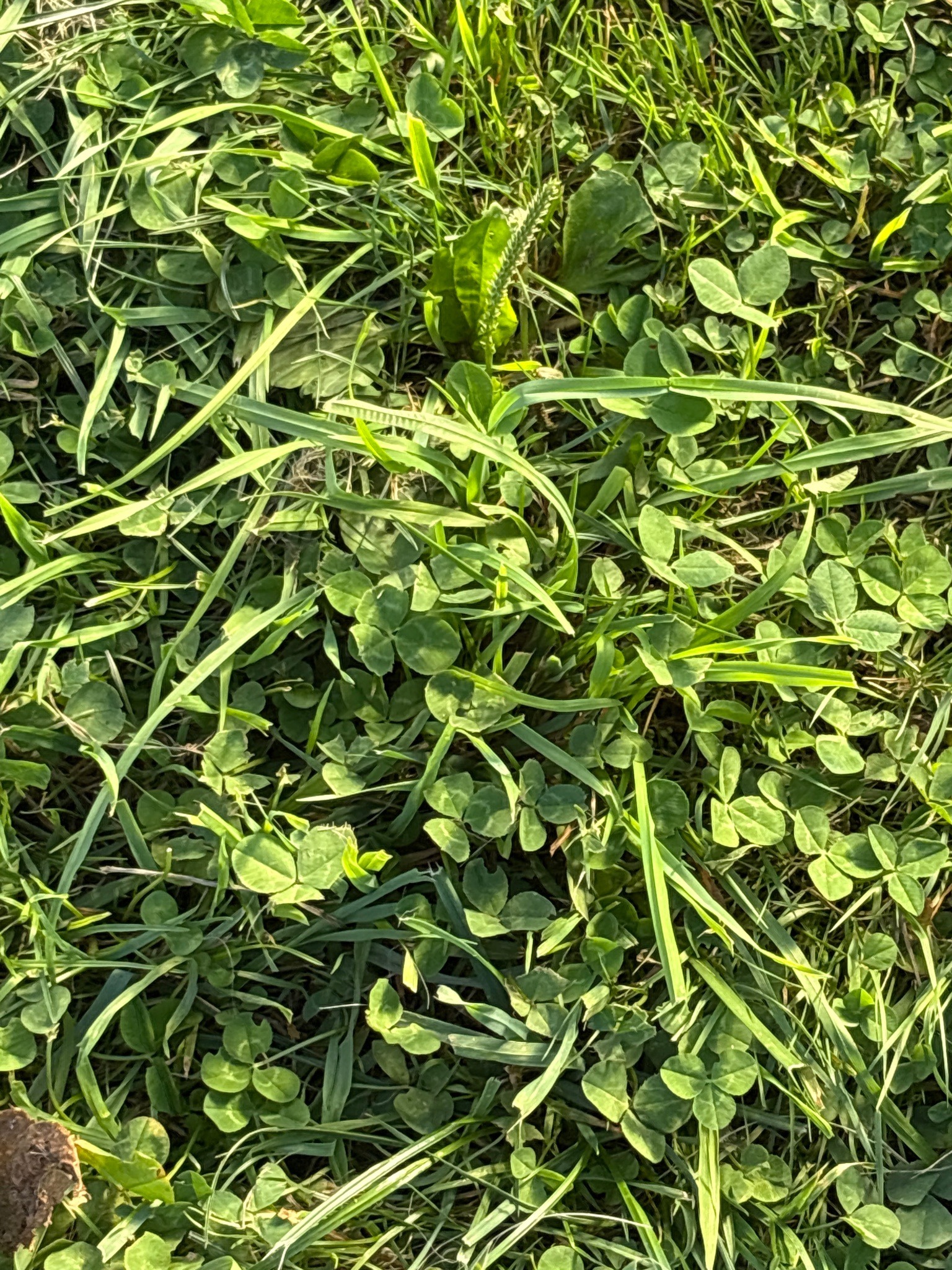
White Clover
Trifolium repens
White clover is a low-growing, creeping perennial herbaceous plant featuring distinctive trifoliate (three-part) leaves often marked with faint whitish watermarks, and rounded clusters of small white flowers.
- Light
- Full sun to partial shade, approximately 6 to 8 hours of direct sunlight daily.
- Water
- Moderate water needs; tolerates short dry periods once established. Water when the top inch of soil feels dry.
- Growth
- Low-growing perennial ground cover spreading via creeping stems (stolons) that root at nodes, typically reaching heights of 4 to 8 inches with an indefinite spread.
Care instructions
Grow in full sun to partial shade with regular watering during dry spells. Prefers well-draining soils and generally requires little to no added fertilizer due to its ability to fix atmospheric nitrogen.
Growing details
Sunlight
Full sun to partial shade, approximately 6 to 8 hours of direct sunlight daily.
Watering
Moderate water needs; tolerates short dry periods once established. Water when the top inch of soil feels dry.
Soil
Adapts to a wide range of soil types from clay to loam and sandy soils, preferring a neutral pH between 6.0 and 7.0 with good drainage.
Hardiness zone
USDA zones 3 through 10, exhibiting strong tolerance to varying temperatures and seasonal fluctuations.
Growth habit
Low-growing perennial ground cover spreading via creeping stems (stolons) that root at nodes, typically reaching heights of 4 to 8 inches with an indefinite spread.
Bloom season
Blooms from late spring through autumn, producing small, spherical flower heads composed of numerous tiny white or pale pinkish florets.
Propagation
Propagates easily through creeping stolons that self-root, division of established clumps, and by sowing seeds directly onto the soil surface.
Common pests & issues
Generally resilient, but susceptible to root rots in poorly draining soils, as well as occasional fungal leaf spots and infestations of clover mites or aphids.
Similar species
Red Clover (Trifolium pratense), which is taller with larger, reddish-pink flower heads and hairy stems, and Black Medic (Medicago lupulina), which has similar trifoliate leaves but produces small yellow flower clusters and has a pointed terminal leaflet.