Artichoke Identification Guide
Identify the globe artichoke by its silvery jagged leaves, tall stalks, and the unmistakable scaly green flower buds that open into purple thistle blooms.
Read the full Artichoke encyclopedia entry →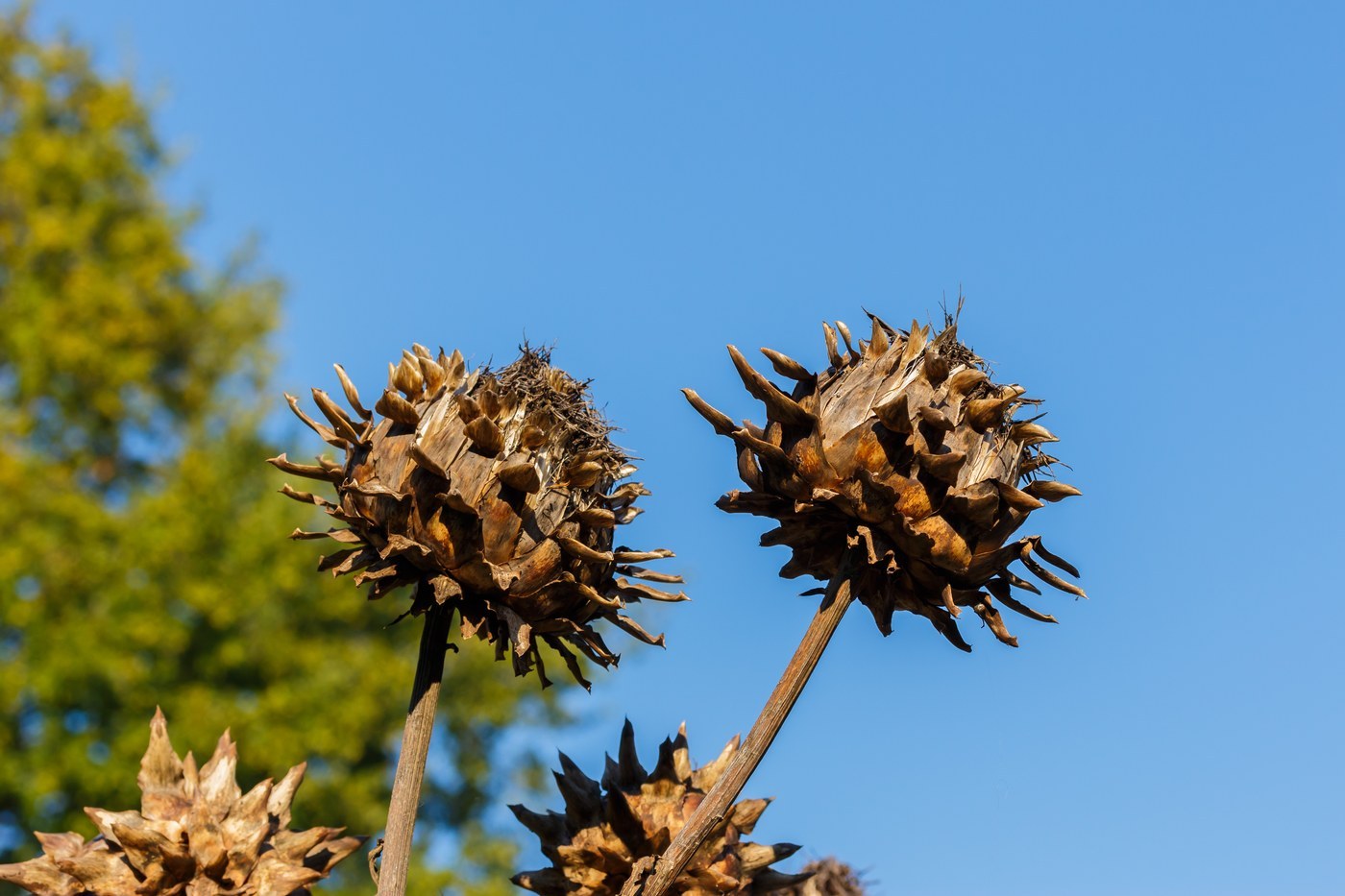
Key Identifying Features
The globe artichoke (Cynara cardunculus var. scolymus) is a large herbaceous perennial thistle in the daisy family (Asteraceae). It is recognized by its big silvery-green, deeply cut leaves forming an architectural rosette, topped by tall stalks bearing the familiar scaly flower buds — the "artichokes" are immature flower heads.
- Growth habit: bold clumping plant 3–6 ft tall and nearly as wide
- Texture/color: whole plant has a frosted, gray-green look from fine hairs
Leaves & Stems
Leaves are large (up to 2–3 ft long), arching, deeply pinnately lobed (almost fern-like), gray-green above and woolly-white beneath. Unlike its relative the cardoon, true artichoke leaves are usually spineless or only weakly spiny. The stout, ridged flowering stems are gray-green, grooved, and slightly woolly, rising well above the foliage.
Flowers & Fruit
The defining feature is the flower head (capitulum): a fat, rounded bud 2–5 inches across made of tightly overlapping, fleshy, triangular bracts (scales) that are green often flushed purple, sometimes tipped with a small spine. If left to develop, the bud opens into a stunning 6+ inch thistle flower with a dense brush of violet-blue to purple florets. Pollinated heads produce plumed seeds typical of thistles.
How to Tell It Apart from Look-Alikes
- Cardoon (Cynara cardunculus): very close relative, but cardoon has more strongly spiny leaves; its flower buds are smaller and spinier.
- Other thistles (Cirsium, Onopordum): have spiny stems and small heads, never the big fleshy scaly bud.
- Ornamental alliums or globe thistle (Echinops): globe thistle has spherical steel-blue heads but spiny, divided leaves and no fleshy bract bud.
The large frosted lobed leaves + tall stalk + scaly green-purple bud combination is unique to artichoke.
Where You'll Find It
Native to the Mediterranean, the globe artichoke is grown commercially in mild, frost-free climates (famously coastal California) and as a striking ornamental in temperate gardens. Look for it in gardens, market farms, and as a dramatic accent plant in borders.
Quick ID Checklist
- Big silvery-gray, deeply lobed, mostly spineless leaves in a rosette
- Tall grooved gray stalks, 3–6 ft
- Scaly green-to-purple flower buds
- Open flower: large purple-blue thistle brush
- Overall frosted, architectural appearance
Frequently asked questions
How do I tell an artichoke from a cardoon?
They're the same species group, but artichoke is grown for its large, mostly spineless leaves and big rounded flower buds, while cardoon has noticeably spinier leaves and smaller, spinier buds.
What does an artichoke look like if it flowers?
An unharvested bud opens into a large, showy thistle flower with a thick brush of violet-blue to purple florets sitting on the scaly base.
Is the artichoke related to thistles?
Yes. It is a domesticated thistle in the daisy family (Asteraceae), which is why its open flower looks like a giant purple thistle bloom and its seeds carry feathery plumes.
How do I recognize an artichoke plant in a garden?
Look for a bold, frosted gray-green rosette of large, deeply lobed, arching leaves, with tall grooved stalks rising 3–6 ft and topped by fat scaly buds. The whole plant has an architectural, silvery appearance.
Artichoke identified by the community
Recent Artichoke specimens identified with Plant Identifier.