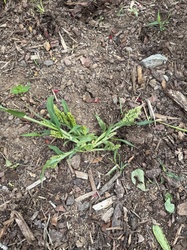
Barnyardgrass Identification Guide
A field guide to recognizing barnyardgrass (Echinochloa crus-galli), a coarse warm-season annual grass of crop fields, ditches, and wet ground. Covers its hairless ligule, reddish stem bases, and bristly seedheads.
Read the full Barnyardgrass encyclopedia entry →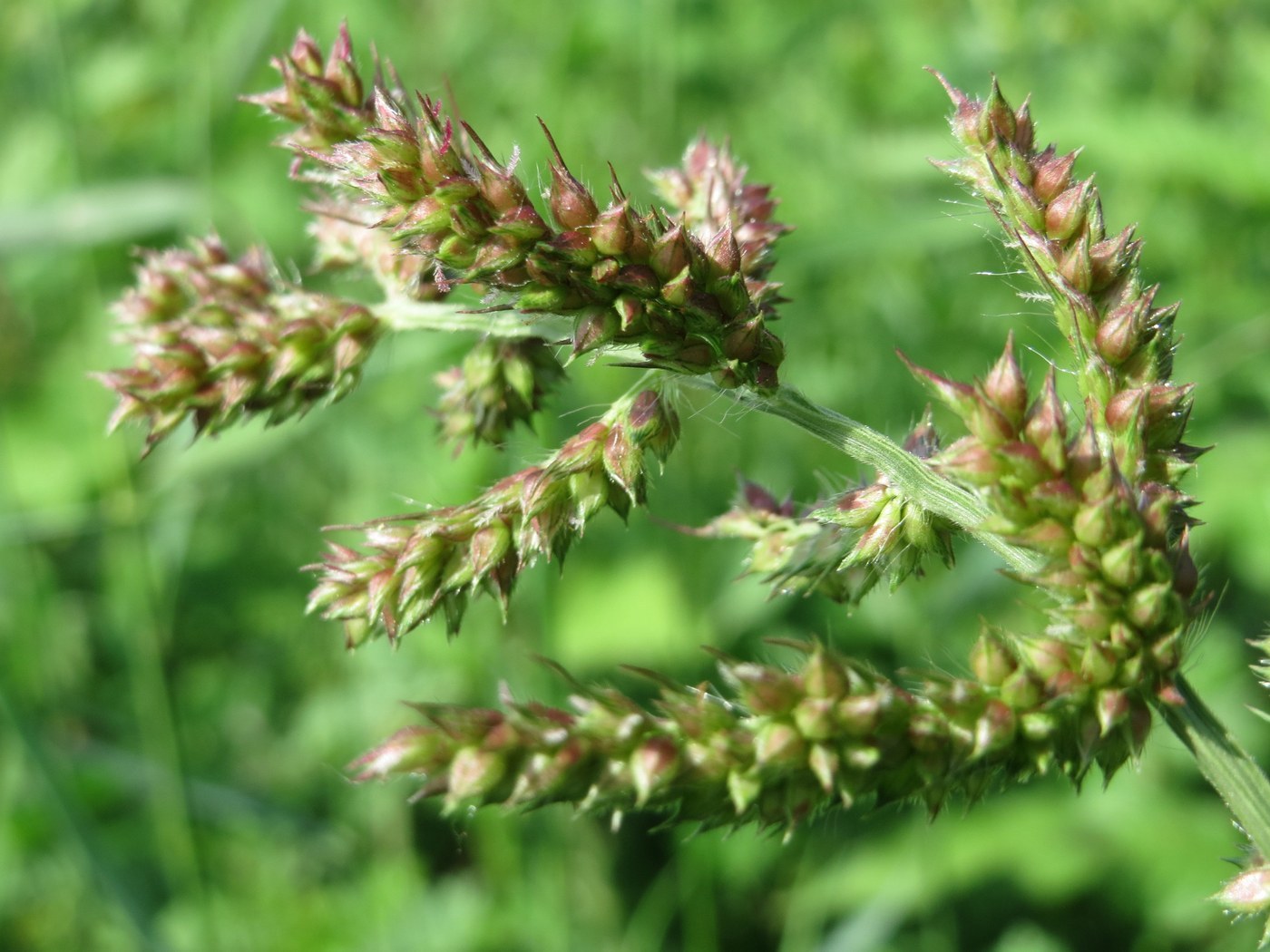
Key Identifying Features
Barnyardgrass (Echinochloa crus-galli) is a robust, warm-season annual grass that often grows in dense clumps. The single most reliable feature is the complete absence of a ligule where the leaf blade meets the sheath. Run your fingernail along that junction and you will feel a smooth membrane with no projecting collar or hairs at all. Very few common grasses lack a ligule entirely, so this trait quickly separates it from foxtails and crabgrass.
- No ligule and no auricles at the leaf collar
- Stout, often reddish or purplish stem bases that flatten near the ground
- Coarse, broad leaf blades up to about 1 inch wide
- Branched, often nodding seedhead with short, stiff bristles (awns)
- Plants commonly 1 to 5 feet tall, sometimes sprawling and rooting at lower nodes
Leaves & Stems
The leaf blades are flat, smooth, and hairless, with a prominent whitish midrib. They are fairly wide (up to 25 mm) and can be 4 to 20 inches long, tapering to a fine point. The leaf sheaths are smooth and often tinged red or maroon at the base, a useful clue when plants are young. Stems (culms) are thick, succulent, and frequently bend at the lower nodes, where they may root if pressed into wet soil. There is no hairiness anywhere on healthy plants, distinguishing it from hairy crabgrass.
Flowers & Fruit
The inflorescence is a panicle of several spike-like branches arranged along a central axis, frequently nodding and turning purplish or green-brown as it matures. Each branch bears crowded, plump spikelets. Many spikelets carry short to long, stiff bristle-like awns, giving the seedhead a coarse, bristly look. Seeds are shiny, plump, and pale to purplish. Flowering runs from midsummer into fall.
How to Tell It Apart from Look-Alikes
- Foxtails (Setaria): Have a fringe of hairs (a ligule of hairs) at the collar and a single dense, cylindrical "foxtail" spike, not branched.
- Crabgrass (Digitaria): Has a membranous ligule and finger-like seedhead spokes radiating from one point; often hairy.
- Fall panicum: Similar size but has a hairy ligule and an open, diffuse panicle without bristly awns.
- Johnsongrass: Much taller, perennial, with a stout white midrib and thick rhizomes plus a membranous ligule.
The foolproof check is the ligule test: if there is truly nothing at the collar, you are almost certainly looking at barnyardgrass.
Where You'll Find It
Barnyardgrass favors moist, fertile, disturbed ground: edges of crop fields (especially corn, soybeans, and rice), irrigation ditches, low wet spots, roadsides, gardens, and pond margins. It is one of the world's most widespread weeds and tolerates standing water better than most grasses, which is why it thrives in rice paddies.
Quick ID Checklist
- Warm-season annual grass, often clumped, 1 to 5 ft
- No ligule at the leaf collar (key trait)
- Smooth, hairless wide blades with a white midrib
- Reddish/purple flattened stem bases
- Branched, nodding seedhead with stiff bristly awns
- Wet, disturbed, fertile soils
Frequently asked questions
What is the easiest way to confirm barnyardgrass?
Check the leaf collar for a ligule. Barnyardgrass has no ligule at all, which is rare among common weedy grasses and reliably separates it from foxtails, crabgrass, and panicums.
Is barnyardgrass hairy?
No. The leaves, sheaths, and stems are smooth and hairless. If you see fuzzy or hairy blades, you are likely looking at crabgrass instead.
Why does the stem base look red or purple?
Reddish or maroon coloring at the lower sheaths and stem nodes is a normal characteristic of barnyardgrass and a helpful clue, especially on younger plants.
Where does barnyardgrass usually grow?
It prefers moist, fertile, disturbed soil such as crop field edges, ditches, low wet spots, rice paddies, and pond margins, and it tolerates flooding better than most grasses.
Barnyardgrass identified by the community
Recent Barnyardgrass specimens identified with Plant Identifier.