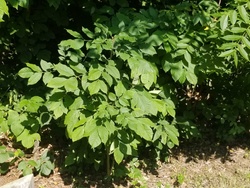
Black Walnut Identification Guide
How to identify black walnut (Juglans nigra) by its large pinnately compound leaves, round green husked nuts, and chambered pith.
Read the full Black Walnut encyclopedia entry →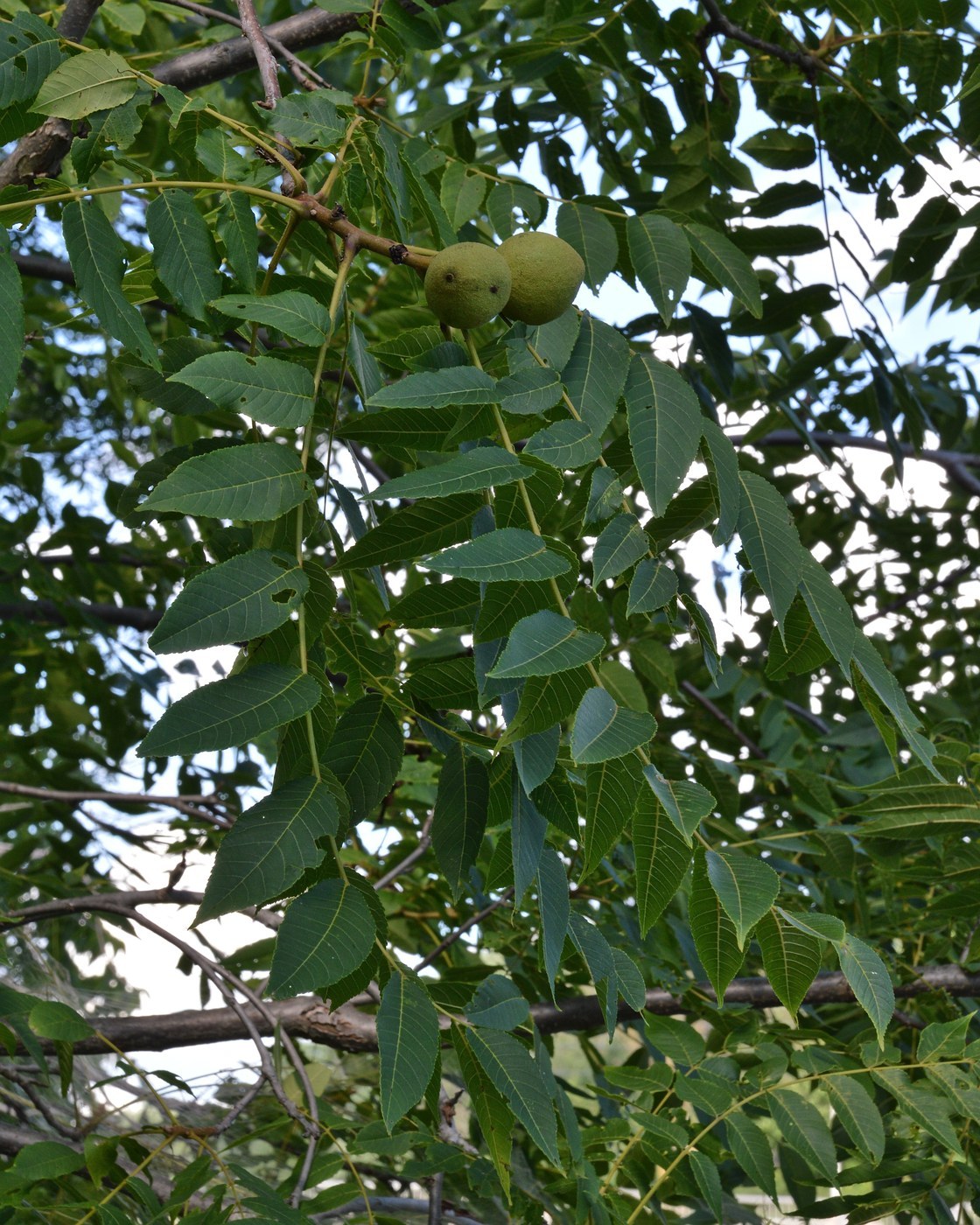
Key Identifying Features
Black walnut (Juglans nigra) is a large deciduous hardwood recognized by its long pinnately compound leaves, its round, green, husk-covered nuts, and a distinctive chambered pith inside the twigs. It grows 70–100 feet tall with a tall, straight trunk and an open, rounded crown.
- Compound leaves 1–2 feet long with 15–23 pointed leaflets
- Round green nuts with a thick husk that stains hands brown
- Chambered (ladder-like) pith revealed when a twig is cut lengthwise
- Dark, deeply furrowed, diamond-patterned bark
Leaves & Stems
The leaves are pinnately compound, 12–24 inches long, with 15–23 leaflets arranged along a central stalk. Each leaflet is 2–4 inches long, lance-shaped, finely toothed, and pointed, and the leaf is often slightly smaller or even missing the terminal leaflet. Crushed foliage has a pungent, spicy scent. A definitive test: slice a twig lengthwise to reveal the buff-colored pith divided into a ladder of hollow chambers. The bark is dark gray-brown with deep furrows forming a rough diamond pattern; leaf scars are large and shaped like a monkey or shield face.
Flowers & Fruit
Black walnut is monoecious. In spring, drooping yellow-green male catkins and small female flowers appear. The fruit is the giveaway: a round, solid green ball 1.5–2.5 inches across with a thick, fleshy husk that does not split open and stains skin a deep brown. Inside is the hard, deeply ridged shell enclosing the nut. Fruits drop in fall and often litter the ground beneath the tree.
How to Tell It Apart from Look-Alikes
The closest look-alike is butternut (Juglans cinerea), which has fewer leaflets, oblong fuzzy fruits (not round), and a darker chocolate-brown chambered pith. Hickories have compound leaves too but solid (not chambered) pith, fewer leaflets, and husks that split open. Tree-of-heaven and sumac have compound leaves but lack the round walnut fruit and chambered pith; tree-of-heaven leaflets have basal glandular teeth and a rank odor.
Where You'll Find It
Native to the central and eastern United States, black walnut grows in rich, moist, well-drained bottomland and slope soils, along fencerows, and in open woods and fields. It releases juglone, a chemical that inhibits the growth of many nearby plants.
Quick ID Checklist
- Leaves: large compound, 15–23 toothed pointed leaflets
- Twig: sliced pith is chambered (ladder-like), light brown
- Fruit: round, green, solid husk that stains brown; doesn't split
- Bark: dark, deeply furrowed in a diamond pattern
- Habitat: rich soils of central/eastern North America
A tall tree with big compound leaves, round green nuts, and chambered twig pith is black walnut.
Frequently asked questions
What is the easiest way to confirm black walnut?
Cut a twig lengthwise and look at the pith: black walnut has a light brown pith divided into a ladder of hollow chambers. Combined with round green nuts and large compound leaves, this is conclusive.
How do I tell black walnut from butternut?
Black walnut has round green fruits and a buff-colored chambered pith, while butternut has oblong, fuzzy, sticky fruits and a darker chocolate-brown chambered pith with fewer leaflets.
Why does the husk stain my hands brown?
The fleshy green husk contains a potent natural dye (juglone and related compounds) that quickly stains skin and clothing. Wear gloves when handling the nuts.
Why do few plants grow under a black walnut?
Black walnut releases juglone, a chemical from its roots, leaves, and husks that inhibits the growth of many plants, suppressing sensitive species in the soil around it.
Black Walnut identified by the community
Recent Black Walnut specimens identified with Plant Identifier.