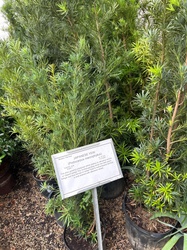
Buddhist Pine Identification Guide
How to identify Buddhist pine (Podocarpus macrophyllus) by its long, strap-shaped leaves spirally crowded on the shoots and fleshy purple receptacles bearing green seeds. Covers leaves, fruit, and look-alikes.
Read the full Buddhist Pine encyclopedia entry →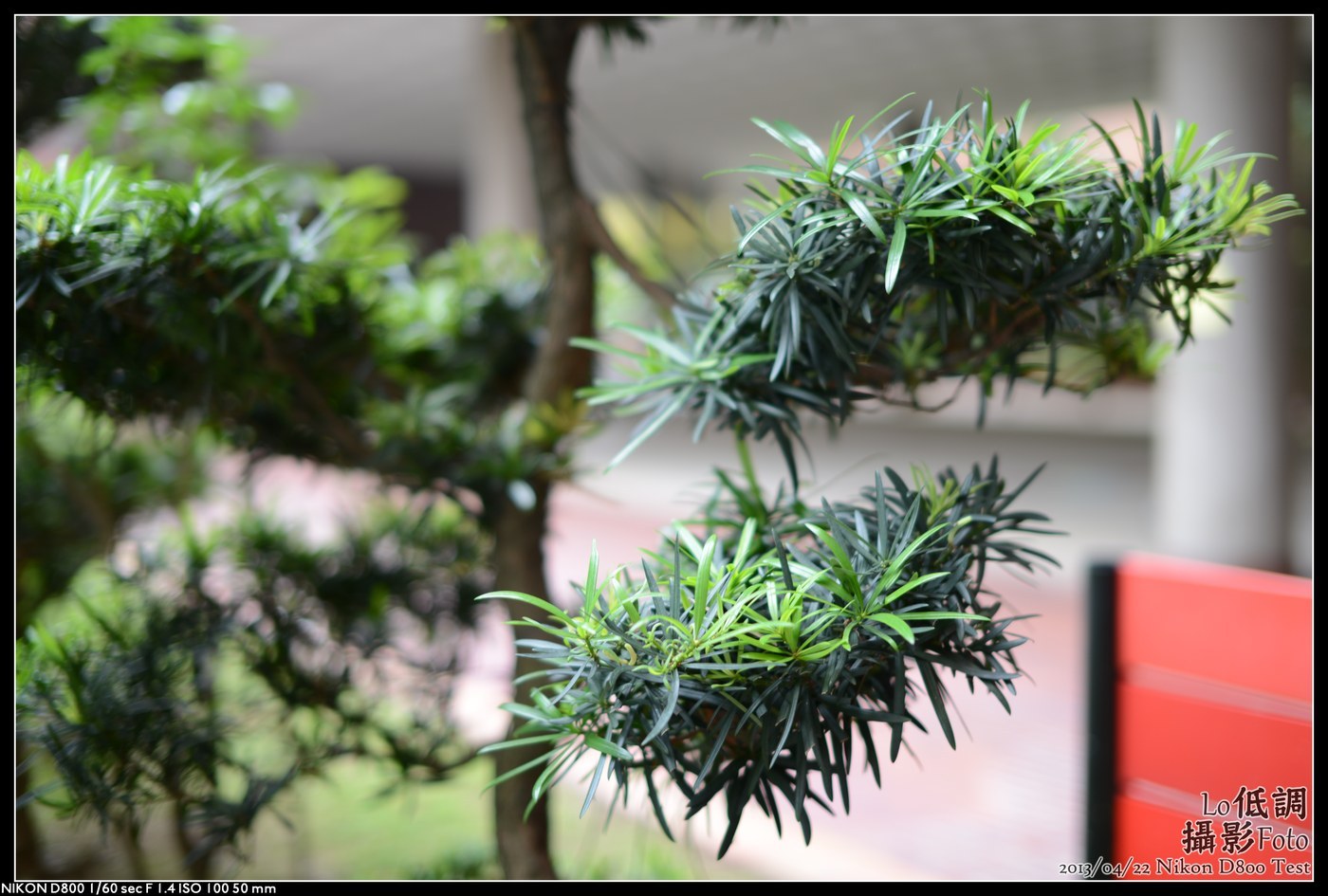
Key Identifying Features
Buddhist pine (Podocarpus macrophyllus), also called yew plum pine or kusamaki, is not a true pine but a podocarp recognized by its long, narrow, leathery strap-shaped leaves densely arranged in spirals, and by curious fruits where a fleshy purple stalk (receptacle) carries a green seed.
- Leaves long and strap-like (5–12 cm), broader than any pine needle
- Leaves spirally crowded and tending to point upward/forward
- Dark glossy green above, paler with a raised midrib beneath
- Fruit: a swollen red-purple fleshy base topped by a green seed
Leaves & Stems
Leaves are linear-lanceolate, 5–12 cm long and about 1 cm wide, much broader and longer than a true pine's needles. They are thick, leathery, dark glossy green above with a prominent raised midrib, and slightly glaucous beneath. They are arranged spirally, densely crowded along the green shoots, often angling forward, giving a bushy, plume-like look. Tips are tapered but not sharply spiny. Stems are green and ridged when young, browning with age; the bark is greyish-brown and peels in thin strips on older trunks. Often seen clipped as a hedge or topiary, holding dense foliage.
Flowers & Fruit
Usually dioecious. Male plants bear catkin-like clusters of small cylindrical pollen cones. Female plants produce the distinctive 'fruit': a single green to bluish seed (about 1 cm) sitting atop a swollen, fleshy receptacle that ripens red to purple, looking like a tiny colorful figure or a berry with a cap. The fleshy base is attractive to birds, which help disperse the seed.
How to Tell It Apart from Look-Alikes
- True pines (Pinus): Needles in bundles of 2–5; Buddhist pine has solitary, broad, strap-shaped leaves—no bundles.
- Yew (Taxus): Shorter flat needles and a red cup-shaped aril; Buddhist pine leaves are far longer and broader with a fleshy stalked fruit.
- Plum yew (Cephalotaxus): Spine-tipped needles with white bands; Buddhist pine leaves lack the spine and bright bands.
- Other Podocarpus: Distinguished by leaf size; macrophyllus has notably large leaves (the name means 'large-leaved').
Where You'll Find It
Native to southern Japan and southern/eastern China, widely planted across warm-temperate and subtropical regions as a hedge, screen, foundation shrub, topiary, and bonsai. Common in gardens, courtyards, and around temples (hence 'Buddhist pine'). Look for a tidy evergreen with long, dark, glossy strap-leaves crowded on green stems.
Quick ID Checklist
- Long, broad, strap-shaped leaves (not pine needles)
- Leaves spirally crowded, glossy dark green, raised midrib
- No needle bundles, no spiny tips
- Fruit = green seed on a fleshy red-purple base
- Tidy evergreen shrub/tree, often hedged
An evergreen with long, glossy, strap-shaped leaves spirally packed on green shoots, bearing green seeds on fleshy purple stalks, is Buddhist pine.
Frequently asked questions
Is Buddhist pine actually a pine?
No. It is a podocarp (Podocarpus macrophyllus), not a true pine; it lacks pine-style needle bundles and instead has long, broad, strap-shaped leaves.
What is the strange colorful fruit?
Female plants produce a green or bluish seed sitting on a swollen fleshy receptacle that ripens red to purple, looking like a small berry with a cap. The fleshy base attracts birds, which help disperse the seed.
How do I tell Buddhist pine from a yew?
Buddhist pine has much longer, broader strap-shaped leaves and a fleshy stalked fruit, while yew has short flat needles and a single seed in an open red cup-like aril.
Where is Buddhist pine usually seen?
It is native to southern Japan and China and is widely grown in warm regions as a hedge, screen, topiary, or bonsai, often around temples and courtyards.
Buddhist Pine identified by the community
Recent Buddhist Pine specimens identified with Plant Identifier.