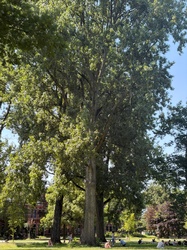
Cottonwood Identification Guide
Identify cottonwood by its triangular toothed leaves on flattened stalks, deeply furrowed grey bark, and the fluffy cottony seeds it releases in summer. Includes how to tell it from aspen, poplar, and willow.
Read the full Cottonwood encyclopedia entry →
Key Identifying Features
Cottonwoods (Populus species, such as P. deltoides and P. fremontii) are large, fast-growing deciduous trees of riverbanks and floodplains. Recognize them by their triangular (deltoid), coarsely toothed leaves that flutter on flattened leaf stalks, the deeply furrowed grey bark of mature trunks, and the clouds of cottony seed fluff released in early summer that give the tree its name.
- Triangular/heart-shaped leaves with coarse rounded teeth
- Flattened petioles that make leaves tremble in wind
- Deeply furrowed, thick grey bark on mature trees
- Cottony white seed fluff drifting in late spring/summer
Leaves & Stems
Cottonwood leaves are alternate, broadly triangular to heart-shaped, 5 to 12 cm long, with coarse, blunt, rounded teeth along the margin and a pointed tip. The defining trick is the petiole (leaf stalk), which is flattened side-to-side; this causes the leaves to flutter and quake in the slightest breeze, producing a rustling sound. Young bark is smooth and yellow-green to grey; mature bark becomes thick, ashy grey, and deeply furrowed into rough ridges. Twigs are stout, and winter buds are resinous and sticky with a balsam scent in some species.
Flowers & Fruit
Cottonwoods are dioecious (separate male and female trees) and bloom before the leaves in early spring as drooping catkins. Male catkins are reddish; female catkins are greenish and develop into strings of small capsules. When ripe, the capsules split to release tiny seeds attached to tufts of white cottony hairs, which drift on the wind in great quantities, blanketing the ground like snow. This summer "cotton" is the most memorable identifier.
How to Tell It Apart from Look-Alikes
- Aspen (Populus tremuloides): also has flattened petioles and quaking leaves, but leaves are smaller, rounder, finely toothed, and bark is smooth white-grey; aspen is an upland tree, cottonwood a lowland riparian one.
- Other poplars / Lombardy poplar: narrower or differently shaped leaves and often a columnar habit; cottonwood is broadly spreading.
- Willow (Salix): narrow lance-shaped leaves, not triangular, and round (not flattened) petioles.
The triangular toothed leaf on a flattened stalk plus floodplain habitat plus cotton seed confirms cottonwood over willows and other poplars.
Where You'll Find It
Cottonwoods are classic riparian trees, lining riverbanks, streamsides, irrigation ditches, ponds, and floodplains across North America. Their presence often marks water in otherwise dry landscapes (the Fremont cottonwood is a hallmark of southwestern desert oases). They grow fast, get very large, and are relatively short-lived with brittle wood.
Quick ID Checklist
- Triangular to heart-shaped leaves with coarse teeth
- Flattened leaf stalks; leaves flutter in wind
- Thick, deeply furrowed grey bark on old trees
- Cottony seed fluff in late spring/summer
- Large, fast-growing tree near water
- Catkins in early spring before leaves
Frequently asked questions
What is the cotton that cottonwoods release?
Female cottonwood trees produce seeds attached to tufts of fine white hairs. In early summer the capsules split and these cottony seeds drift on the wind, sometimes piling up like snow.
Why do cottonwood leaves rustle so much?
The leaf stalk is flattened side to side, so leaves catch the wind and tremble easily, producing a constant rustling. This flattened petiole is shared with aspens, a close relative.
How do I tell a cottonwood from an aspen?
Both flutter, but cottonwood leaves are larger and triangular with coarse teeth and grow on lowland riverbanks, while aspen leaves are small and round with fine teeth and smooth white bark on upland slopes.
Does a cottonwood mean there's water nearby?
Often, yes. Cottonwoods are riparian trees that depend on moist soil, so in dry regions a line of cottonwoods usually marks a stream, ditch, or high water table.
Cottonwood identified by the community
Recent Cottonwood specimens identified with Plant Identifier.