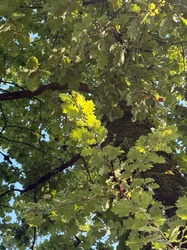
English Oak Identification Guide
How to identify English Oak (Quercus robur) by its short-stalked leaves with ear-like basal lobes and its acorns borne on long stalks (peduncles).
Read the full English Oak encyclopedia entry →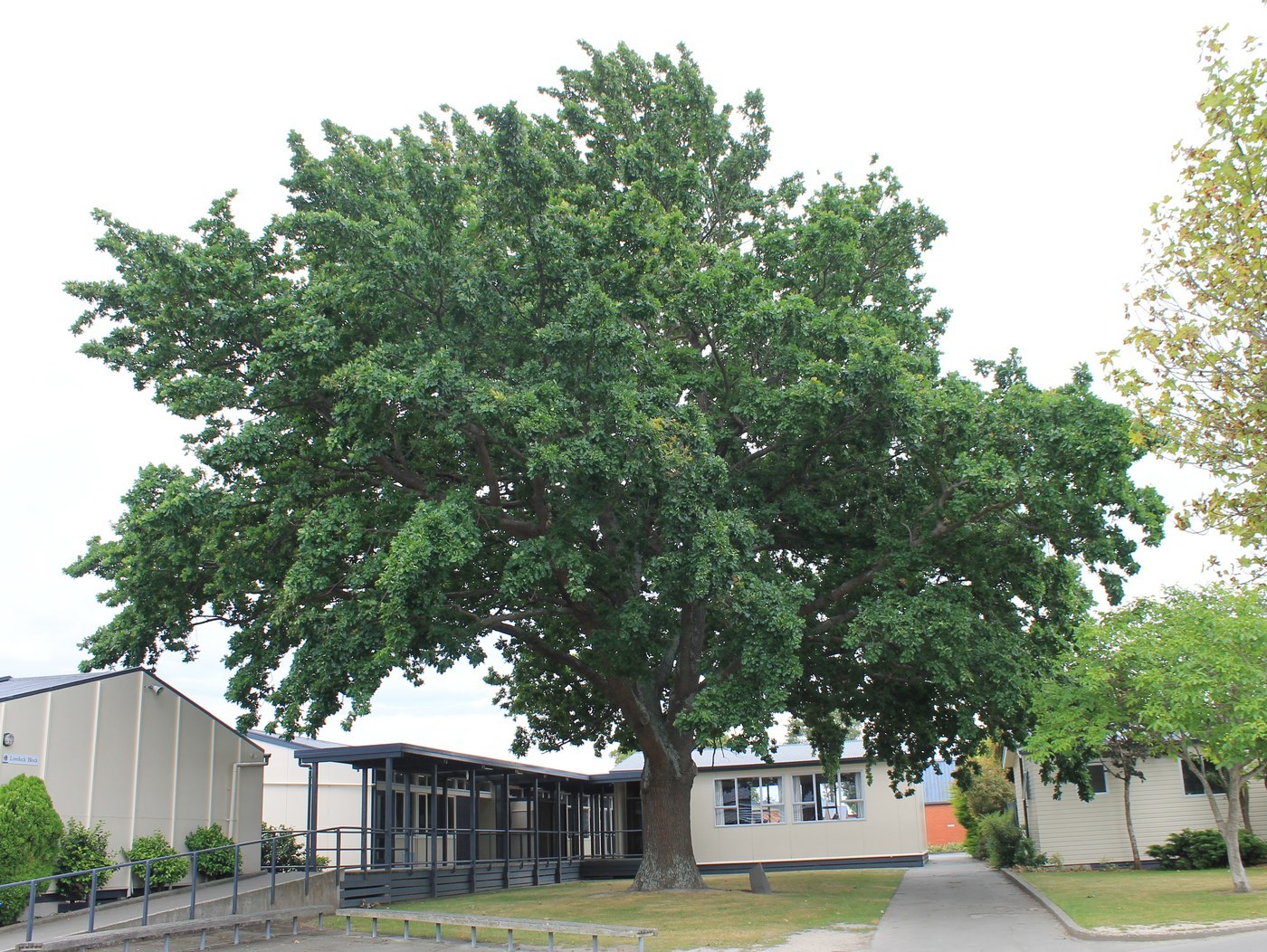
Key Identifying Features
English Oak (Quercus robur), also called pedunculate oak, is the classic broad-crowned oak of Europe, widely planted elsewhere. Two paired features identify it neatly: the leaves are nearly stalkless with two small ear-like (auricled) lobes clasping the twig at the base, and the acorns hang on long stalks (peduncles) 1-3 inches long. This stalk-vs-leaf reversal (short leaf stalk, long acorn stalk) is the key to telling it from sessile oak.
- Acorns on long stalks (pedunculate)
- Leaves almost stalkless with ear-like basal lobes
- Rounded lobes, no bristle tips (a European white-oak relative)
Leaves & Stems
Leaves are 2-5 inches long with 3-7 pairs of rounded, irregular lobes and a very short petiole (under 1/4 inch). The leaf base typically has two small backward-pointing auricles (ear-lobes) that wrap around the twig. The upper surface is dark blue-green, the underside paler and hairless. Leaves often emerge late and drop late, sometimes hanging brown through winter (marcescent).
Twigs are gray-brown and hairless, with clustered, blunt, scaly buds at the tips (a general oak trait). Bark is gray-brown, deeply fissured into a rugged, rough network of ridges on mature trunks. The crown is broad, spreading, and often gnarled with massive limbs.
Flowers & Fruit
Yellow-green catkins dangle in spring as leaves expand. The acorn is the giveaway: oblong, 1-1.5 inches, set in a shallow cap, and borne in groups of 1-3 on a long, slender stalk well away from the leaves. Acorns ripen in a single autumn.
How to Tell It Apart from Look-Alikes
- Sessile oak (Quercus petraea): the mirror image — long leaf stalks and stalkless (sessile) acorns; its leaves lack the clasping ear-lobes and are more evenly lobed.
- White oak (Quercus alba): an American species with longer leaf stalks, finger-like lobes, and stalkless acorns.
- Red/black oaks: bristle-tipped, pointed lobes; English oak lobes are rounded.
Remember the rule: English oak = short leaf stalk + long acorn stalk + ear-lobed leaf base.
Where You'll Find It
English Oak is native across Europe, from the British Isles east to the Caucasus and parts of North Africa and western Asia. It is a long-lived, iconic parkland and hedgerow tree and is widely planted in North America and elsewhere as an ornamental and street/park tree, where it sometimes naturalizes. It grows in a range of soils but favors deep, fertile loams.
Quick ID Checklist
- Acorns on long stalks (pedunculate)
- Very short leaf stalk with ear-like basal lobes clasping the twig
- 3-7 pairs of rounded lobes, no bristles
- Clustered blunt buds at twig tips; deeply fissured gray bark
- Broad, spreading, often gnarled crown
- Native to Europe; commonly planted ornamental elsewhere
Frequently asked questions
How do I tell English oak from sessile oak?
Check the stalks. English (pedunculate) oak has acorns on long stalks and leaves on very short stalks with ear-like basal lobes; sessile oak is the reverse — stalkless acorns and long-stalked leaves.
Why is it called pedunculate oak?
Because its acorns are carried on a peduncle, a long stalk, holding them well away from the twigs and leaves.
Does English oak grow in North America?
It is not native but is widely planted as a park, street, and ornamental tree, and it occasionally naturalizes outside cultivation.
Are English oak lobes pointed or rounded?
Rounded, without the bristle tips found in red and black oaks, marking it as a white-oak-group (Quercus) relative.
English Oak identified by the community
Recent English Oak specimens identified with Plant Identifier.