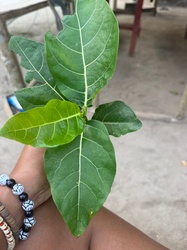
Fiddle Leaf Fig Identification Guide
Identify the fiddle-leaf fig (Ficus lyrata) by its huge, violin-shaped, heavily veined leaves and upright tree form, and tell it apart from other large-leaved Ficus.
Read the full Fiddle Leaf Fig encyclopedia entry →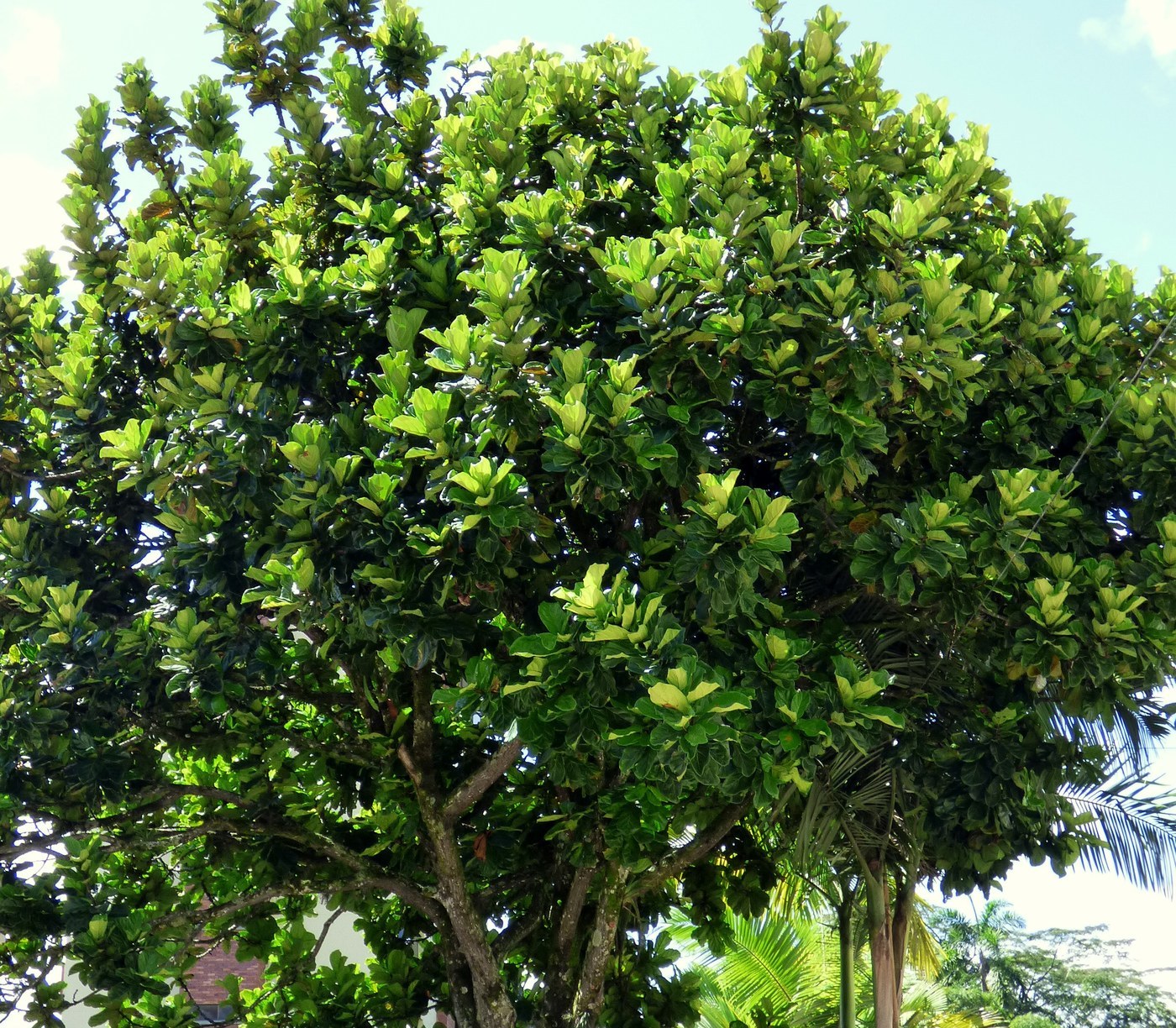
Key Identifying Features
The fiddle-leaf fig (Ficus lyrata) is named for its distinctive leaf shape:
- Very large, leathery, violin- (fiddle-) shaped leaves — broad and rounded at the tip, narrowing in the middle, then flaring again at the base.
- Strongly sunken, pale veins that give the leaf a corrugated, sculptural look.
- An upright, tree-like form with a woody trunk.
Leaves & Stems
Leaves are glossy deep green, thick and stiff, often 25–45 cm (10–18 in) long, with prominent light-colored veins deeply impressed into the upper surface and raised on the underside. The leaf edge is gently wavy. Leaves are arranged alternately and tend to cluster toward the branch tips, giving a bold, top-heavy canopy.
The stem is a gray-brown woody trunk that thickens with age. Like all figs, cutting a stem or leaf releases a milky white latex sap (a key Ficus trait). New leaves emerge from a pointed reddish-brown sheath at the growing tip.
Flowers & Fruit
Indoors it virtually never flowers or fruits. In its native habitat it produces typical fig structures — small, green figs (syconia) along the branches — pollinated by a specific fig wasp. Flowering/fruiting is not useful for houseplant ID; rely on leaf shape and latex.
How to Tell It Apart from Look-Alikes
- Rubber tree (Ficus elastica): leaves are smooth-edged ellipses without the fiddle waist or deeply sunken veins, often with a reddish midrib and burgundy new-leaf sheath.
- Ficus altissima / Ficus benghalensis: larger oval leaves with lighter venation but not violin-shaped.
- Philodendron/Alocasia: these aroids lack milky latex and have very different leaf textures and petiole sheaths.
The clincher: violin-shaped leaf + deeply sunken pale veins + milky latex = fiddle-leaf fig.
Where You'll Find It
Native to lowland tropical rainforest of western Africa, where it can grow into a large tree, sometimes starting life as a strangler. Worldwide it's a fashionable indoor statement plant for bright, indirect light. Outdoors it grows only in warm, frost-free climates (USDA zones 10–11).
Quick ID Checklist
- Large, leathery violin/fiddle-shaped leaves
- Sunken pale veins giving a corrugated surface
- Glossy deep green, wavy leaf margins
- Milky white latex when cut
- Upright tree form with woody trunk
A tall indoor tree carrying huge, stiff, violin-shaped leaves with deeply etched veins is the fiddle-leaf fig.
Frequently asked questions
Why is it called fiddle-leaf?
The leaves are shaped like a violin or fiddle: broad and rounded at the top, pinched narrower in the middle, then widening again toward the base, which gives the species its common name and its botanical name lyrata.
How do I tell it from a rubber plant?
Rubber plant (Ficus elastica) has smooth, oval, glossy leaves with a flat surface and prominent midrib, while the fiddle-leaf fig has waisted, violin-shaped leaves with deeply sunken, corrugated veins. Both ooze milky latex.
What is the white sap that comes out when I prune it?
That's milky latex, characteristic of the genus Ficus. It is a reliable identifying trait shared across fig species and a useful confirmation when telling figs apart from look-alikes.
Will my indoor fiddle-leaf fig ever fruit?
Almost never. Fruiting requires its specific fig-wasp pollinator and mature outdoor conditions, so indoor specimens are grown purely for their dramatic foliage.
Fiddle Leaf Fig identified by the community
Recent Fiddle Leaf Fig specimens identified with Plant Identifier.