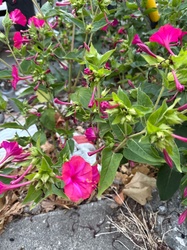
Four O'Clock Identification Guide
Identify the four o'clock (Mirabilis jalapa) by its fragrant trumpet flowers that open in late afternoon and its bushy habit with multicolored, sometimes marbled blooms.
Read the full Four O'Clock encyclopedia entry →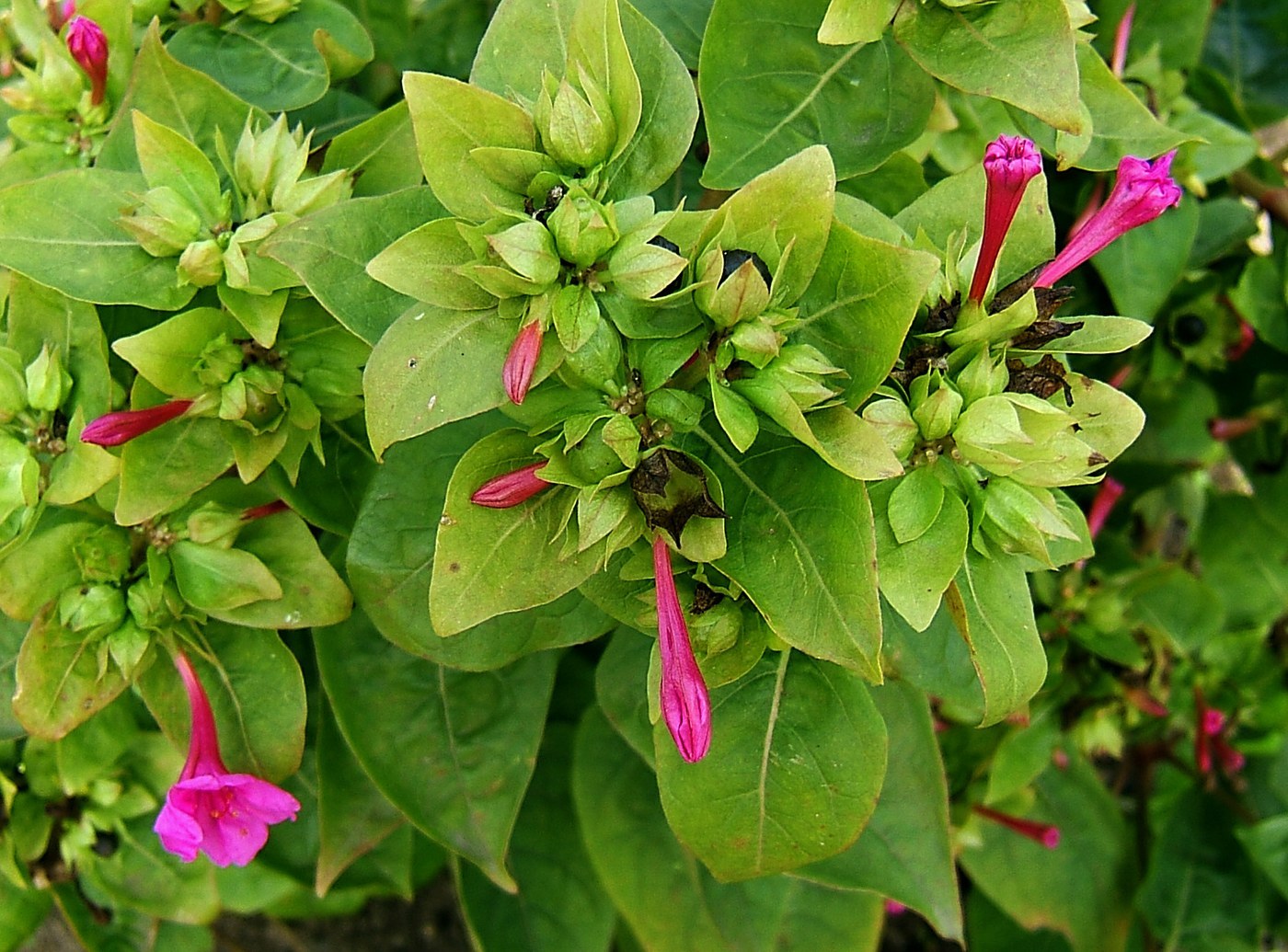
Key Identifying Features
The four o'clock (Mirabilis jalapa) gets its name from the way its flowers open in late afternoon (around 4 p.m.) and stay open through the night, closing by morning. It forms a bushy, shrub-like mound covered in fragrant, trumpet-shaped flowers that can appear in several colors — even on the same plant.
- Funnel-shaped flowers about 1–2 inches across
- Colors of magenta, pink, yellow, white, red, often striped, splashed, or marbled
- Flowers open afternoon to night, sweetly scented
- Bushy plant 2–4 feet tall and wide
Leaves & Stems
Leaves are heart-shaped to broadly oval, opposite, smooth, and deep green with pointed tips. Stems are green, often tinged red or purple at the nodes, branching freely to create a rounded bushy form. The plant grows from a large tuberous root that lets it return as a perennial in mild climates and behave as a self-seeding annual elsewhere.
Flowers & Fruit
The flowers have no true petals — the colorful trumpet is actually a fused calyx-like structure. They flare into five shallow lobes and emit a sweet fragrance that attracts moths and hummingbirds at dusk. A striking trait is color variation: a single plant may bear flowers of different colors, and individual blooms may be striped or speckled. After flowering, a hard, ribbed, black seed (resembling a small grenade or peppercorn) forms.
How to Tell It Apart from Look-Alikes
- Petunia: Has similar trumpet flowers but blooms continuously through the day; four o'clocks famously stay closed until afternoon.
- Datura: Much larger trumpets and coarse, lobed leaves.
- Morning glory: A climbing vine that opens in the morning — the opposite schedule and habit.
- The afternoon opening + multicolored/marbled flowers on one plant + hard black seeds combo is diagnostic.
Where You'll Find It
Four o'clocks are common old-fashioned garden annuals/perennials in cottage gardens, foundation plantings, and along fences. Native to tropical South America, they have naturalized in many warm regions and can be found on roadsides and disturbed ground. They thrive in full sun, tolerate heat and poor soil, and reseed readily.
Quick ID Checklist
- Trumpet flowers that open in late afternoon/evening
- Multiple flower colors, often striped or marbled, sometimes on one plant
- Heart-shaped opposite leaves on a bushy 2–4 ft plant
- Sweet evening fragrance
- Hard, ribbed black seeds after bloom
Frequently asked questions
Why are they called four o'clocks?
The flowers typically open in the late afternoon, around four o'clock, and remain open through the night, closing again by the next morning. This unusual timing is the easiest way to identify the plant.
Can one four o'clock plant have different colored flowers?
Yes. A single plant can produce flowers in several colors and often shows striped, splashed, or marbled blooms, a trait that strongly suggests Mirabilis jalapa.
How are four o'clocks different from morning glories?
Morning glories are climbing vines whose flowers open in the morning, while four o'clocks are bushy plants whose trumpet flowers open in the afternoon and evening.
Four O'Clock identified by the community
Recent Four O'Clock specimens identified with Plant Identifier.