Globe Thistle Identification Guide
Spot Echinops by its perfectly spherical steel-blue flower heads, spiny thistle-like leaves, and white-woolly stems.
Read the full Globe Thistle encyclopedia entry →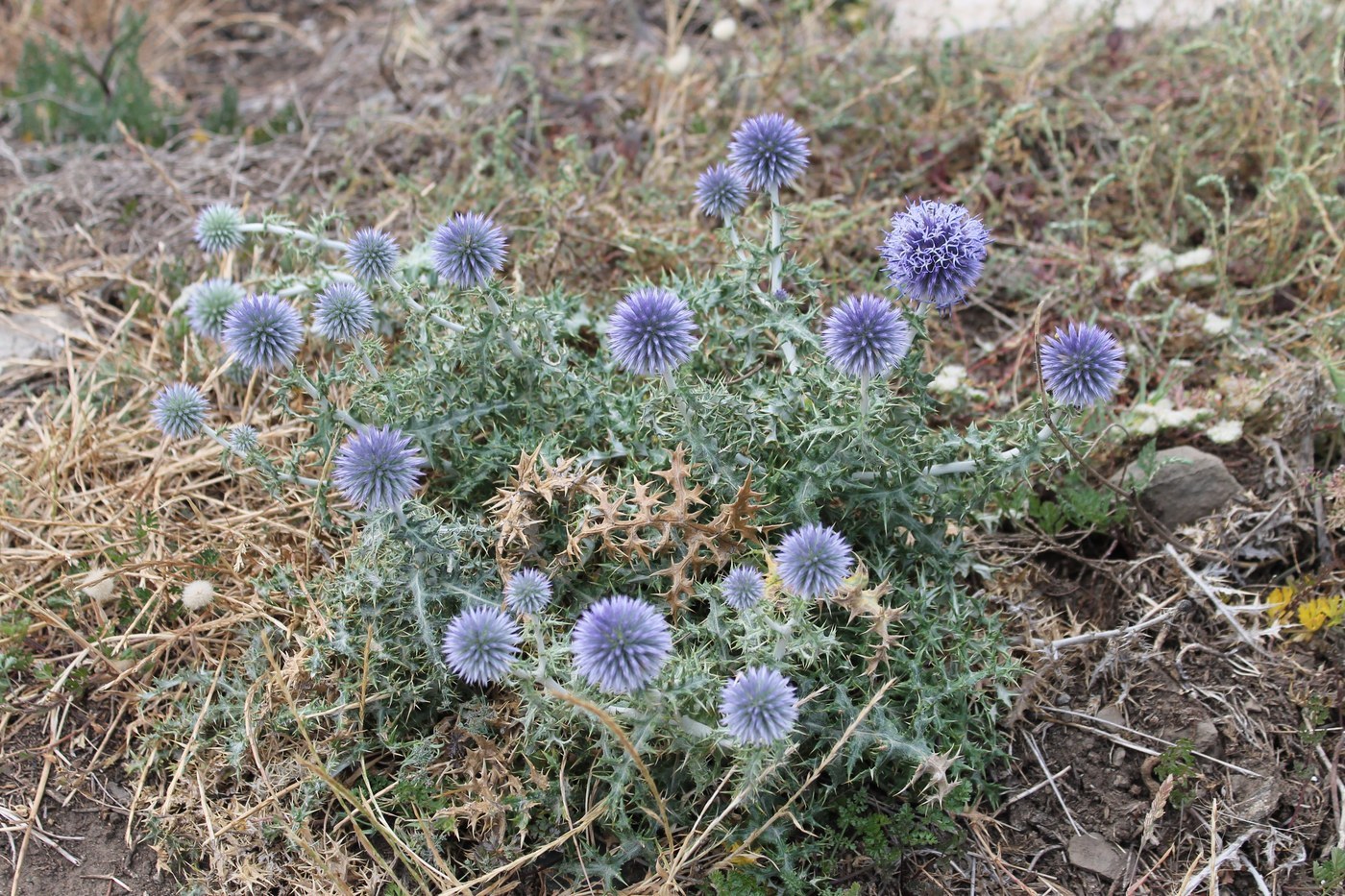
Key Identifying Features
Globe thistle (Echinops spp.) is a bold, architectural perennial unmistakable when in bloom. Look for:
- Perfectly round, golf-ball-to-tennis-ball flower heads in steel-blue to silvery blue
- Spiny, thistle-like leaves, deeply cut and often gray-green above with white-woolly undersides
- Stout, often white-felted stems reaching 2-5 ft tall
- A spiky, sculptural overall form
Leaves & Stems
Leaves are large, deeply lobed (pinnately divided), and edged with spines, much like a true thistle. The upper surface is dark to gray-green, while the underside is densely white-woolly/hairy — flip a leaf to confirm. Leaves are alternate along the stem. Stems are thick, ridged, and usually coated in fine white wool (tomentum), contributing to the plant's silvery cast.
Flowers & Fruit
The flower heads are the signature feature: blooming mid- to late summer, they are rigidly spherical, 1-2 in across, composed of many tiny individual tubular florets radiating outward from a central point, each tipped with a spiky bract. Before opening they look like spiky steel marbles; opened, they show metallic blue (or white in some species) florets. They are intensely attractive to bees and butterflies. Seeds are small dry achenes; dried heads hold shape well and are popular in arrangements.
How to Tell It Apart from Look-Alikes
- True thistles (Cirsium, Carduus) — also spiny, but their flower heads are brush-like tufts, not perfect rigid spheres.
- Sea holly (Eryngium) — spiny and blue too, but flowers are cone-shaped heads ringed by spiky bracts (a ruff), not smooth globes; leaves are different.
- Allium 'Globemaster' — round blue-purple flower balls, but on a leafless bare stalk with strappy onion leaves and no spines.
- Knapweed (Centaurea) — thistle-like but flowers are flat fringed tufts, not balls.
The flawless spherical blue head plus spiny white-backed leaves confirms globe thistle.
Where You'll Find It
Native to dry, rocky slopes, grasslands, and steppe of Europe, Asia, and Africa. It thrives in full sun and poor, well-drained soil and is widely grown in borders and pollinator gardens. Look for its blue globes humming with bees in July and August.
Quick ID Checklist
- Perfectly round, spiky flower heads in steel-blue
- Deeply lobed, spine-edged thistle-like leaves
- White-woolly leaf undersides and often white-felted stems
- 2-5 ft tall, stiff and architectural
- Dry, sunny habitat
A sturdy thistle-leaved plant topped with perfect metallic-blue spheres is a globe thistle.
Frequently asked questions
Is globe thistle a true thistle?
It belongs to the same daisy family (Asteraceae) and shares spiny foliage, but its perfectly spherical flower heads distinguish it from true thistles, whose heads are brush-like tufts.
How do I tell globe thistle from sea holly?
Globe thistle has smooth, perfectly round flower balls, while sea holly (Eryngium) has cone-shaped heads surrounded by a spiky collar of bracts.
What color are the flowers?
Most are steel-blue to silvery metallic blue, though some species and cultivars are white. Before opening, the heads look like spiky gray-blue marbles.
Why is it covered in white wool?
The stems and leaf undersides have a dense coating of fine white hairs (tomentum), an adaptation to dry, sunny habitats that also gives the plant its silvery look.
Globe Thistle identified by the community
Recent Globe Thistle specimens identified with Plant Identifier.