Japanese Knotweed Identification Guide
How to identify Japanese knotweed (Reynoutria japonica) by its bamboo-like hollow zigzag stems, broad shovel-shaped leaves, and creamy white flower sprays.
Read the full Japanese Knotweed encyclopedia entry →
Key Identifying Features
Japanese knotweed (Reynoutria japonica, syn. Fallopia japonica, Polygonum cuspidatum) is a notorious invasive perennial. Recognize it by:
- Hollow, bamboo-like stems with swollen joints (nodes) and a zigzag growth pattern
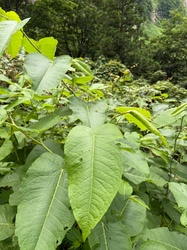
- Broad, shovel- or shield-shaped leaves with a flat (truncate) base and pointed tip
- Leaves arranged alternately in a zigzag along the stem
- Sprays of creamy-white flowers in late summer
Mature stands reach 6-10 feet tall and form dense thickets.
Leaves & Stems
Stems are green with reddish-purple speckles, hollow, and segmented like bamboo, with a thin papery sheath at each swollen node. They grow in a distinctive zigzag between nodes. Leaves are broadly oval to shield-shaped, 3-6 inches long, with a squared-off (straight, flat) base and an abruptly pointed tip, and smooth margins. The leaves are arranged alternately, giving the stem a stair-stepped look. The plant spreads aggressively by thick, woody rhizomes that can extend many feet and regenerate from tiny fragments.
Flowers & Fruit
In late summer to early fall, knotweed produces showy, branching sprays (panicles) of small creamy-white to greenish-white flowers that emerge from the leaf axils. These attract many pollinators. The seeds are small and winged, though in many regions spread is overwhelmingly vegetative via rhizomes rather than seed. In winter, the canes die back to hollow, tan, persistent dead stems that resemble bamboo.
How to Tell It Apart from Look-Alikes
- Bamboo: Truly woody and persistent, with narrow grass-like leaves; knotweed has broad shield-shaped leaves and herbaceous stems that die back each winter.
- Giant knotweed (Reynoutria sachalinensis): Larger, with heart-shaped leaf bases rather than the flat/truncate base of Japanese knotweed.
- Bohemian knotweed: A hybrid intermediate between the two.
- Dogwood / lilac: Shrubby look-alikes lack the hollow bamboo-like jointed stems and zigzag leaf pattern.
The hollow bamboo-like zigzag stems plus broad flat-based shovel leaves plus creamy flower sprays identify Japanese knotweed.
Where You'll Find It
Japanese knotweed invades riverbanks, roadsides, ditches, waste ground, old gardens, and around foundations across temperate North America, Europe, and beyond. It tolerates many soils and partial shade, forms dense monocultures that exclude native plants, and its rhizomes can damage pavement and structures.
Quick ID Checklist
- Hollow, bamboo-like, jointed stems with a zigzag
- Stems green with reddish-purple speckles
- Broad shield/shovel-shaped leaves, flat base, pointed tip
- Alternate, zigzag leaf arrangement
- Creamy-white flower sprays in late summer
- Dense thickets, dies back to tan canes in winter
A dense, fast-growing thicket of hollow bamboo-like zigzag stems with broad flat-based leaves and creamy flower sprays is Japanese knotweed.
Frequently asked questions
Is Japanese knotweed the same as bamboo?
No. It superficially resembles bamboo because of its hollow, jointed, segmented stems, but it is an herbaceous perennial in the buckwheat family with broad shield-shaped leaves, and its canes die back each winter, unlike true woody bamboo.
Why is Japanese knotweed considered so destructive?
It spreads by thick rhizomes that regenerate from tiny fragments, forms dense thickets that crowd out native vegetation, and can exploit cracks in pavement, drains, and foundations, making it extremely difficult and costly to remove.
How do I distinguish Japanese knotweed from giant knotweed?
Look at the leaf base. Japanese knotweed leaves have a flat, squared-off (truncate) base, while giant knotweed leaves are larger with a heart-shaped base. A hybrid called Bohemian knotweed is intermediate between the two.
When does Japanese knotweed flower?
It blooms in late summer to early fall, producing branched sprays of small creamy-white flowers from the leaf axils, which are a useful seasonal identification feature alongside the bamboo-like stems.
Japanese Knotweed identified by the community
Recent Japanese Knotweed specimens identified with Plant Identifier.