Japanese Knotweed
Reynoutria japonica
Japanese knotweed is an aggressive bamboo-like perennial that spreads by powerful rhizomes, damaging pavement and buildings and ranking among the world's worst invasive plants.
- Light
- Full sun to part shade
- Water
- Moderate to high; tolerates moist soil
- Difficulty
- Easy
Got a plant like this?
Identify any plant from a photo, free.
Overview
Japanese knotweed (Reynoutria japonica, syn. Fallopia japonica, Polygonum cuspidatum) is a vigorous herbaceous perennial native to East Asia. It forms dense thickets of hollow, bamboo-like canes and spreads through an extensive, deep rhizome system.
Its roots can penetrate cracks in concrete, asphalt, and foundations, causing structural damage, and even tiny rhizome fragments can sprout new plants. It is listed among the world's most invasive species and is notoriously difficult to eradicate.
How to identify it
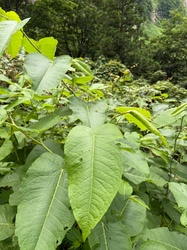
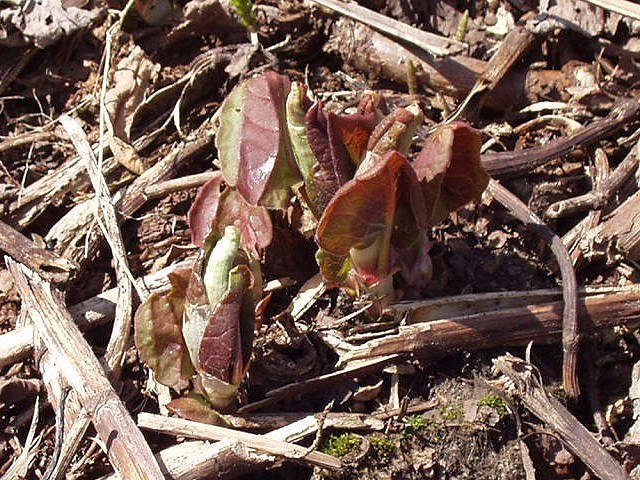
Look for bamboo-like stems and broad, shield-shaped leaves.
- Stems: Hollow, jointed, bamboo-like canes, often with reddish-purple speckles
- Leaves: Broad, oval to shovel- or shield-shaped, with a flat or slightly heart-shaped base and pointed tip, arranged in a zigzag along the stem
- Flowers: Sprays of small creamy-white flowers in late summer
- Size: Canes reach 7-10 feet tall, dying back in winter
- Rhizomes: Thick, extensive, orange-centered when cut
Care & growing
Not cultivated in most regions; included for control.
- Light: Full sun to partial shade
- Water: Favors moist soils; common along streams and ditches but tolerant of many sites
- Soil: Tolerates poor and disturbed soils
- Temperature: Cold-hardy; tops die back in winter and regrow each spring
- Control: Very difficult; requires persistent cutting plus systemic herbicide injection over multiple years; never compost or transport fragments
- Spread: Almost entirely by rhizome and stem fragments
Habitat & origin
Native to Japan, China, Korea, and other parts of East Asia, Japanese knotweed was introduced to Europe and North America in the 1800s as an ornamental and erosion-control plant. It is now a serious invasive in both regions.
It colonizes riverbanks, roadsides, waste ground, gardens, and disturbed areas, and is especially problematic near buildings, pavement, and drainage systems.
Frequently asked questions
Why is Japanese knotweed so destructive?
Its powerful rhizomes can exploit and widen cracks in concrete, asphalt, drains, and foundations, and it spreads rapidly, forming dense thickets that crowd out other plants.
How do you get rid of Japanese knotweed?
It is very hard to eradicate. Effective control usually requires repeated cutting combined with systemic herbicide over several years, and fragments must never be composted or moved.
How does Japanese knotweed spread?
Mainly vegetatively, through its extensive rhizomes and from broken stem or root fragments, which can each sprout a new plant even from a tiny piece.
Japanese Knotweed guides
In-depth guides for identifying, growing, and caring for Japanese Knotweed.
How to Care for Japanese Knotweed
Growing notes for Reynoutria japonica, an extremely vigorous perennial that thrives almost anywhere and must be contained.
Japanese Knotweed Identification Guide
How to identify Japanese knotweed (Reynoutria japonica) by its bamboo-like hollow zigzag stems, broad shovel-shaped leaves, and creamy white flower sprays.
Japanese Knotweed identified by the community
Real specimens identified with Plant Identifier.