Monstera Identification Guide
How to recognize Monstera deliciosa by its split, hole-punched leaves, climbing habit, and aerial roots, and how to separate it from common look-alikes.
Read the full Monstera encyclopedia entry →
Key Identifying Features
Monstera deliciosa is instantly recognizable once mature, but young plants can fool you. Look for this combination:
- Large, glossy, heart-shaped leaves that develop deep splits (lobes) and oval holes (called fenestrations) as the plant ages.
- A climbing, vining habit with thick green stems marked by prominent leaf scars.
- Aerial roots emerging from the stem nodes — long, brown, cord-like roots that anchor the plant to supports.
The common name "Swiss cheese plant" comes directly from the perforated leaves.
Leaves & Stems
Mature leaves are large, often 25–90 cm (10–36 in) across, deep green and leathery. Juvenile leaves are entire (no holes or splits) and roughly heart-shaped, which is why small Monsteras are mistaken for other aroids. Fenestration develops with maturity, light, and support to climb.
The leaf surface is smooth and shiny, with a slightly puckered texture along the veins. Petioles (leaf stalks) are long, stout, and channeled, with a papery sheath at the base that dries and peels. Stems are thick, green, and segmented, producing aerial roots at each node.
Flowers & Fruit
Indoors, flowering is rare. In the wild or in greenhouses, Monstera produces a typical aroid spadix surrounded by a creamy-white spathe. The fruit is a green, cone-like spike that ripens slowly.
How to Tell It Apart from Look-Alikes
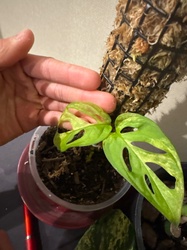
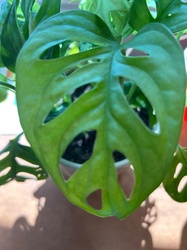
- Monstera adansonii: smaller, thinner leaves where the holes are enclosed by leaf tissue (the leaf edge stays intact). M. deliciosa's lobes usually reach and break the leaf margin.
- Split-leaf philodendron (Thaumatophyllum/Philodendron bipinnatifidum): leaves are deeply cut but lack the closed oval holes and form a self-supporting rosette rather than a climbing vine.
- Rhaphidophora tetrasperma ("mini monstera"): much smaller, faster, with split but rarely holed leaves.
The deciding clue: true M. deliciosa has both holes and edge-splits plus aerial roots and a climbing stem.
Where You'll Find It
Native to tropical rainforests of southern Mexico and Central America, where it climbs trees. As a houseplant it's globally popular for bright, indirect light. Outdoors it thrives only in frost-free, humid climates (USDA zones 10–12), where it can sprawl across the ground and up trunks.
Quick ID Checklist
- Large glossy green leaves with holes AND marginal splits
- Splits typically reach the leaf edge
- Thick climbing stem with aerial roots at nodes
- Papery sheath at base of long petioles
- Juvenile leaves heart-shaped and solid (no holes yet)
If you see a sprawling vine with perforated, deeply lobed shiny leaves and rope-like aerial roots, you're almost certainly looking at Monstera deliciosa.
Frequently asked questions
Why doesn't my Monstera have holes?
Fenestration develops with age, adequate light, and something to climb. Young plants and those in low light produce solid, heart-shaped juvenile leaves first; holes appear as the plant matures.
How do I tell Monstera deliciosa from Monstera adansonii?
On adansonii the holes are fully enclosed by leaf tissue and the leaf is smaller and thinner. On deliciosa the lobes usually split all the way to the leaf margin and leaves are much larger and leathery.
Is the split-leaf philodendron the same as Monstera?
No. Split-leaf philodendron has deeply cut leaves but no enclosed oval holes, and it grows as a self-supporting rosette rather than a climbing vine with aerial roots.
Are those brown roots on the stem a problem?
No, those are normal aerial roots Monstera uses to climb and absorb moisture. They're a key identification feature, not a sign of disease.
Monstera identified by the community
Recent Monstera specimens identified with Plant Identifier.