Mulberry Tree Identification Guide
Identify mulberry trees (Morus species) by their variable lobed leaves, milky sap, catkin flowers, and aggregate blackberry-like fruit.
Read the full Mulberry Tree encyclopedia entry →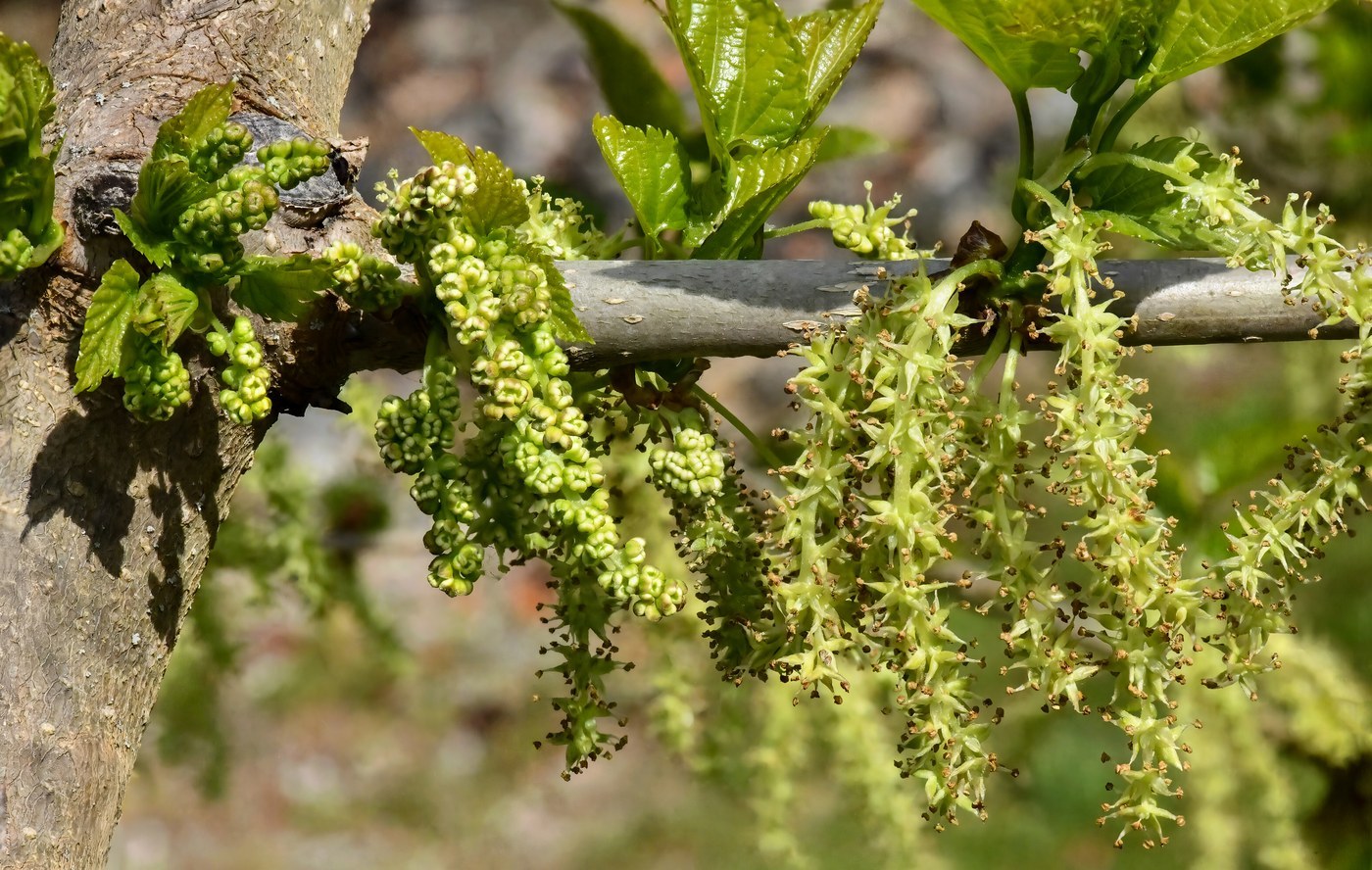
Key Identifying Features
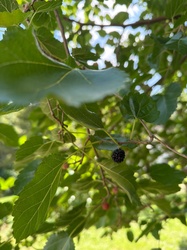
Mulberries (Morus species, chiefly white M. alba, red M. rubra, and black M. nigra) are deciduous trees or large shrubs, 9-20 m tall depending on species. The hallmark traits are highly variable leaves on the same tree (some unlobed, some with several deep lobes), milky white sap, and a multiple/aggregate fruit that looks like an elongated blackberry. Stems exude latex when broken.
Leaves & Stems
- Leaves are alternate, 6-20 cm long, broadly heart-shaped at the base, with toothed margins and a pointed tip.
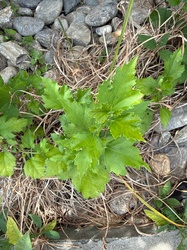
- A single tree shows polymorphic leaves: unlobed, mitten-shaped (one lobe), or deeply 3-5 lobed, often all on one branch.
- White mulberry leaves are glossy and nearly hairless; red mulberry leaves are larger, rough/sandpapery above and hairy beneath.
- Broken leaves and twigs ooze milky sap.
Flowers & Fruit
- Flowers are tiny and greenish, borne in short hanging catkins in spring; trees may be male, female, or both.
- Fruit is a cylindrical aggregate (multiple) fruit 2-5 cm long, resembling a slim blackberry.
- Color ripens white/pink (M. alba), deep red to near-black (M. rubra), or dark purple-black (M. nigra); fruit stains hands and pavement heavily.
- Each "berry" is a cluster of tiny drupelets, each surrounding a seed.
How to Tell It Apart from Look-Alikes
- Blackberry/raspberry (Rubus): these are thorny brambles, not trees, though the fruit looks similar.
- Paper mulberry (Broussonetia papyrifera): related and also lobed-leaved with milky sap, but its fruit is a round orange-red ball, not cylindrical.
- Basswood/linden (Tilia): has heart-shaped leaves but no milky sap and no mulberry fruit.
- Fig (Ficus): also has milky sap and lobed leaves but bears the characteristic fig fruit, not catkins.
Where You'll Find It
Mulberries grow in temperate and warm climates worldwide. White mulberry (native to China, widely naturalized) is common in cities, fencerows, vacant lots, and along streams as a weedy volunteer spread by birds. Red mulberry is native to eastern North American woodlands, and black mulberry is grown in Mediterranean and warm gardens. They tolerate poor soil and urban conditions.
Quick ID Checklist
- Tree/large shrub with milky sap in leaves and twigs
- Variable leaves: unlobed, mitten, and multi-lobed on one plant
- Toothed, heart-based leaves
- Hanging catkin flowers in spring
- Cylindrical blackberry-like fruit that stains
Frequently asked questions
Why do mulberry leaves have different shapes on the same tree?
Mulberries are leaf-polymorphic: the same tree produces unlobed, mitten-shaped (single-lobe), and deeply multi-lobed leaves, often on the same branch. This variability is itself a strong identification clue.
How can I confirm a tree is a mulberry?
Snap a leaf stalk or young twig: mulberries exude milky white sap. Combined with toothed heart-based leaves of varying lobing and elongated blackberry-like fruit, the milky sap confirms it.
How do I tell white, red, and black mulberry apart?
White mulberry has glossy, nearly hairless leaves and pale to dark fruit; red mulberry has large, sandpapery leaves hairy underneath and dark red-black fruit; black mulberry has thick rough leaves and very dark fruit.
Mulberry Tree identified by the community
Recent Mulberry Tree specimens identified with Plant Identifier.