Mullein Identification Guide
Spot common mullein (Verbascum thapsus) by its large velvety rosette of woolly leaves and tall, club-like yellow flower spike.
Read the full Mullein encyclopedia entry →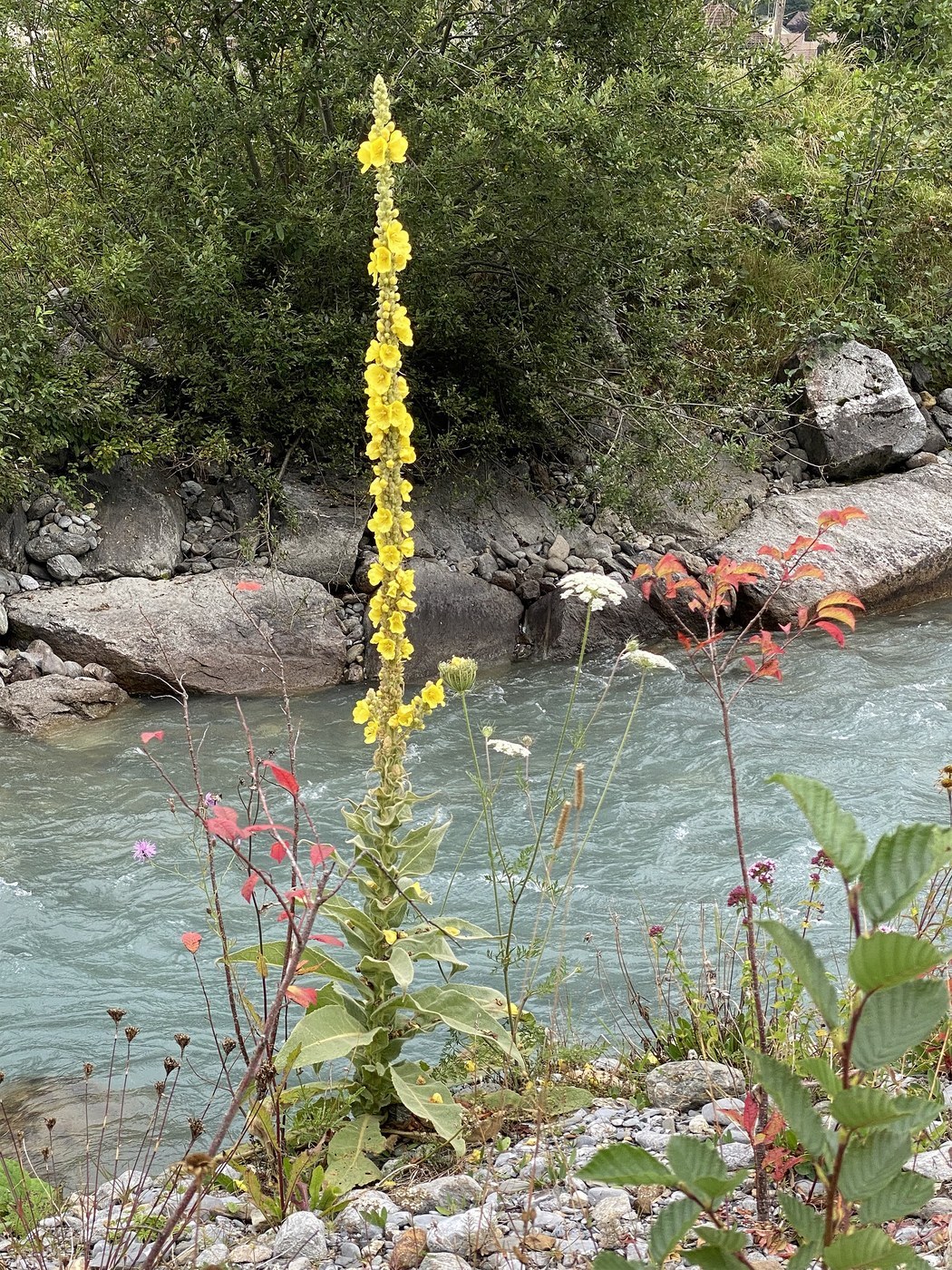
Key Identifying Features
Common mullein (Verbascum thapsus) is a striking biennial recognized by its rosette of huge, soft, woolly gray-green leaves in the first year and a single tall, club-like spike of yellow flowers in the second. The dense felting of hairs makes the whole plant feel like flannel.
- First year: flat rosette up to 2 ft (60 cm) wide
- Second year: unbranched flower stalk 3-7 ft (1-2 m) tall
- Everything covered in soft, woolly white-gray hairs
Leaves & Stems
The leaves are unmistakable: large, oblong, thick, and densely felted with branched hairs on both surfaces, giving a soft, velvety, pale gray-green look. Lower leaves can be 6-12 in (15-30 cm) long. They are arranged in a tight rosette the first year and spiral up the stem the second, with leaf bases often running down (decurrent) onto the winged stem. The single thick stem is also woolly and rigid.
Flowers & Fruit
In the second summer, mullein sends up a dense, cylindrical, club-shaped spike packed with 5-petaled yellow flowers about 3/4-1 in (2-2.5 cm) across. Only a few flowers open at once, scattered up the spike. Each flower has 5 stamens, the upper 3 bearing whitish or yellow hairs - a useful detail. After flowering, the spike fills with small, rounded seed capsules and the dried brown stalk often stands through winter as a recognizable silhouette.
How to Tell It Apart from Look-Alikes
- Moth mullein (Verbascum blattaria): Has smooth, nearly hairless leaves and looser flowers - very different texture.
- Lamb's ear (Stachys byzantina): Also woolly but low-growing with a square stem and purple flowers, not a tall yellow spike.
- Foxglove rosette: Greener and only sparsely hairy; mullein's intensely felted gray rosette is distinct.
- The combination of dense woolly gray leaves and a single tall yellow club spike is diagnostic.
Where You'll Find It
Mullein is a pioneer of disturbed, dry, sunny ground: roadsides, railway banks, gravel pits, pastures, old fields, and waste places. It favors poor, well-drained soil and full sun, often appearing where ground has been recently cleared.
Quick ID Checklist
- Large, soft woolly gray-green leaves in a rosette
- Leaves feel like felt or flannel
- Single tall unbranched stem to 7 ft
- Dense club-shaped spike of yellow 5-petaled flowers
- Stem winged where leaf bases run down
- Dry, sunny, disturbed ground
Frequently asked questions
How do I know I've found common mullein?
Look for the rosette of very large, soft, woolly gray-green leaves and, in the second year, a single tall unbranched stem topped by a club-like spike of yellow flowers.
Why are mullein leaves so fuzzy?
They are covered in dense branched hairs that reduce water loss and deter grazing, giving the plant its velvety, flannel-like feel.
Does mullein flower in its first year?
No. Mullein is a biennial - it forms only a leaf rosette the first year and produces its tall yellow flower spike in the second year.
What is the difference between common and moth mullein?
Common mullein has densely woolly leaves and a packed flower spike, while moth mullein has smooth, hairless leaves and looser, more open flowers.
Mullein identified by the community
Recent Mullein specimens identified with Plant Identifier.