Nasturtium Identification Guide
Identify nasturtium by its round shield-like leaves, spurred funnel-shaped flowers in fiery colors, and trailing habit. Covers how to separate it from watercress nasturtium.
Read the full Nasturtium encyclopedia entry →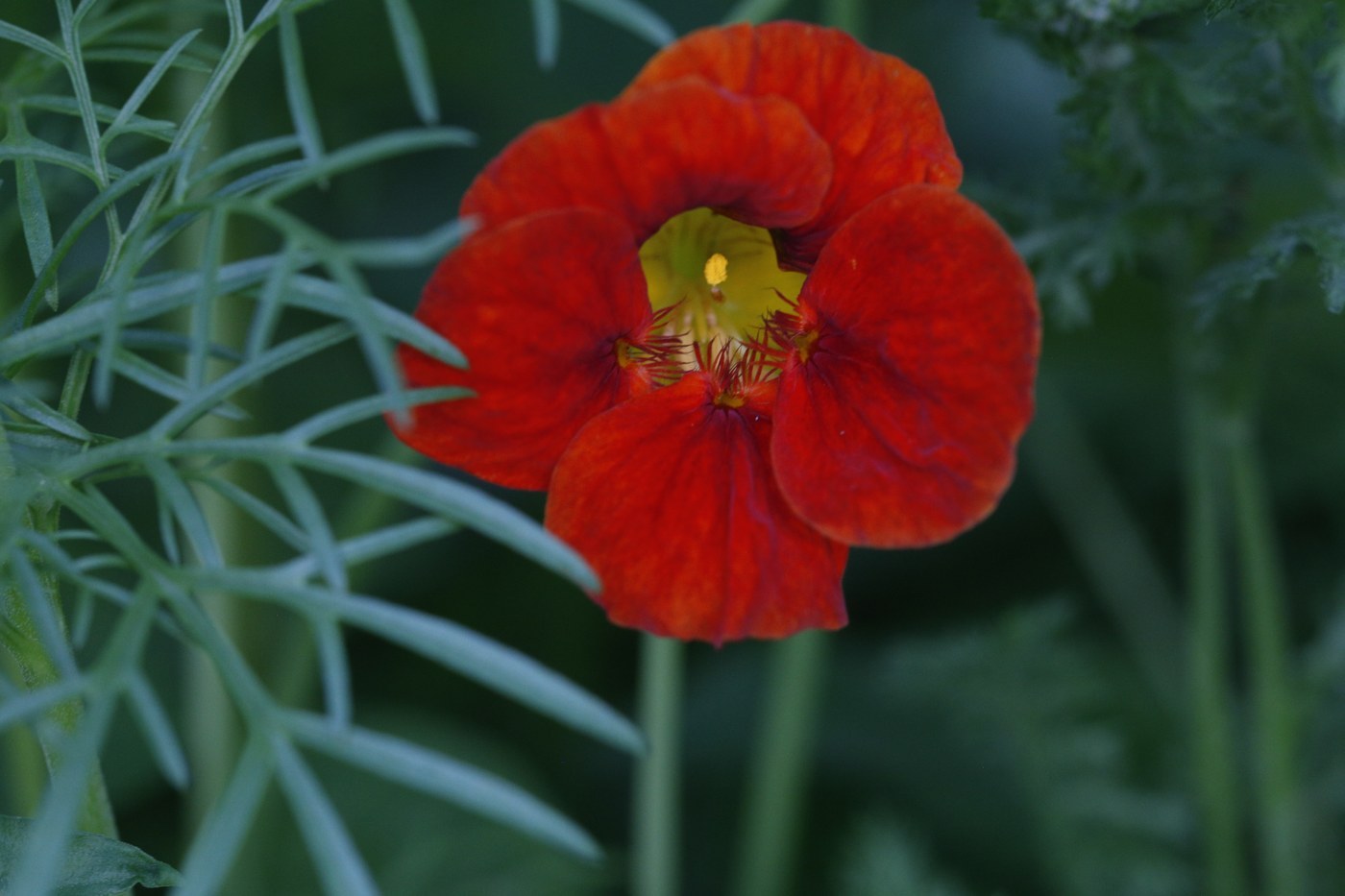
Key Identifying Features
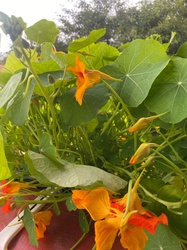
Garden nasturtium (Tropaeolum majus) is a trailing or mounding annual with unmistakable circular, shield-shaped leaves and bright funnel flowers.
- Round, peltate leaves (leaf stalk attaches at the center, like a tiny lily pad)
- Funnel-shaped flowers with a long rear spur
- Vivid colors: orange, red, yellow, mahogany, cream
- Sprawling, trailing, or climbing habit
Leaves & Stems
Leaves are round to slightly lobed, with the petiole joining at or near the center of the leaf blade (peltate)—a key trait. Veins radiate out from that central point. The surface is smooth and often water-repellent, beading droplets. Stems are succulent, trailing, and can climb or cascade several feet. Leaves are alternately arranged.
Flowers & Fruit
Flowers have 5 petals, the lower ones often fringed at the base, and a prominent nectar spur projecting backward. They are slightly irregular. After bloom, the fruit splits into 3 ribbed segments (each a single seed).
How to Tell It Apart from Look-Alikes
- Watercress (Nasturtium officinale): confusingly shares the name 'nasturtium' but is a different plant—an aquatic mustard with small white flowers and pinnate leaves. Garden nasturtium (Tropaeolum) has round peltate leaves and showy spurred flowers.
- Morning glory: also trailing with funnel flowers, but its leaves are heart-shaped (not round/peltate) and flowers have no spur.
- The central-stalked round leaf plus spurred 5-petal flower uniquely identify garden nasturtium.
Where You'll Find It
Nasturtiums are easy-grow garden favorites in beds, baskets, and vegetable plots, often used as companion plants and ornamental garnishes. They prefer full sun and poor-to-average soil (rich soil gives leaves at the expense of flowers). They self-seed readily and trail over walls and borders.
Quick ID Checklist
- Round leaves with center-attached stalk (peltate)
- Spurred, funnel-shaped 5-petal flowers
- Fiery orange/red/yellow colors
- Trailing or climbing succulent stems
- 3-segmented ribbed seeds
Round lily-pad leaves on trailing stems, topped with spurred orange or red funnel flowers, identify the garden nasturtium.
Frequently asked questions
Is watercress the same as nasturtium?
No, though it shares the name. Watercress (Nasturtium officinale) is an aquatic mustard, while the showy garden nasturtium is Tropaeolum majus, an unrelated plant with round peltate leaves.
How do I recognize a nasturtium leaf?
Look for a round, shield-shaped (peltate) leaf where the stalk attaches at or near the center of the blade and the veins radiate outward, like a miniature lily pad.
Why won't my nasturtium flower?
Overly rich or heavily fertilized soil pushes leafy growth at the expense of blooms; nasturtiums flower best in full sun and poorer, leaner soil.
Nasturtium identified by the community
Recent Nasturtium specimens identified with Plant Identifier.