Norfolk Island Pine Identification Guide
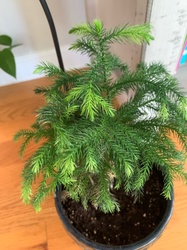
Spot the Norfolk Island Pine (Araucaria heterophylla) by its perfectly symmetrical tiered branches and soft, awl-shaped needles - a popular living-Christmas-tree houseplant.
Read the full Norfolk Island Pine encyclopedia entry →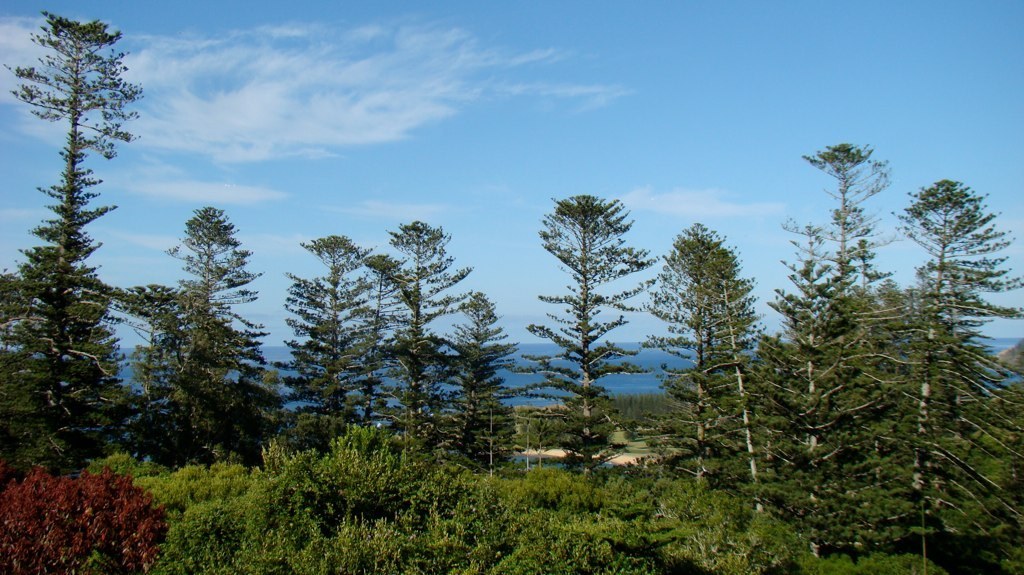
Key Identifying Features
The Norfolk Island Pine (Araucaria heterophylla) is not a true pine but an ancient southern-hemisphere conifer in the family Araucariaceae. It is instantly recognizable by its strikingly symmetrical, tiered structure: a straight central trunk with branches arranged in even, evenly spaced whorls (usually 4-5 per tier) radiating like the spokes of an umbrella. Indoors it is a popular tabletop "living Christmas tree" 2-6 ft tall; in frost-free climates it becomes a towering coastal tree 100+ ft tall.
- Form: geometric, layered, symmetrical pyramid
- Branches: soft, horizontal, in tidy whorls
- Texture: soft and feathery, not prickly
Leaves & Stems
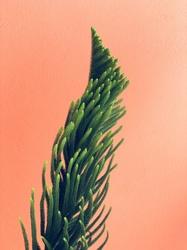
The foliage explains the species name heterophylla ("different leaves"). Juvenile leaves are soft, short, awl- or needle-shaped, about 1/2 inch long, and curve slightly inward, densely covering the branchlets to give a soft green plumy look. Adult leaves (on old trees) are shorter, thicker, scale-like and overlapping. The needles are bright to medium green, flexible, and not sharp - you can run your hand along a branch comfortably. Branchlets are arranged in flat, frond-like sprays along each tiered limb.
Flowers & Fruit
Indoor specimens rarely produce cones. On mature outdoor trees, female cones are large, rounded, and spiny, 4-6 inches across, disintegrating when ripe to release winged seeds; male cones are smaller and cylindrical. Most people will identify this plant by form and foliage rather than cones.
How to Tell It Apart from Look-Alikes
- True pines (Pinus): have needles in bundles of 2-5 and irregular branching - Norfolk's single soft awl-leaves in tidy whorls are completely different.
- Spruces/firs: stiff or prickly needles, less rigidly symmetrical tiers.
- Monkey puzzle (Araucaria araucana): a close relative, but its leaves are large, hard, sharp, triangular scales - very stiff and spiny, unlike Norfolk's soft needles.
- Cook pine (Araucaria columnaris): very similar but narrower and often leaning; Norfolk is broader and more symmetrical.
The soft awl-shaped needles + perfectly whorled tiers + symmetrical pyramidal form confirm Norfolk Island pine.
Where You'll Find It
Native to tiny Norfolk Island in the South Pacific, it is grown worldwide as a houseplant and holiday tree, and outdoors as a coastal landscape tree in frost-free regions (Florida, southern California, Hawaii, the Mediterranean), where it tolerates salt spray and sandy soil.
Quick ID Checklist
- Symmetrical tiers of branches in even whorls (umbrella-like)
- Soft, awl-shaped needles ~1/2 in, curved, not sharp
- Feathery, geometric overall form
- Sold as a tabletop living Christmas tree
- Coastal tree in frost-free climates; large spiny cones when mature
Frequently asked questions
Is the Norfolk Island Pine a real pine?
No. It is *Araucaria heterophylla* in the family Araucariaceae, an ancient southern-hemisphere lineage unrelated to true pines (*Pinus*). It has single soft needles, not bundled ones.
What makes its shape so distinctive?
Its branches grow in evenly spaced horizontal whorls around a straight trunk, creating a tiered, almost artificially symmetrical pyramid - very different from the irregular branching of pines and spruces.
Are the needles sharp?
No, the juvenile needles are soft, flexible and awl-shaped, so the foliage feels feathery rather than prickly - a quick way to separate it from spiny relatives like monkey puzzle.
Can it live indoors permanently?
Yes, it is a common houseplant grown in bright indirect light. It only reaches its giant coastal-tree size when planted outdoors in frost-free climates.
Norfolk Island Pine identified by the community
Recent Norfolk Island Pine specimens identified with Plant Identifier.