Passionflower Identification Guide
How to recognize passionflower (Passiflora) by its unmistakable fringed corona, climbing tendrils, and lobed leaves. Covers leaves, flowers, fruit, look-alikes, and where it grows.
Read the full Passionflower encyclopedia entry →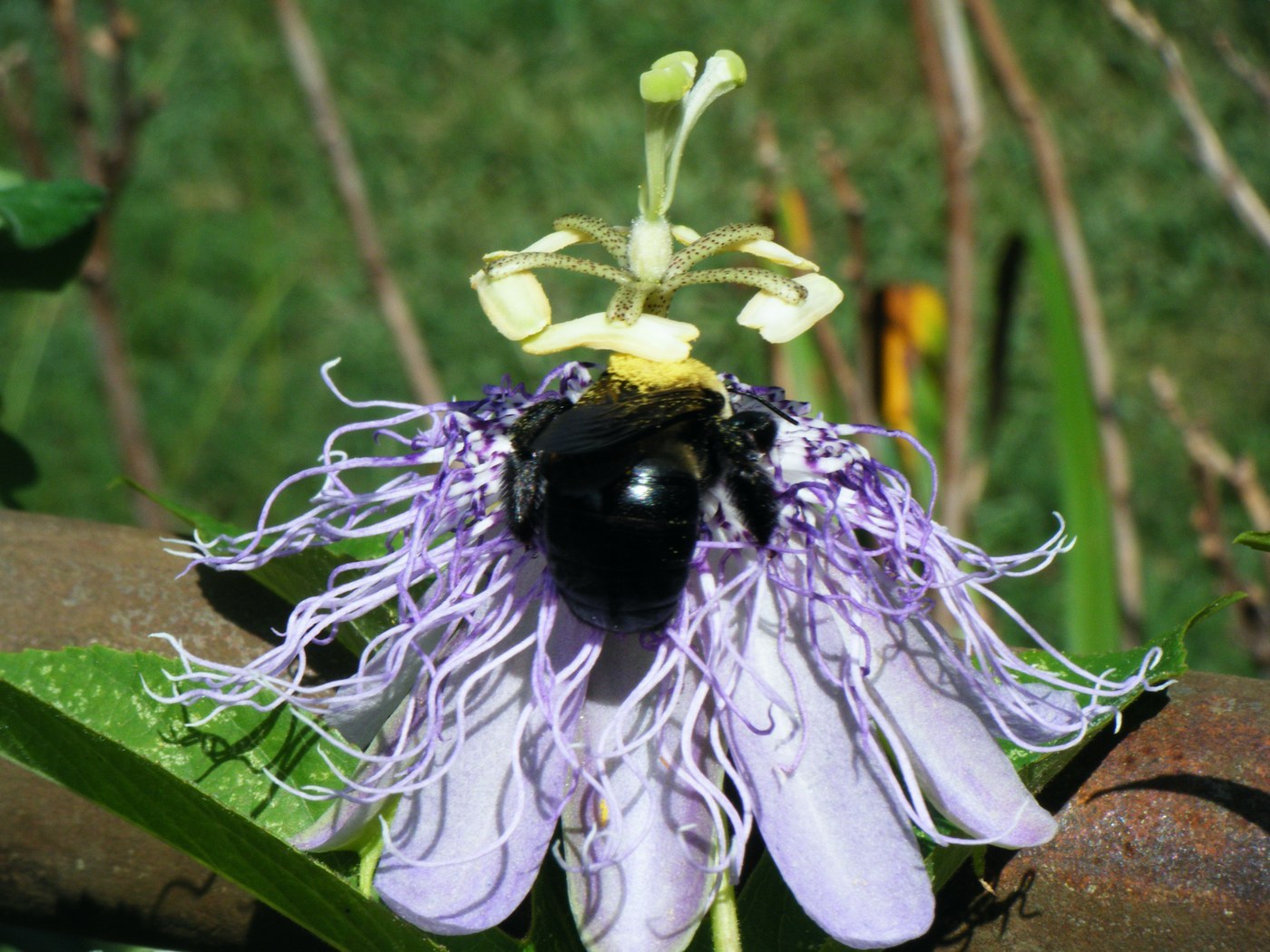
Key Identifying Features
Passionflower (genus Passiflora, most commonly P. incarnata in North America and P. caerulea in cultivation) is one of the most instantly recognizable flowers in the world. Look for:
- An intricate flower with a flat ring of petals and sepals topped by a dense fringe of wavy or straight filaments (the corona).
- A central column bearing 5 stamens and a distinctive 3-branched style with knob-like stigmas held above the corona.
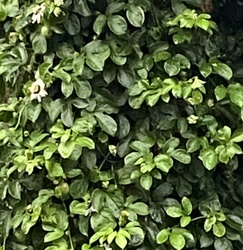
- A climbing or sprawling vine that grips supports with coiled tendrils arising from the leaf axils.
No other temperate vine combines a fringed corona with axillary tendrils, so a single open flower confirms the identification.
Leaves & Stems
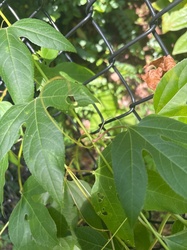
The stems are slender, herbaceous to semi-woody, and climb by tendrils rather than twining. Leaves are alternate and usually deeply 3-lobed (sometimes 5-lobed), with finely toothed margins and a somewhat glossy upper surface. In P. incarnata the leaves are 6-15 cm wide and slightly fuzzy beneath. Many species carry tiny nectar glands on the leaf stalk (petiole) just below the blade, a useful microscopic clue. Bruised foliage of P. incarnata gives off a faint, slightly unpleasant smell.
Flowers & Fruit
Flowers are 5-9 cm across and short-lived, often lasting a single day. Color ranges from lavender-purple with a banded corona (P. incarnata) to blue-and-white (P. caerulea) to red in tropical species. After flowering, an egg-shaped berry forms. In P. incarnata this is the maypop, 4-6 cm long, ripening from green to yellowish with a hollow-sounding pop when stepped on; its pulp surrounds many seeds. P. caerulea fruit is orange.
How to Tell It Apart from Look-Alikes
- Cucumber/melon vines also climb by tendrils and have lobed leaves, but their flowers are simple yellow funnels with no corona.
- Wild grape has tendrils but bears toothed unlobed-to-shallowly-lobed leaves and clustered small greenish flowers, never a corona.
- Clematis climbs by twisting leaf stalks and has star-shaped flowers without a filament fringe.
The fringed corona and 3-branched style are diagnostic; nothing else in temperate flora copies them.
Where You'll Find It
P. incarnata is native to the southeastern and south-central United States, scrambling along fencerows, roadsides, field edges, and disturbed sunny ground. It dies back to the root each winter and resprouts late in spring. Ornamental species are grown on trellises in gardens and can naturalize in mild climates.
Quick ID Checklist
- Climbing vine with coiled tendrils from leaf axils
- 3- to 5-lobed, toothed alternate leaves
- Flower with a fringed corona of filaments
- 5 stamens and a 3-branched style on a central column
- Egg-shaped berry (a maypop in P. incarnata)
Frequently asked questions
Is passionflower a vine or a shrub?
It is a climbing or sprawling vine that uses coiled tendrils from the leaf axils to grip fences, shrubs, and trellises. It has no woody trunk and herbaceous species die back to the roots each winter.
What does the fruit look like?
Passionflower produces an egg-shaped berry. In the native maypop (P. incarnata) it is a 4-6 cm green-to-yellow fruit with seed-filled pulp; ornamental P. caerulea bears an orange fruit.
How can I be sure I have a passionflower and not a cucumber vine?
Both climb by tendrils and have lobed leaves, but only passionflower has the elaborate fringed corona of filaments and a central column with a 3-branched style. Cucumber relatives have plain yellow funnel flowers.
Are the leaves always three-lobed?
Most common species have deeply 3-lobed leaves, but some are 5-lobed or, rarely, unlobed. Combine leaf shape with the tendrils and flower structure rather than relying on leaf shape alone.
Passionflower identified by the community
Recent Passionflower specimens identified with Plant Identifier.