Prayer Plant Identification Guide
Identify the Prayer Plant (Maranta leuconeura) by its strikingly patterned oval leaves and its nightly folding movement that gives the plant its name.
Read the full Prayer Plant encyclopedia entry →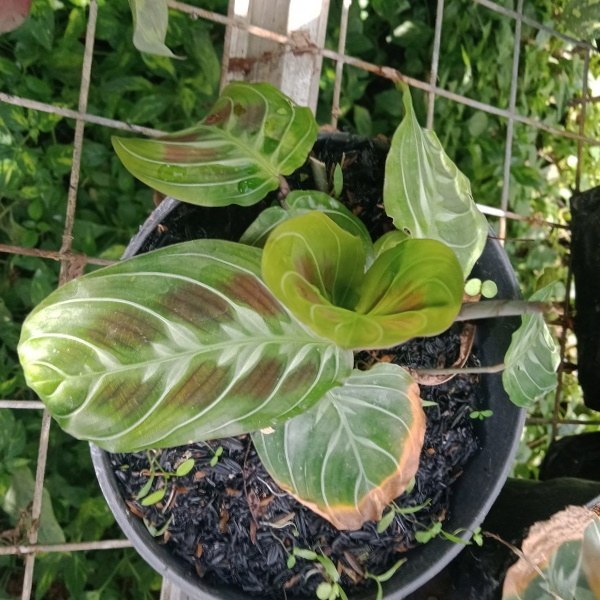
Key Identifying Features
The Prayer Plant (Maranta leuconeura) is a low, spreading tropical houseplant famous for two things: boldly patterned leaves and a daily folding habit. In the evening the leaves rise and fold upward together, resembling hands pressed in prayer — the single most telling identification clue.
- Broad oval to elliptic leaves, 7–15 cm long
- Striking patterns: herringbone veins, dark blotches, or red veining
- Nyctinastic movement — leaves flatten by day, fold up at night
- Low, sprawling growth to about 30 cm tall
Leaves & Stems
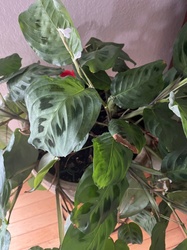
Leaves are the main attraction. The common 'Kerchoveana' form has light green leaves with twin rows of dark blotches (sometimes called "rabbit tracks") flanking the midrib. The 'Erythroneura' (Herringbone) form has deep velvety green leaves with bright red lateral veins and a lighter green feathered center. Leaf undersides are often grayish-green or purple-tinged. Stems are short and the plant grows from a clumping base, spreading outward rather than upright. The leaf joins the stem at a small swollen hinge called a pulvinus, which drives the prayer movement.
Flowers & Fruit
Indoors, Prayer Plants occasionally produce small, delicate flowers on thin spikes — usually white to pale lavender, about 1 cm, with fine purple speckling. Blooms are modest and short-lived, and the plant is grown for foliage rather than flowers.
How to Tell It Apart from Look-Alikes
Prayer Plants are easily confused with their relatives in the Marantaceae family:
- Calathea: generally taller, with larger, longer leaves and often scalloped or wavy margins; many also move but Maranta stays low and sprawling.
- Stromanthe and Ctenanthe: taller, more upright, with longer lance-shaped leaves.
- The Prayer Plant's combination of low sprawling habit, small oval leaves, and clear nightly folding distinguishes true Maranta. The red-veined herringbone pattern is especially diagnostic.
Where You'll Find It
Native to the tropical rainforest floors of Brazil, it grows as understory groundcover in warm, humid, shaded conditions. As a houseplant it thrives in indirect light, high humidity, and consistently moist (not soggy) soil. Leaf edges brown in dry air, and patterns fade in too much direct sun.
Quick ID Checklist
- Low, spreading plant under ~30 cm tall
- Oval leaves with bold patterns (rabbit-track blotches or red herringbone veins)
- Leaves fold upward at night and flatten by day
- Purple or grayish leaf undersides
- Tiny swollen hinge (pulvinus) where leaf meets stem
Frequently asked questions
Why do Prayer Plant leaves fold up at night?
The movement, called nyctinasty, is driven by a swollen joint (pulvinus) at the base of each leaf that changes water pressure with the day-night cycle. Folding is normal and a key identifying trait.
How is a Prayer Plant different from a Calathea?
Both belong to the Marantaceae family, but Prayer Plants (Maranta) stay low and sprawling with smaller oval leaves, while Calatheas are generally taller with larger, often wavy-edged leaves.
What are the dark spots on the leaves?
On the common 'Kerchoveana' variety, the paired dark blotches along the midrib are a natural pigment pattern nicknamed 'rabbit tracks' and are a sign of a healthy, correctly identified Prayer Plant.
Does the Prayer Plant flower indoors?
Occasionally. It produces small white-to-lavender flowers with purple speckles on slender spikes, but it is grown mainly for its foliage rather than its modest blooms.
Prayer Plant identified by the community
Recent Prayer Plant specimens identified with Plant Identifier.