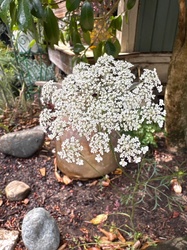
Queen Anne's Lace Identification Guide
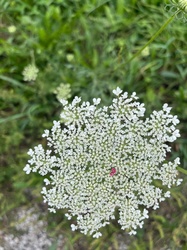
Identify Queen Anne's lace (Daucus carota) by its flat lacy white flower umbels with a central dark floret, ferny carrot-scented leaves, and bird's-nest seed heads.
Read the full Queen Anne's Lace encyclopedia entry →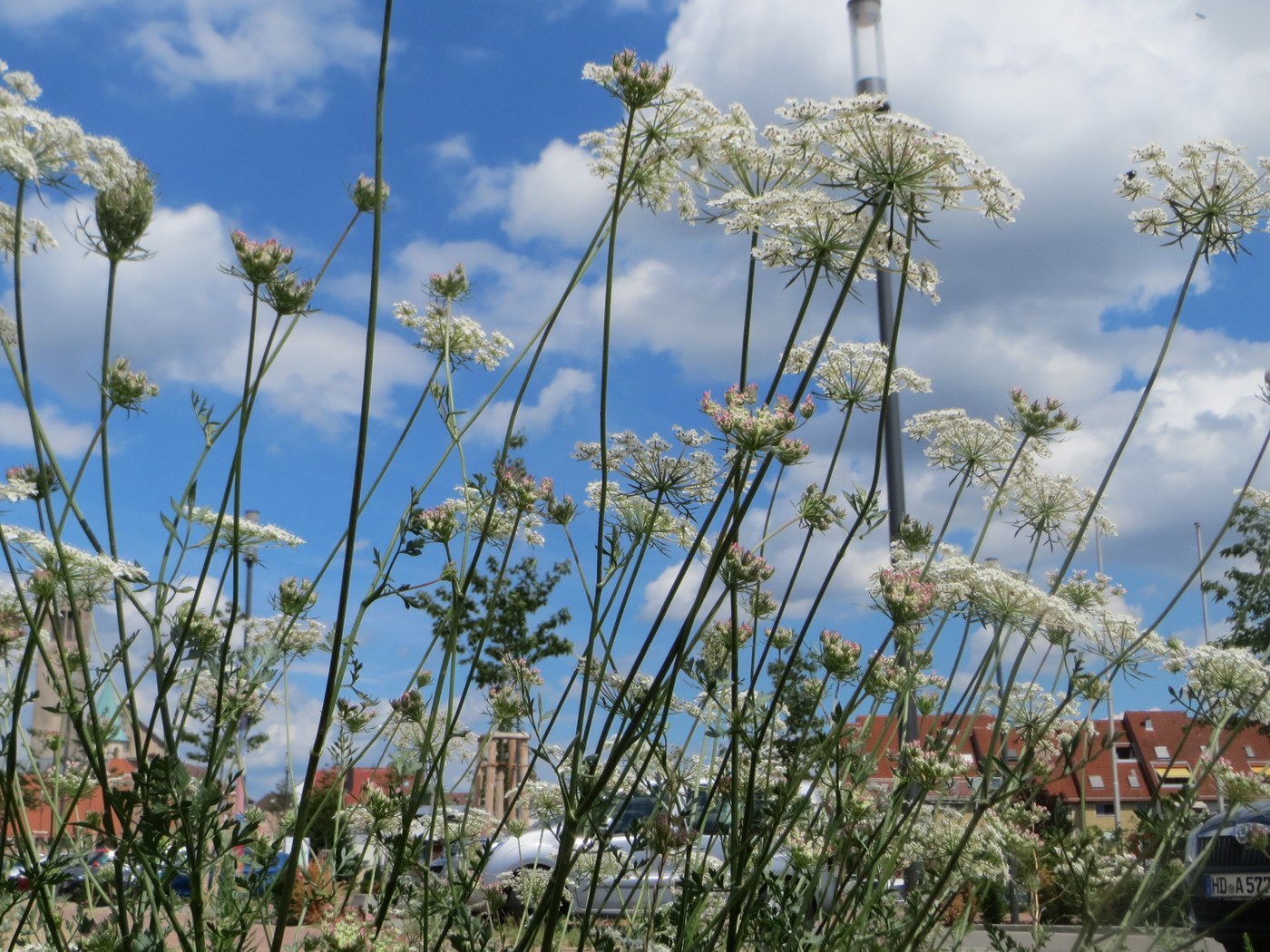
Key Identifying Features
Queen Anne's lace (Daucus carota), also called wild carrot, is a biennial broadleaf wildflower in the carrot family. Its flat-topped, lacy white flower clusters, often with a single tiny dark purple floret in the center, are iconic. The whole plant smells like carrot when crushed, since it is the wild ancestor of the cultivated carrot.
- Flat, lacy white umbel of tiny flowers
- A single dark purple/black floret often at the cluster's center
- Ferny, finely divided leaves that smell of carrot
- Seed head curls inward into a "bird's nest" cup
Leaves & Stems
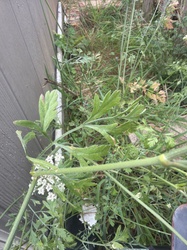
Leaves are finely divided (2-3 times pinnate), feathery and fern-like, and release a strong carrot scent when crushed. The stems are green, hairy (bristly), and solid (not blotched) reaching 1-4 feet tall in the second year. Beneath the umbel are distinctive three-forked, finely divided bracts that splay out below the flower head.
Flowers & Fruit
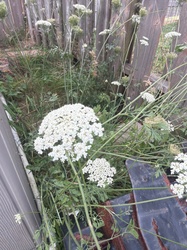
Flowering occurs late spring through fall. The flower head is a compound umbel (umbrella of umbrellas) of tiny white flowers forming a flat or slightly domed lacy disk 2-5 inches across. The classic central dark floret is present in many but not all heads. After flowering, the umbel curls upward and inward to form a concave "bird's nest" holding bristly seeds, which is highly diagnostic.
How to Tell It Apart from Look-Alikes
- Poison hemlock (Conium maculatum): has smooth, hairless stems with purple blotches, a musty smell, and lacks the central dark floret and hairy stems. Queen Anne's lace has hairy stems, no purple blotches, a carrot scent, and the bird's-nest seed head.
- Wild parsnip: has yellow flowers, not white.
- Yarrow: has white flat clusters too, but soft feathery foliage that is not as finely cut and lacks the central floret and carrot scent.
Hairy stem + carrot scent + central dark floret + bird's-nest seed head confirms Queen Anne's lace. To separate it from poison hemlock, check the stems for the hairy, unblotched texture rather than smooth, purple-spotted stems.
Where You'll Find It
It grows in dry, sunny, disturbed open ground: roadsides, meadows, fields, pastures, vacant lots, and prairies across North America and Eurasia. It is a common naturalized weed of unmowed open areas.
Quick ID Checklist
- Flat lacy white umbel of tiny flowers
- Often a single dark floret in the center
- Ferny leaves smelling of carrot
- Hairy stem, no purple blotches
- Three-forked bracts beneath the flower head
- Seed head curls into a bird's nest
Frequently asked questions
What is the most distinctive feature of Queen Anne's lace?
Its flat, lacy white flower umbel, frequently with a single tiny dark purple floret in the center, plus the way the seed head curls inward into a bird's-nest shape.
How do I tell it apart from poison hemlock?
Check the stem. Queen Anne's lace has hairy, solid green stems and a carrot scent, while poison hemlock has hairless stems with purple blotches and a musty odor.
Why does it smell like carrots?
Queen Anne's lace is wild carrot, the wild ancestor of the cultivated carrot, so its ferny leaves and taproot give off a distinct carrot scent when crushed.
Is Queen Anne's lace an annual?
It is a biennial: the first year it forms a leafy rosette, and in the second year it bolts, flowers, sets seed, and dies.
Queen Anne's Lace identified by the community
Recent Queen Anne's Lace specimens identified with Plant Identifier.